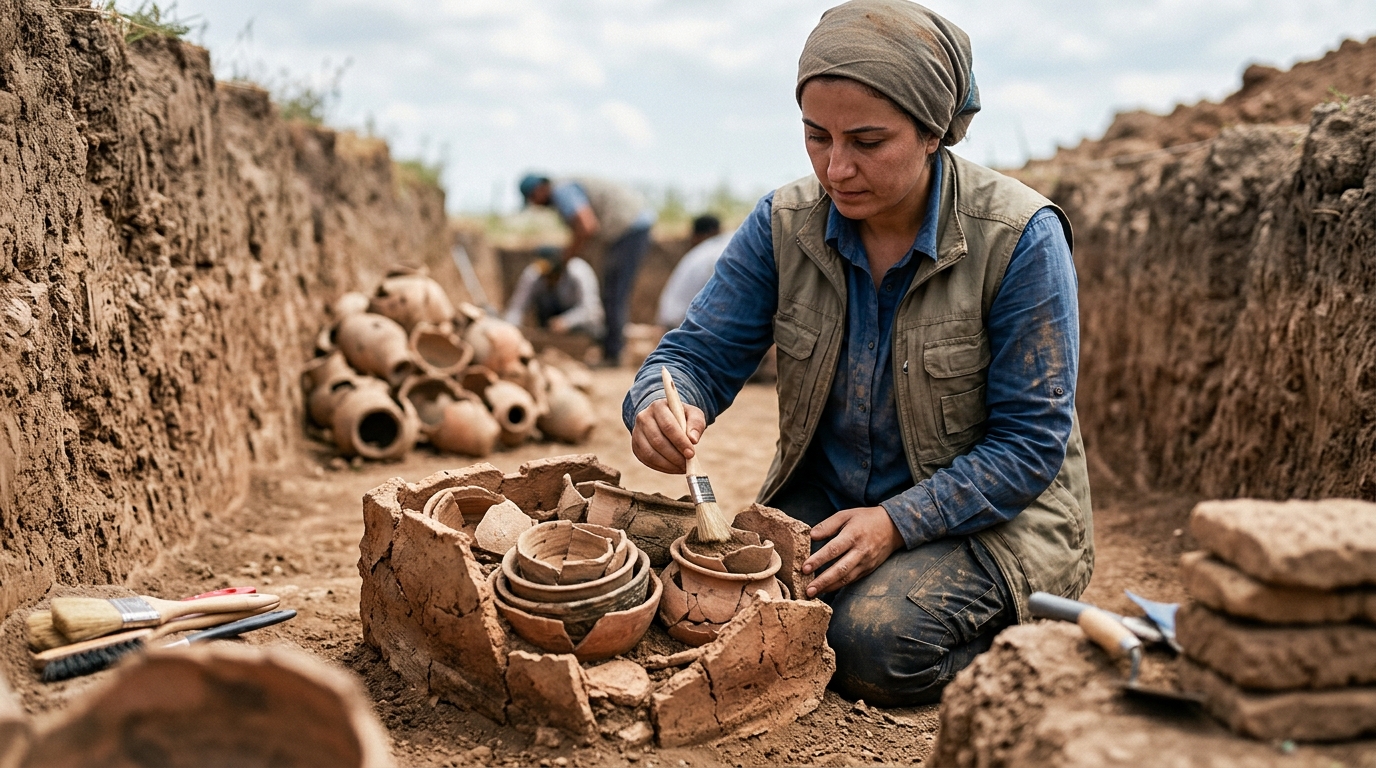
ANKARA, Turkey — Archaeologists excavating the Bronze Age settlement of Tepe Çiftlik in central Anatolia have recovered a vast archive of cuneiform tablets revealing a highly advanced civilization whose entire cultural, artistic, and theatrical output was dedicated to the systematic, step-by-step opening of everyday shipping containers.
The site, which dates to approximately 1400 BCE, was initially believed to be a major administrative outpost of the Hittite Empire. However, three years of translation work on more than 43,000 clay tablets have forced researchers to conclude that the population of Tepe Çiftlik belonged to a distinct, highly literate culture whose intellectual resources were channeled exclusively into documenting the physical extraction of goods from their packaging.
While contemporary civilizations of the Late Bronze Age recorded military conquests, divine mythologies, and royal genealogies, the scribes of Tepe Çiftlik preserved thousands of highly stylized, first-person accounts of opening standard reed baskets, clay amphorae, and wooden crates.
"We spent months translating what we assumed was a major military epic, expecting to read about a siege or a grand migration," said Dr. Marcus Thorne, a senior philologist at the Munich Institute of Antiquity. "Instead, it turned out to be a twelve-tablet masterwork detailing the slow, rhythmic untying of a leather strap on a pine crate containing six medium-grade copper adzes. The narrative tension relies entirely on whether the adzes are wrapped individually in wool or loose in the straw packing."
The text, known to researchers as the *Epic of the Seven Knots*, describes the physical properties of the container in agonizing detail—praising the tight weave of the protective linen cover and the pleasant, earthy aroma of the dried reeds inside. According to the translation, the climax of the narrative occurs in Tablet Nine, when the protagonist finally breaks the wax seal of the inner chamber to reveal the bronze implements beneath.
"The text ends immediately after the tools are laid side-by-side on a flat stone," Thorne said. "There is no mention of what the tools were used for, who manufactured them, or why they were ordered. The final line is simply, 'They are of standard weight, and they shine as the morning sun on the river.'"
Further excavations have revealed that this obsession was not limited to written records. The settlement boasts three massive stone amphitheaters, which researchers now believe were designed specifically for public "extraction exhibitions." Unlike Roman coliseums or Greek theaters, these venues featured a single, elevated stone pedestal at the center, with no backstage area or scenery.
Forensic analysis of the soil surrounding these pedestals revealed high concentrations of pine resin, beeswax, and dried flax fibers—the primary materials used to seal trade vessels in the ancient Mediterranean. Scribes recorded that thousands of citizens would sit in absolute silence for hours to watch a trained "unpacker" remove the outer clay casing of an imported oil jar.
"It was the dominant form of mass entertainment in the region," said Dr. Leyla Özkan, director of the Anatolian Antiquities Museum in Ankara, which is currently housing the collection of tablets. "We have found hundreds of smaller 'review tablets' scattered throughout the seating areas. These appear to be the ancient equivalent of critical commentary, written by audience members who were either satisfied or disappointed by the quality of the presentation."
One translated review tablet, recovered from the third-tier seating of the eastern amphitheater, complains that a prominent unpacker "hastened the breaking of the seal, denying the assembly the proper enjoyment of the clay’s resistance." Another praises a performer for their "fluid, silent extraction of twelve dried figs, each preserved without bruise or blemish."
The economic structure of Tepe Çiftlik appears to have been entirely organized around sustaining this loop of acquisition and presentation. Rather than trading goods for practical use, the city’s merchant class imported vast quantities of textiles, pottery, and agricultural products from across Mesopotamia, only to have them immediately cataloged, ceremonially opened, and then placed in subterranean storage vaults.
Archaeologists have found no evidence that the vast majority of the imported goods were ever used. Tens of thousands of high-quality bronze tools, woven tunics, and decorative glassware items have been recovered from the site’s deep trenches, completely untouched by wear.
"For this society, the utility of the object was secondary, perhaps even irrelevant, to the sensory experience of its reveal," Özkan said. "The peak of human satisfaction, for them, was located entirely in the brief window between the container being sealed and the container being empty."
A newly translated fragment of a philosophical treatise found in the ruins of the city’s central archives appears to confirm this cultural outlook. The author, writing under the pseudonym of a simple scribe, ponders the inherent disappointment of ownership.
"When the wool is out of the basket, it is merely wool to be worn," the tablet reads. "But while the basket remains bound by the cord, it contains all the wool of the world."