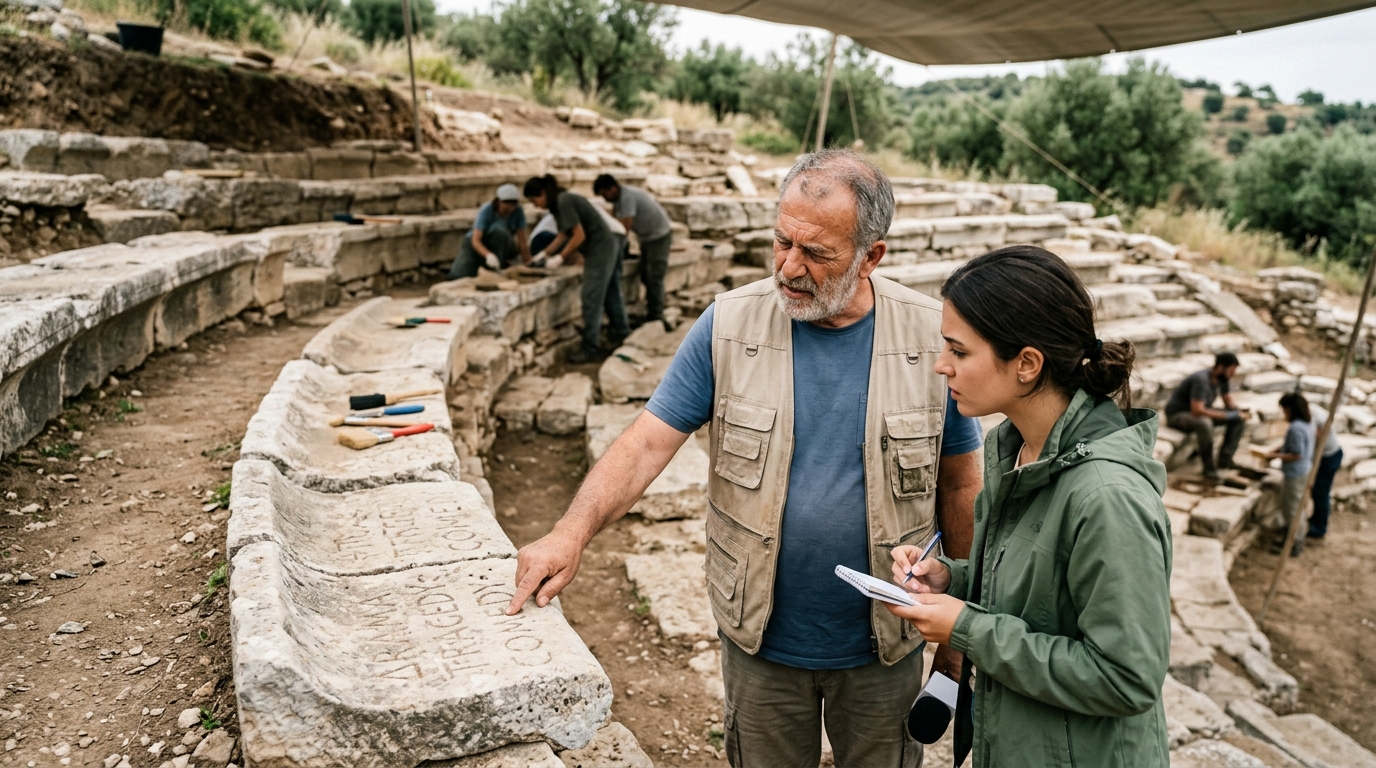
KLENIA, Greece — Archaeologists excavating a newly discovered fourth-century BCE settlement near Corinth have unearthed a sprawling entertainment complex dedicated entirely to the ancient Greek art of deciding what to watch and then doing nothing.
The site, which includes a 14,000-seat limestone amphitheater and thousands of preserved clay tablets, suggests that classical antiquity’s most popular cultural pastime was not the performance of drama itself, but rather the agonizing, communal process of browsing through potential options.
"For decades, we believed the Greeks invented tragedy and comedy as vessels for civic discourse," said Dr. Helena Vance, director of the Athens Institute of Classical Archaeology. "But the Klenia tablets reveal a much more relatable reality. The citizens of this province spent up to three hours a night gathered in the amphitheater watching a single performer, known as the Anagnostes, slowly read aloud the titles of various tragedies from a massive, rotating wooden rack while the audience debated whether they were 'in the mood' for them."
According to researchers, the performance—historically referred to as the Sisyphiad of Choice—always ended the same way. After reviewing dozens of options, the performer would extinguish their torch, declare that there was "nothing on," and go to sleep.
The excavation has yielded several highly preserved stone "scroll-boards," which functioned as ancient precursors to modern digital queues. These boards allowed citizens to carve the names of up to fifty plays they intended to watch at a later date, though analysis of wear patterns suggests that 94 percent of the carved titles were never actually performed.
"We found votive offerings dedicated to Philophrosyne, the goddess of mild interest, begging her for the stamina to actually commit to a three-act play," said Professor Marcus Thorne, a cultural historian at Oxford University. "The archaeological record shows that the citizens of Klenia would frequently walk past live, fully produced stagings of Oedipus Rex to sit in the 'Browsing Pit,' where they could comfortably argue about whether they preferred a satire or a history, until it was too late to watch either."
The discovery also sheds light on ancient economic structures. The theater was funded by a local guild of merchants who charged citizens a monthly subscription fee of three drachmas to access the amphitheater, regardless of whether they sat through a performance or simply hovered in the courtyard reading the promotional murals.
"It is a remarkably sophisticated system of passive engagement," Thorne added. "They had mastered the art of feeling like they were participating in culture without ever having to endure the intellectual labor of experiencing it."
Among the most significant artifacts recovered was a domestic limestone tablet from a nearby residential villa. The inscription, translated last week, depicts a husband and wife debating whether to attend a local reading of Homer's Odyssey. After forty lines of dialogue concerning whether they were too tired to follow the plot, the tablet ends abruptly with the phrase: "Let us just stare at the hearth until the embers fade."