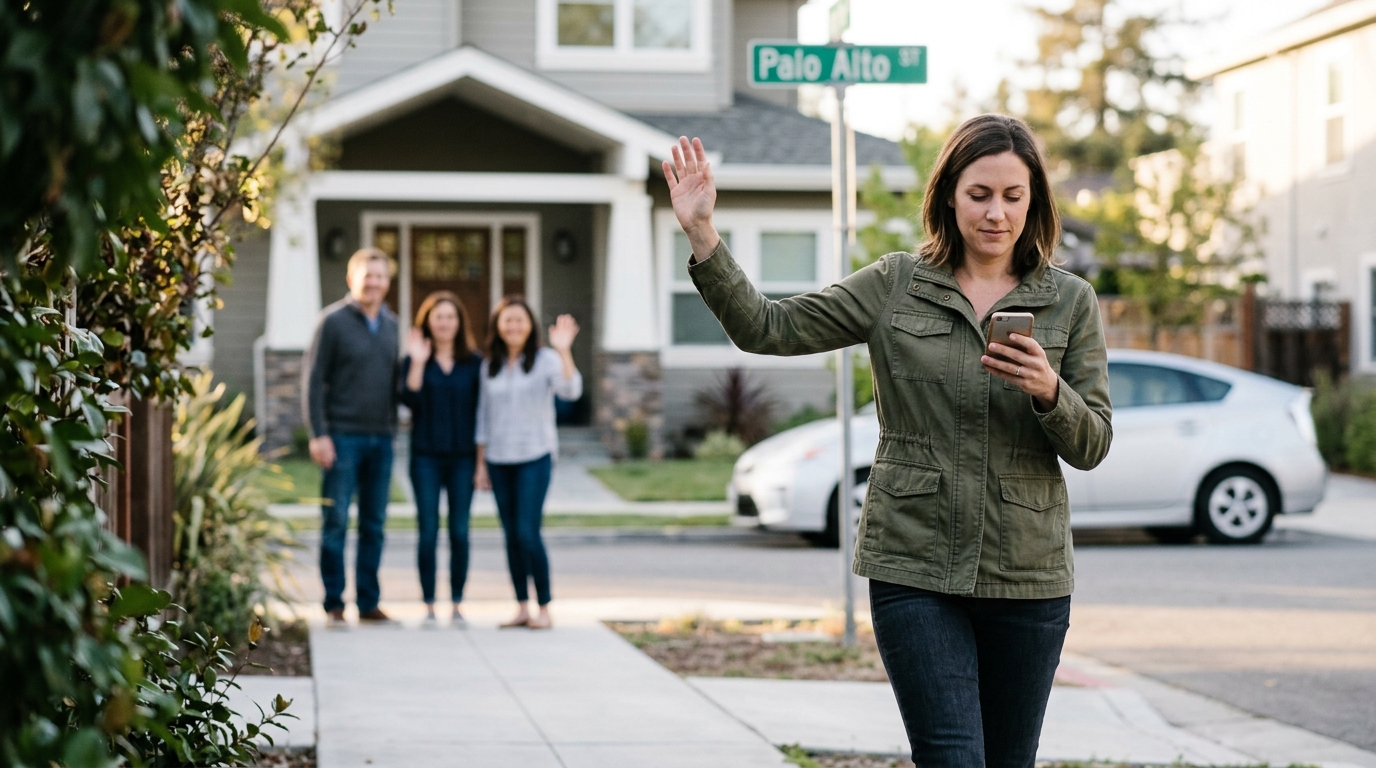
PALO ALTO, Calif.—A Silicon Valley startup has secured $14 million in series-A funding for WaveLength, a mobile application designed to calculate the precise moment a host can socially disengage and stop waving goodbye to departing guests.
The application, which launched on iOS and Android platforms Thursday, aims to resolve what developers call "the driveway dead-zone"—the awkward, unregulated interval between a guest starting their car engine and the vehicle traveling entirely out of visual range.
Using a smartphone’s rear-facing camera, WaveLength employs computer vision to analyze the acceleration of the departing vehicle. It cross-references this telemetry with a proprietary "Relationship Depth Index" that users fill out when their guests first arrive. The app then provides a real-time countdown timer on the user's screen, indicating exactly when they can lower their arm, turn their back, and close the front door without appearing rude.
"For centuries, humanity has relied on uncoordinated, high-anxiety guesswork to end domestic visits," said Marcus Vance, co-founder and CEO of WaveLength. "Do you keep waving when they stop to adjust the radio? Do you maintain a static hand-raise, or transition to a casual hand-in-pocket lean? Our algorithm removes the friction from farewells by delivering data-driven closure."
According to the company’s white paper, the app’s predictive model adjusts for environmental variables. Rain or snow automatically accelerates the "Decay of Obligation" curve by up to 60 percent, while visits from immediate family members require a sustained, elbow-driven wave pattern until the vehicle has cleared the local municipal boundary.
Early adopters of the technology report a significant reduction in post-hospitality fatigue.
"Before WaveLength, I would stand on the porch in my socks, waving at my brother-in-law’s SUV for what felt like miles, just in case he looked in his rearview mirror," said Clara Henderson, a homeowner in nearby Sunnyvale. "Now, the app monitors his taillights. Last night, my phone gave me a sharp haptic vibration to signal 'safe to disengage' the moment his rear tires cleared our curb. I was back on the couch before he even hit the intersection."
However, the technology has not been without initial deployment hurdles. A recent software patch reportedly caused a minor synchronization error in several residential neighborhoods, where the app mistook an idling Amazon delivery truck for a high-affinity departing relative. Three beta testers in New Jersey reportedly waved at an empty street for forty-five minutes before manually overriding the software.
Sociologists have also raised questions about the long-term cultural impact of outsourcing basic non-verbal communication to automated systems.
"By digitizing the natural decay of a social interaction, we are replacing intuitive human empathy with strict binary parameters," said Dr. Aris Thorne, a professor of micro-sociology at Stanford University. "When we automate the fade-out of a human connection, we risk losing the valuable, slightly clumsy vulnerability that defines genuine hospitality."
In response to such criticisms, Vance announced that WaveLength is already developing its next major feature: an integrated smart-home API called Auto-Sigh, which will automatically trigger a home's smart speakers to emit a soft, collective sigh of relief the moment the front door deadbolt engages.