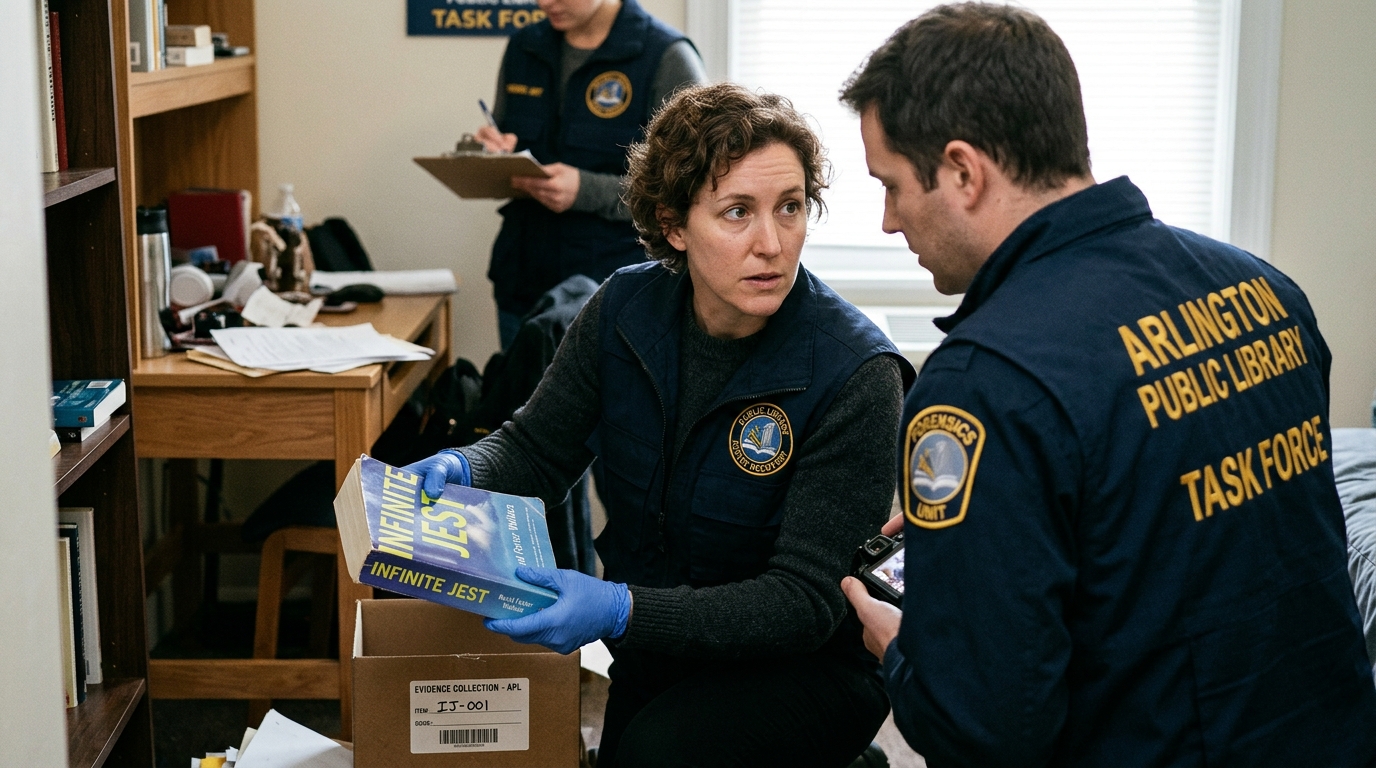
ARLINGTON, Va. — The Arlington County Public Library system has formally launched its Active Recovery and Literary Preservation Task Force, a specialized division authorized to deploy tactical surveillance, forensic asset tracking, and knock-and-announce warrants to recover materials overdue by more than two weeks.
The program, which received $1.4 million in municipal funding under the county's FY 2026 budget, aims to address a critical backlog of unreturned physical assets. According to department guidelines, any item outstanding past its 14-day grace period is automatically reclassified as a "withheld public resource," triggering an escalation pathway that begins with automated text alerts and ends with plainclothes "literary recovery specialists" conducting neighborhood canvasses.
"We are no longer in the business of sending polite email reminders that end up in the spam folder," said Marcus Vance, Director of Library Services and Chief of the Active Recovery Division. "When a patron retains a copy of Infinite Jest or a mobile Wi-Fi hotspot past the due date, they are actively depriving their fellow citizens of county-funded infrastructure. Our recovery agents are trained to locate these assets with minimal disruption to the surrounding block."
On Tuesday, recovery specialists executed a low-profile asset retrieval at the home of local resident Sarah Jenkins, whose copy of Zadie Smith's White Teeth was 22 days overdue. According to Jenkins, two men in navy windbreakers emblazoned with the county library seal arrived at her residence at 6:30 a.m., presenting a notarized "Notice of Asset Seizure" and requesting permission to inspect her living room bookshelves.
"They were very polite, but they had a canine unit that I think was trained to sniff out library-grade binding glue and plastic dust jackets," Jenkins said. "They found the book behind my television. They bagged it in anti-static plastic, logged its condition on a tablet, and told me I was lucky they weren't charging me with unauthorized transport of municipal property across state lines."
The task force operates out of a converted basement at the Central Library branch, featuring a digital "dashboard of delinquency" that tracks outstanding items in real time. Items categorized as "high-risk"—such as test-preparation manuals, newly released memoirs, and baking pans shaped like cartoon characters—are assigned to dedicated investigators within 48 hours of expiration.
"People think they can just move to Maryland and forget about their obligations to the Arlington collection," said Lead Investigator Diane Cho, a former county fraud analyst. "But we work closely with regional toll authorities and license-plate readers. If you have our copy of Guns, Germs, and Steel in your trunk, we will eventually find you."
The county board has defended the program's budget, noting that while the task force has spent $340,000 on tactical gear and forensic fiber analysis since its inception, it has successfully recovered 114 books, representing a net asset value of approximately $2,850.