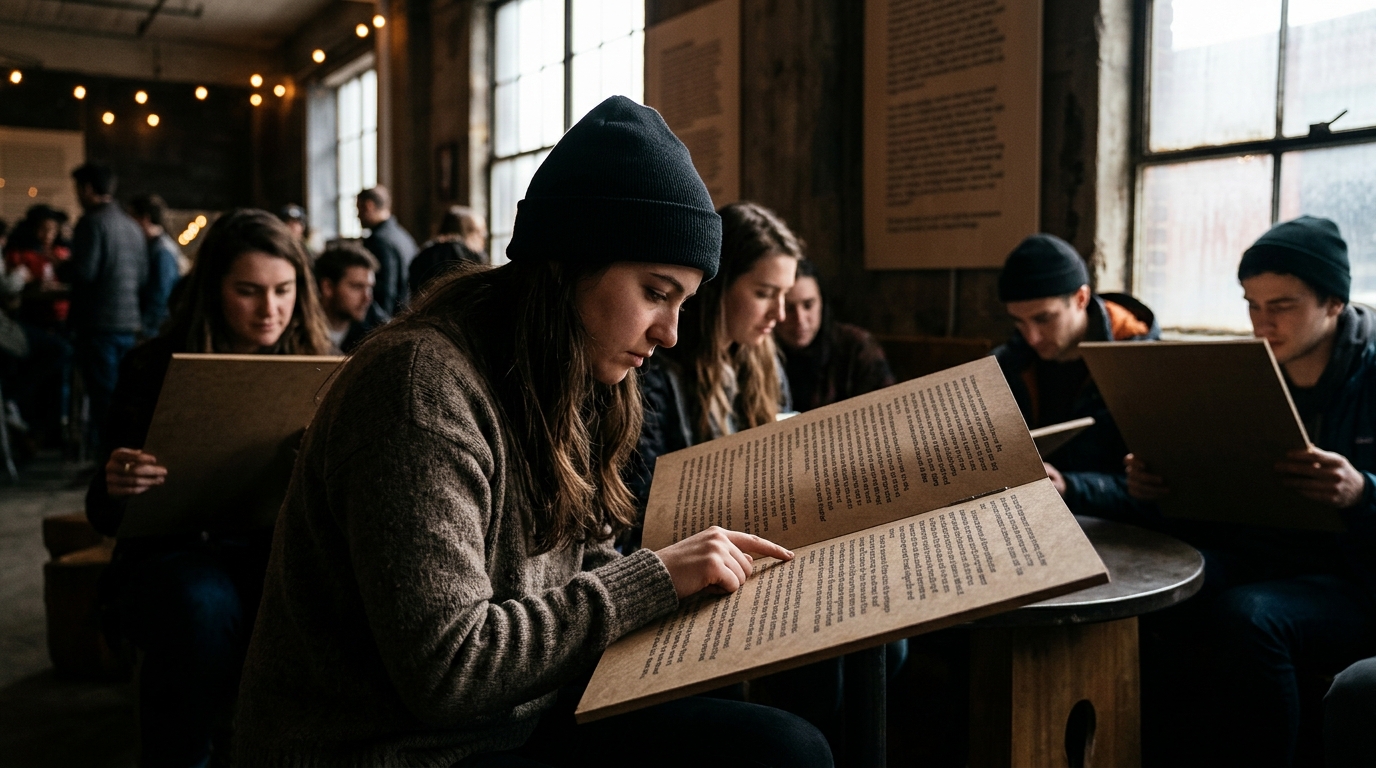
BROOKLYN, N.Y. — Inside a dimly lit warehouse in Bushwick on Tuesday afternoon, a dozen young adults sat in silence, staring intently at rectangular blocks of compressed wood pulp bound together by industrial adhesive.
They were experiencing "The Spine," a new entertainment lounge where patrons pay $45 an hour to interact with what its creators call "static-text physical modules." The venue, which has seen reservations surge among customers aged 18 to 26, offers a curated library of narrative experiences that require zero battery power, emit no blue light, and operate entirely without a network connection.
Unlike digital e-readers or tablets, the modules—traditionally known as printed books—feature typography that is permanently embedded into the physical medium during manufacturing. This design choice has been hailed by local enthusiasts as a breakthrough in cybersecurity and attention-span architecture.
"With a screen, there is an ambient anxiety that the text might change, update, or push a notification to you," said Elijah Vance, 24, the founder of The Spine and a former user-interface designer. "But with these physical carbon-ink arrays, the pixels are permanent. They are chemically bound to the organic fiber. Once the author commits the data to the page, it remains exactly where it is forever, even if the building loses power. It is a completely local, zero-latency narrative environment."
To navigate these modules, users must physically grasp the top or bottom corner of the right-hand sheet and pull it leftward in a sweeping motion—a physical interaction Vance describes as "tactile scrolling." To preserve their place in the narrative upon exiting, users do not rely on cloud-syncing metadata; instead, they insert a thin strip of colored cardstock, known as a "spatial save-state," between the sheets.
The novelty of this non-backlit medium has sparked a broader cultural movement in metropolitan areas. In neighborhoods like Williamsburg and Greenpoint, young professionals are forming "linear processing clubs" to read the same physical modules simultaneously, sharing their progress by comparing the physical thickness of the remaining pages on the right-hand side.
For Maya Lin, a 22-year-old freelance graphic assistant, the transition to manual reading has required a cognitive shift.
"The first time I tried it, my thumb kept twitching on the margin because I wanted to double-tap to like a passage, or pinch-to-zoom on the smaller footnotes," Lin said. "But after about twenty minutes, my optic nerves adjusted to the ambient light reflection. There’s a profound sense of security in knowing that the text isn't tracking my eye movements or tailoring the next chapter to my search history. It's just... there. It exists independently of my attention."
The commercial entertainment sector has quickly moved to capitalize on the trend. Several major publishing houses have announced the establishment of "Legacy Static Divisions" to strip their digital catalogs of hyperlinks, animated illustrations, and text-to-speech options, re-releasing them as "Pure-Form Hardbacks."
Industry analysts estimate that sales of these non-digital modules have grown by 42% over the last fiscal quarter, driven largely by consumers who view the physical degradation of the paper over time as a desirable, high-fidelity aesthetic feature. Enthusiasts have even begun reviewing different paper stocks based on their scent, a phenomenon known in online forums as "pulp-off-gassing."
Academic researchers are observing the phenomenon with a mix of curiosity and validation. Dr. Fiona Hennessey, a media sociologist at Columbia University, suggests that the sudden appeal of static text is a predictable reaction to an oversaturated digital landscape.
"For a generation raised on dynamic, algorithmically optimized text feeds that adjust in real-time to maximize engagement, a text that is physically unchangeable is the ultimate luxury," Hennessey said. "It represents an un-editable reality. There is no edit history, there is no comment section, and there are no hot-patches. The author must get it right the first time, and the reader must accept it as-is. That finality is incredibly grounding."
Back at The Spine, Vance was busy restocking the lounge’s "Science Fiction" shelf with vintage paperbacks, carefully wiping dust off their laminated covers. Despite the high cost of maintenance and the physical space required to store the massive amounts of offline data, Vance remains optimistic about the future of the analog entertainment industry.
"We are currently experimenting with a serialized subscription model where we physically shear a module in half and mail the second part to the customer a month later to simulate a content drop," Vance said, adjusting a low-wattage desk lamp to optimize the legibility of a 1994 printing of a paperback novel. "But for now, our users are just happy to sit in a quiet room and manually advance their own pages at their own pace."