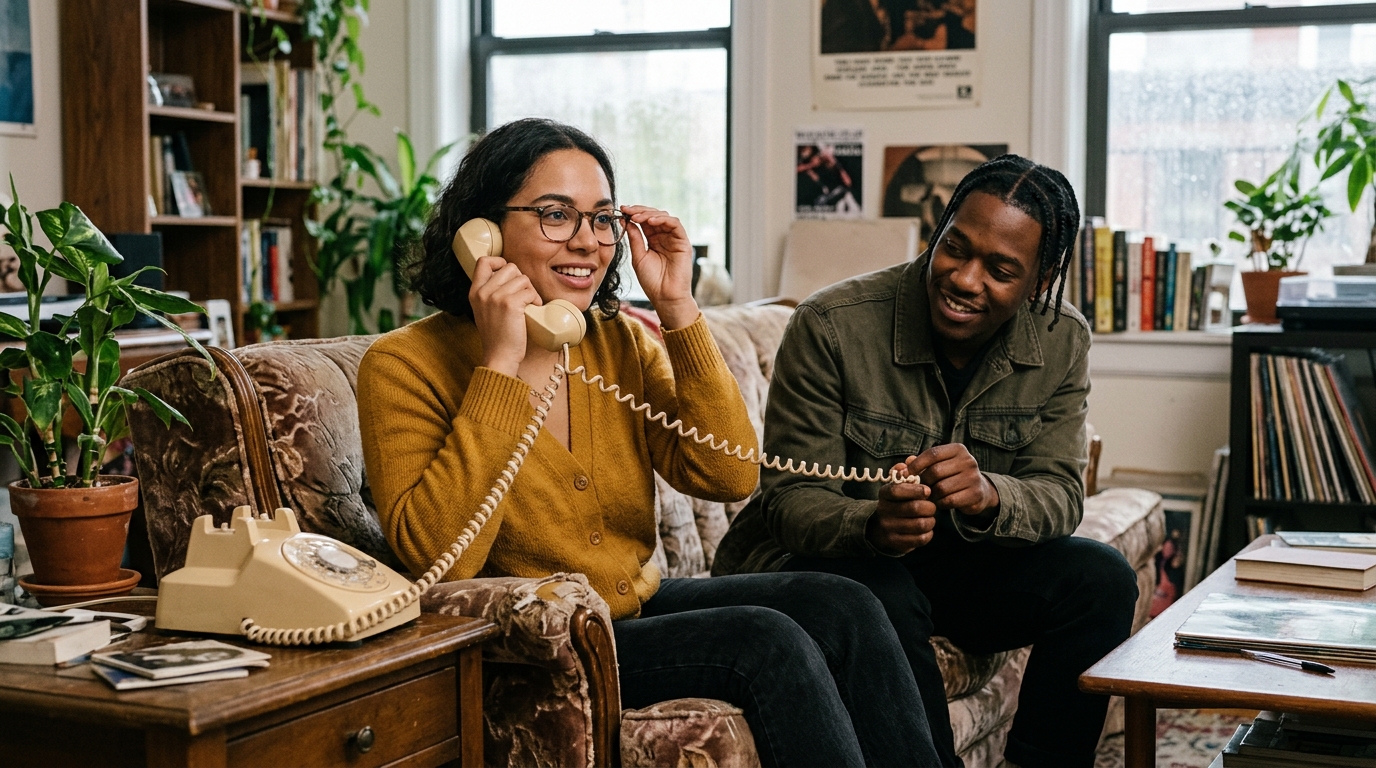
BROOKLYN, N.Y.—A growing number of young urban professionals are paying premium installation fees to run analog copper wires into their apartments to use "tethered acoustic portals"—a hardware-based communication trend otherwise known as the landline telephone.
The movement, which has gained rapid traction in neighborhoods like Williamsburg and Bushwick, rejects the mobile phone's portability in favor of a fixed, heavy plastic receiver connected to a wall outlet by a springy, expandable cord. Adherents of the trend say that restricting their movement to a three-foot radius around a kitchen or hallway outlet provides a sense of mindfulness that modern smartphones have destroyed.
"When I am on a tethered call, I am physically anchored to the wall," said Maya Lin, a 24-year-old freelance archivist who recently paid $350 to have a refurbished 1982 Western Electric model installed in her living room. "I can’t pace around my apartment, I can’t fold laundry, and I can’t scroll through social media. I am forced to occupy a single, stationary point in space and simply listen. It’s a radical form of sensory isolation."
The demand has fueled a lucrative market for retro telecom hardware. Specialty boutiques like Lineage Wire in Manhattan now sell restored rotary and touch-tone phones, marketing them as "zero-notification audio nodes." The company’s most popular model, a mustard-yellow wall unit, retails for $450 and requires a professional technician to drill holes into drywall to establish a physical connection to the municipal grid.
Sociologists tracking the trend note that the appeal lies in the absolute lack of digital metadata. Unlike modern communication apps, the analog phone offers no read receipts, no video capabilities, and no visual indication of who is calling before the receiver is lifted.
"We are seeing a generation discover the luxury of geographic fixedness," said Dr. Alistair Vance, a digital anthropologist at the Manhattan Institute of Technology. "To these users, the inability to leave the room while speaking is not a limitation, but a boundary. They are treating the physical cord as a protective leash that keeps them from drifting into digital multitasking."
The trend has also revived social etiquette surrounding the "shared domestic terminal." Because the phone belongs to the apartment rather than an individual, residents must once again answer calls intended for their roommates, a process practitioners refer to as "third-party analog routing."
For Lin, the physical feedback of the hardware remains the primary draw, particularly when concluding a conversation.
"You cannot replicate the emotional release of a high-velocity acoustic termination," Lin said, referring to slamming the receiver back onto its heavy plastic cradle. "Pressing a red circle on a glass screen feels empty. Putting a heavy handset down with enough force to ring the internal brass bell is how you let the house know a conversation is over."