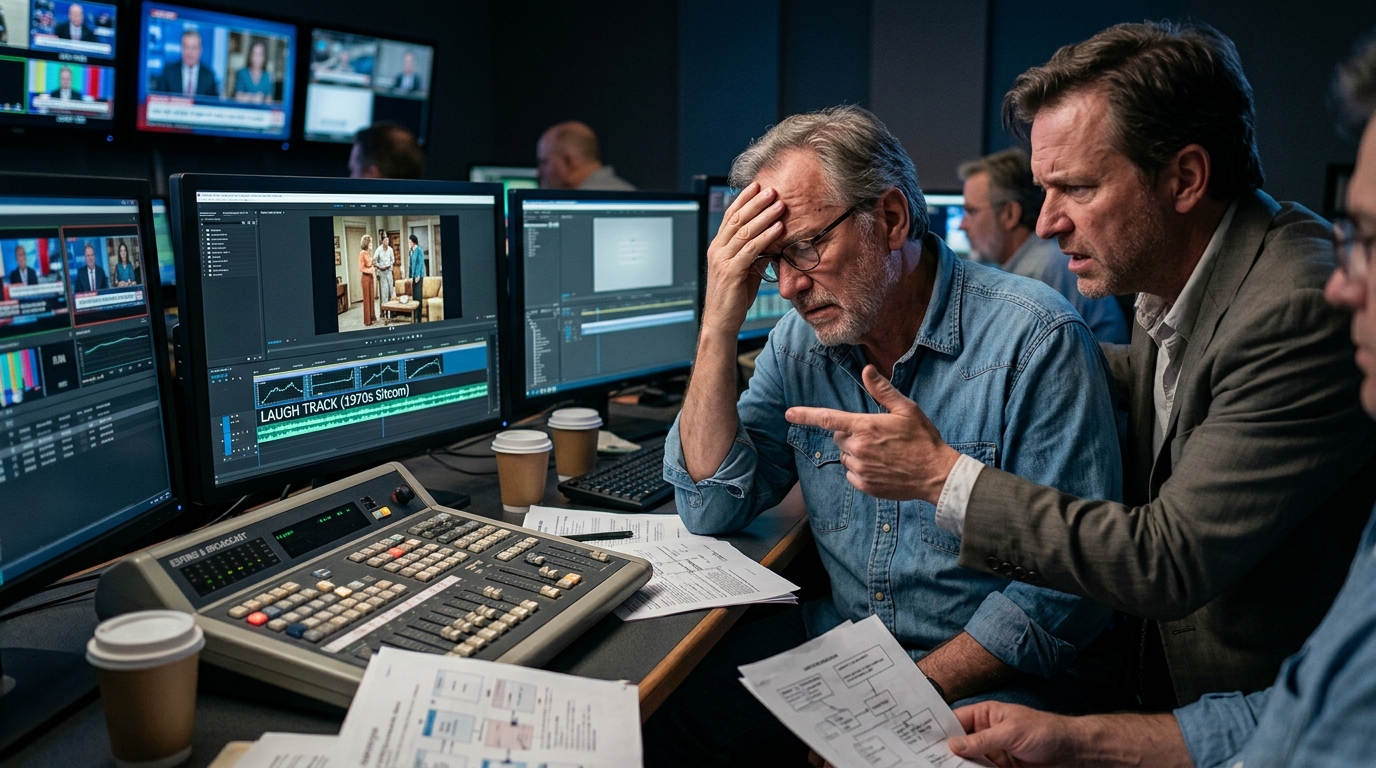
LOS ANGELES — Television syndication networks are scrambling to adjust their programming schedules this week following the complete tokenization of historic sitcom laugh tracks, a move that has turned the background chuckles of long-deceased studio audiences into highly volatile digital assets.
Under a new licensing structure implemented by Apex Media Holdings, the individual laugh tracks recorded between 1953 and 1989—originally compiled by sound engineer Charley Douglass for his famous "Laff Box"—have been minted as unique tokens on the Arbitrum blockchain. Consequently, any network or streaming platform broadcasting a show utilizing these sounds must pay fractional "gas fees" directly to token holders every time a specific laugh is played.
The financial impact was felt immediately by independent and cable broadcasters, many of whom rely on late-night reruns of legacy comedies to fill airtime.
"We had to pull three episodes of The Mary Tyler Moore Show off the Tuesday lineup," said Marcus Vance, vice president of programming at RetroCast Network. "In those particular episodes, the audience reaction includes 'Guffaw #407'—a rare, full-bellied laugh that is currently trading at $4.12 per broadcast second. Airing those episodes back-to-back would have wiped out our entire local advertising revenue for the night."
The tokenization effort, marketed under the platform name "HaHaShare," categorizes the 320 distinct audience reactions in the historic library by intensity, duration, and vocal range. Common "titters" and "light chuckles" remain relatively inexpensive, trading at fractions of a cent per play. However, premier reaction assets—such as "The Wheezy Gasp" and "The Outraged Female Gasp"—have become highly sought-after commodities among speculative investors.
According to Apex Media Holdings, the initiative is a long-overdue correction in the entertainment economy.
"For seventy years, broadcasters have exploited the disembodied joy of mid-century studio audiences without offering any real equity," said Elena Rostova, chief creative officer of HaHaShare. "By anchoring these laughs to the blockchain, we are establishing a decentralized ledger of amusement. When a token holder owns a 1.2-second burst of a woman snorting in 1968, they own a piece of cultural history. Every time that snort brings joy to a modern viewer, the owner deserves to be compensated."
The sudden rise in operational costs has forced television sound editors into an administrative nightmare. At post-production houses across Los Angeles, engineers are working overtime to "sanitize" older programs, surgically removing high-value tokenized laughs and replacing them with cheaper, royalty-free alternatives.
"We are basically doing comedic triage," said David Chen, a veteran audio restoration specialist. "A client will send us an episode of a 1980s sitcom, and our job is to strip out the 'Cascading Hysteria' track, which is currently too expensive to clear, and replace it with 'Generic Polite Amused Murmur.' It completely changes the timing of the show. The jokes feel flat, but from a balance-sheet perspective, it’s the only way these networks can survive."
Chen noted that some networks have even requested the insertion of "synthetic silence"—a digital blanking of the audio track immediately following a punchline—leaving actors standing in eerie, unprompted pauses.
The speculative market surrounding the laugh tokens has already begun to influence content creation. Several independent podcast networks and digital video creators have started purchasing fractional shares of specific laughs to use in their own productions, hoping to drive up the asset's utility and market value through repeated exposure.
However, the legal complexities are mounting. A coalition of descendants of 1950s television studio audiences has filed a class-action lawsuit in California Superior Court, claiming that their ancestors' vocal cords were tokenized without consent. The plaintiffs argue that the distinctive, high-pitched "cackle" of a woman named Mildred Hanes, which appears in over 400 episodes of various classic series, constitutes personal biometric data that cannot be legally traded on a digital exchange.
Representatives for HaHaShare have dismissed the lawsuit, asserting that because the original recordings were captured in public or semi-public studio environments, the acoustic waves became the property of the production companies under the standard release forms of the era.
As the legal and financial battles continue, smaller networks are beginning to explore alternative programming strategies. RetroCast Network announced yesterday that it will begin airing its late-night blocks of The Odd Couple completely muted, accompanied only by a scrolling text crawl explaining the cost-saving measure to viewers.
"We hope our audience understands," Vance said. "We want to bring them classic American humor, but under the current market conditions, we simply cannot afford to let them hear it."