BOSTON — On Monday, regional corporate law firm Vance & Sterling transitioned its entire billing department to a proprietary biometric system designed to track and invoice clients for the exact minutes attorneys spend thinking about their cases outside of working hours.
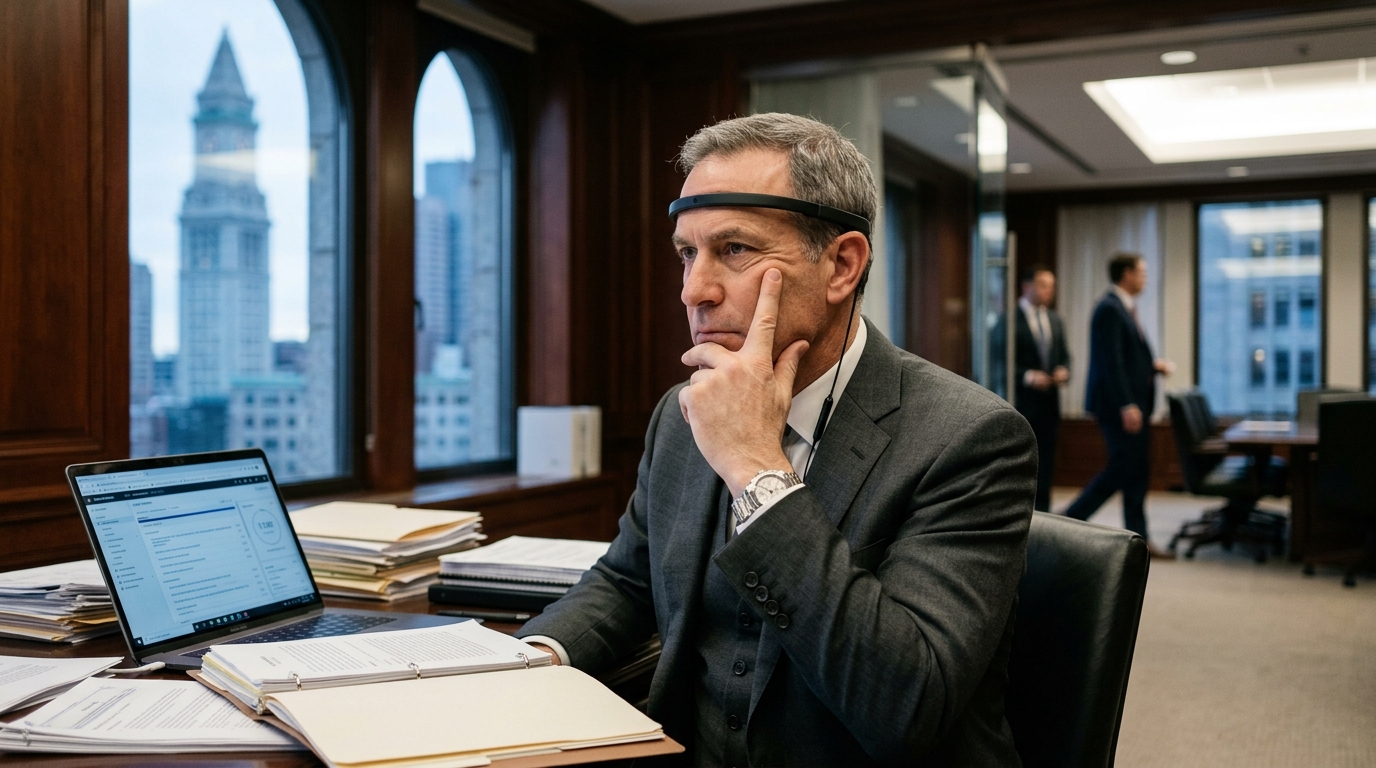
The initiative, branded as "Cognitive Billable Units" (CBUs), relies on lightweight, EEG-enabled headwear distributed to the firm’s 120 associates and partners. The devices monitor neural activity in the prefrontal cortex, allowing the firm’s billing software to automatically generate invoices when an attorney experiences a breakthrough or contemplates a client’s legal strategy during non-traditional hours, such as during a commute, a family dinner, or a brief period of insomnia.
"For over a century, the billable hour has unfairly penalized the modern, creative attorney," said Julian Vance, managing partner at the firm. "Legal breakthroughs do not respect the boundaries of a standard desk calendar. If a senior partner solves a complex intellectual property dispute while staring at a display of heirloom tomatoes at a local market, that is highly valuable labor. The client should pay for that tomato-adjacent labor."
According to the firm’s updated terms of service, cognitive labor is billed across three distinct tiers: Active Synthesis ($950/hour), Passive Conceptualization ($600/hour), and Peripheral Processing ($350/hour). The latter category covers low-level, ambient anxiety related to pending litigation.
Clients have already begun receiving the first round of itemized invoices under the new system. Arthur Pendelton, chief financial officer of regional distributor Beacon Logistics, noted that his company’s July statement included several highly specific, non-office entries.
"There was a line item for 'Subconscious restructuring of contract indemnity clauses during child's cello recital' that cost us $180," Pendelton said. "Another charge for 'Sudden breakthrough regarding maritime jurisdiction at 2:40 AM' was billed at the emergency night rate of $1,200. Initially, we questioned the charges, but the firm provided a localized brainwave map showing a massive spike in beta-wave activity precisely when the partner claims he realized our shipping containers were technically exempt from local tariffs."
The implementation has also shifted internal dynamics within the firm's downtown offices. Junior associates, who are expected to log a minimum of 2,200 cognitive units annually, have reportedly begun practicing intensive mindfulness exercises to minimize "unbillable daydreaming" and personal thoughts during the workday.
The firm is currently developing a firmware update for the tracking headwear to address "cognitive overlap," which occurs when an attorney accidentally contemplates two different clients' cases during the same elevator ride. Under current protocols, such thoughts are pro-rated based on the estimated percentage of mental bandwidth dedicated to each party.
"We are simply aligning compensation with the true nature of intellectual work," Vance said, adjusting his headband. "The brain does not turn off at five o'clock, and neither should the revenue stream."