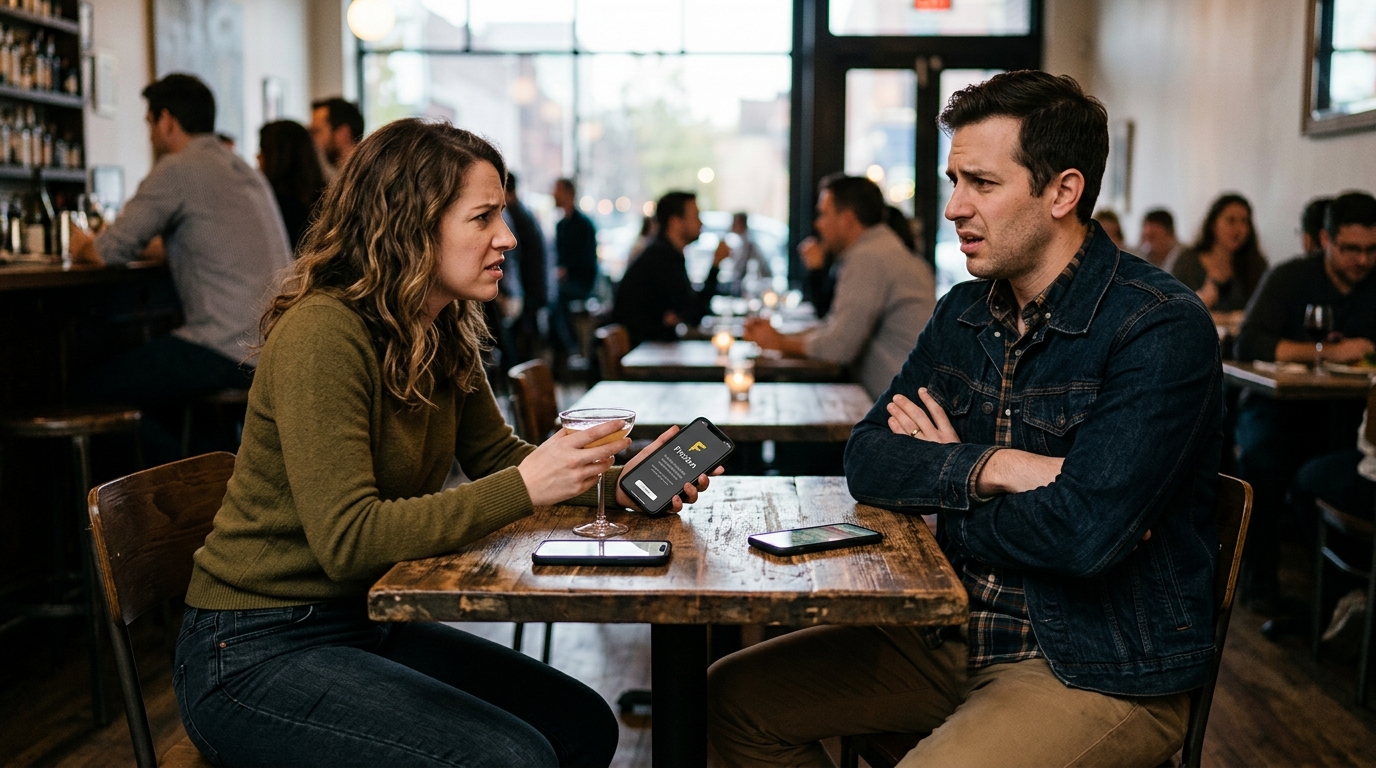
SAN FRANCISCO — A new smartphone application is disrupting the digital dating market by abandoning traditional metrics like shared hobbies or physical attraction, instead pairing users exclusively on their most deeply ingrained psychological flaws.
The app, called Friction, has quickly risen to the top of the lifestyle charts since its launch earlier this spring. Unlike competitors that promise to find a user's "perfect match," Friction uses a proprietary algorithm to pair individuals whose specific emotional dysfunctions are mathematically optimized to aggravate and sustain one another.
To build a profile, new users must grant the app access to their text message history, credit card statements, and Spotify data. They must also complete a mandatory 400-question behavioral assessment designed to isolate their primary personality defect. Categories range from "compulsive conversational monopolization" to "bureaucratic vindictiveness."
"Traditional dating apps are built on a flawed business model: if you find love, you delete the app," said Marcus Vance, Friction’s co-founder and chief executive officer. "We realized that people don’t actually want harmony. They want someone who fits into their existing neuroses like a key in a lock. By pairing a passive-aggressive conflict-avoider with a relentless, hyper-literal debate enthusiast, we create a self-sustaining cycle of domestic tension that neither partner can ever quite bring themselves to leave."
According to company data, the app’s current retention rate is 89% over six months, a figure unprecedented in the industry.
For local users like Clara Higgins, a 31-year-old paralegal, the results have been life-changing. Higgins, whom the app classified as a "hyper-vigilant calendar-planner who views spontaneity as a personal insult," was matched in May with Julian Mercer, a freelance graphic designer classified as "chronically incapable of committing to a dinner location until forty minutes after he is already hungry."
"In the past, I would have swiped left on Julian immediately," Higgins said. "But our dynamic is incredibly stable. He forgets where he parked, which allows me to deploy my color-coded spreadsheet of local parking garages. I complain about his lack of agency, and he apologizes with just enough insincerity to keep me vigilant. We’ve already signed a lease on an apartment."
Behavioral psychologists have noted that the app’s success lies in its recognition of human habituation. Rather than striving for self-improvement, users are encouraged to lean into their worst impulses with a partner uniquely qualified to tolerate, and feed, them.
"We are seeing relationships that are structurally indestructible," said Dr. Evelyn Sterling, a clinical psychologist at the Northern California Behavioral Institute, who is not affiliated with the company. "By matching an individual who expresses affection through silent martyrdom with someone who is entirely oblivious to non-verbal cues, Friction has engineered a closed-loop system of emotional labor. There is no friction-loss; the machine runs forever."
Despite some criticism from relationship counselors who argue the app promotes toxic relationship dynamics, Friction plans to roll out an update next month called "Escalation." The new feature will automatically suggest vacation destinations specifically chosen to trigger both partners' distinct anxiety profiles simultaneously.