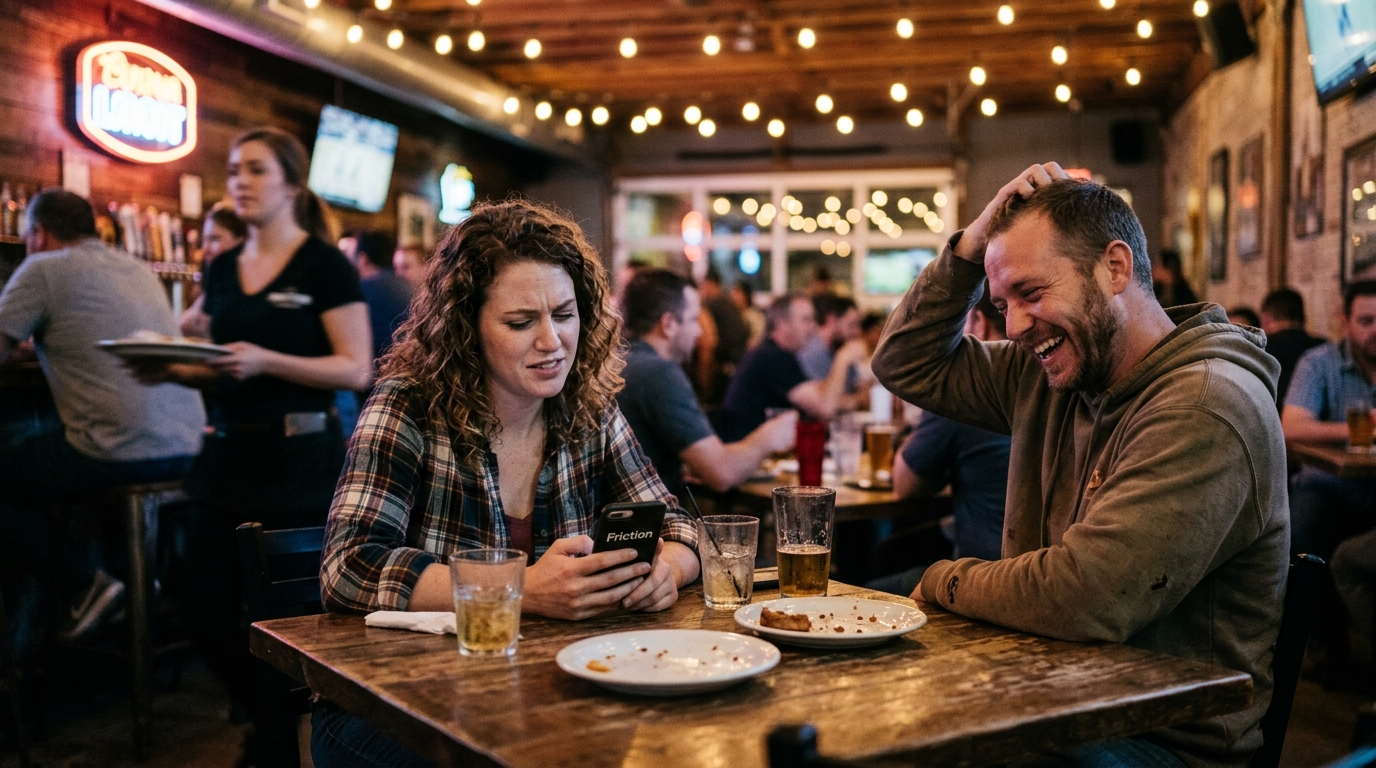
SAN JOSE, Calif. — A new mobile application is shaking up the digital matchmaking industry by abandoning traditional metrics like shared hobbies and physical attraction, opting instead to pair users based on their most deep-seated behavioral defects.
The app, called Friction, has quickly climbed the charts of the Apple App Store since its soft launch in June, claiming a three-month retention rate that outpaces competitors like Tinder and Hinge.
Instead of prompting users to list their favorite travel destinations or musical tastes, Friction requires new sign-ups to complete a 120-question psychological inventory developed in consultation with forensic investigators and divorce attorneys. Users must also grant the app read-only access to their last six months of text messages to verify their self-reported flaws.
"The industry has spent fifteen years matching people on who they pretend to be on Sunday mornings," said Marcus Vance, Friction’s chief product officer. "We match people on who they actually are at 11:30 p.m. on a Tuesday when they’re tired, irritable, and arguing about whose turn it is to empty the dishwasher."
The app’s algorithm operates on what it calls "symmetrical pathology." Users are categorized into primary behavioral archetypes, such as "Anxious Explainer," "Aggressive Silent-Treater," or "Passive-Aggressive Chore Tracker." Matches are then generated by pairing complementary dysfunctions.
For Clara Higgins, a 31-year-old paralegal from Denver, the system proved remarkably efficient. Higgins, who was classified by the app as a "Severe Backseat Navigator," was matched with Daniel Sterling, 34, an "Incurable Refuser of Directions."
"On our first date, Daniel drove us forty minutes out of our way because he refused to use GPS," Higgins said. "In any other relationship, that would have been a fight. But because Friction flagged this compatibility beforehand, I was able to spend the entire drive sighing audibly and checking my watch—which is my primary love language. It was incredibly validating."
According to internal company data, pairings based on mutual irritation last longer than those based on shared interests. Friction’s data scientists suggest that while shared hobbies like hiking or wine tasting can feel superficial over time, a deeply ingrained personality defect is a permanent fixture of an individual's character.
"Shared interests are seasonal," Dr. Evelyn Aris, a relationship therapist not affiliated with the app, noted. "But a pathological need to be the last person to speak in an argument is forever. When two people enter a relationship knowing exactly which buttons the other will press—and specifically desiring to have those buttons pressed—the element of surprise is removed. It's a very stable form of misery."
Friction plans to introduce a premium tier next month called "Friction Prime," which will allow users to filter potential matches by specific domestic dealbreakers, such as "leaves kitchen cabinets open" or "uses the word 'utilize' in casual conversation."
Despite criticism from traditional relationship experts who argue the app promotes toxic relationship dynamics, Vance remains optimistic about Friction’s long-term societal impact.
"We aren't trying to fix people," Vance said. "We're just trying to find the one person who is uniquely equipped to tolerate your specific brand of nonsense, and whose brand of nonsense you find mildly entertaining."