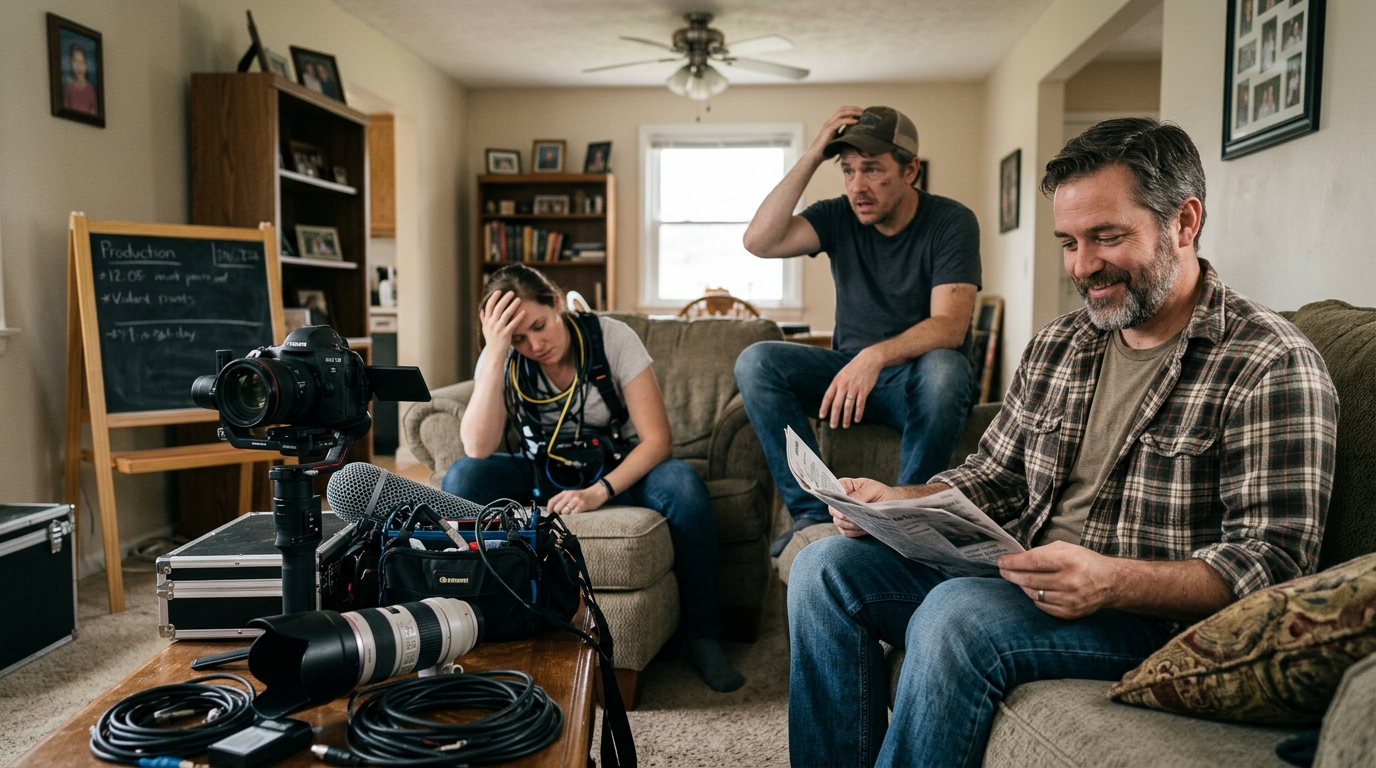
COLUMBUS, Ohio — A high-profile, multi-million dollar documentary project spearheaded by award-winning independent filmmakers has been indefinitely shelved after three years of production, after director Eleanor Vance conceded that her subject possesses absolutely no hidden trauma, repressed longing, or narrative interest.
The film, tentatively titled "Anatomy of a Monday," was conceived as an intimate, slow-cinema portrait of David Miller, a 43-year-old database administrator living in the quiet suburb of Westerville. Backed by a $1.8 million grant from the Independent Cinema Alliance, Vance and her six-person crew embedded with Miller in 2023, expecting to capture the quiet desperation of the modern American middle class.
Instead, they captured 400 hours of a man who is entirely satisfied with his life.
"We went in looking for the cracks in the facade," said Vance, whose previous work includes the critically acclaimed "The Salt in the Wound," a study of generational grief in coastal Maine. "Every documentary filmmaker knows that if you stare at anyone long enough, the shadow self emerges. But with David, we stared for thirty-six months, and there was nothing behind his eyes but a very mild, consistent sense of civic duty."
According to production logs, the crew utilized state-of-the-art Arri Alexa cameras and anamorphic lenses to document Miller’s daily routines, hoping that high-contrast cinematography would reveal the existential dread of his 45-minute commute. Instead, Miller used the time to listen to light rock radio at a reasonable volume, occasionally singing along to the choruses of songs he only partially knew.
The production team reportedly grew desperate during the second year of filming, employing various cinematic techniques to manufacture tension. Director of photography Marcus Geller recalled trying to frame Miller's weekly grocery shopping at a local Kroger as a commentary on late-stage consumerism.
"I used a specialty probe lens to get an extreme close-up of him selecting a head of iceberg lettuce, hoping to capture a moment of profound isolation," Geller said. "But he just checked it for soft spots, put it in his cart, and said, 'That'll do for the tacos.' There was no existential crisis. He just wanted tacos. And the tacos, when he made them, were seasoned entirely according to the packet instructions."
The crew also monitored Miller’s personal relationships for signs of friction. They filmed twelve consecutive Sunday dinners with his extended family, waiting for political arguments or buried resentments to surface. However, the family discussions remained strictly confined to local road construction, the performance of the municipal water system, and whether a nearby hardware store carried a specific size of brass wood screw.
Miller, for his part, expressed nothing but gratitude for the filmmakers’ presence, though he remained baffled by their artistic choices.
"They were very nice people, very quiet," Miller said from his back patio, which he recently pressure-washed to a uniform light gray. "Sometimes they would ask me to sit in a dark room and look out the window for forty-five minutes without blinking. I didn't mind. It gave me a chance to think about whether I needed to rotate my tires. I told them that on camera, but they seemed to get very quiet and frustrated afterward."
In the editing room, editors attempted to salvage the footage by applying a discordant, avant-garde score by a prominent Icelandic composer over footage of Miller changing his furnace filter. The juxtaposition, however, failed to create the desired sense of dread.
"We tried everything," said lead editor Clara Cruz. "We color-graded his backyard to look like a nuclear winter. We ran slow-motion footage of him eating oatmeal to make it look like a cry for help. But David just looks like a guy who enjoys warm oats. You can't edit a soul into a man who is genuinely content with a 15-year-old Honda Civic."
The final decision to abandon the project came last week during a rough-cut screening for the film's distributors. According to sources present, the executives sat through ninety minutes of Miller successfully assembling an Ikea bookshelf, during which he did not lose his temper, lose a dowel, or reflect on his relationship with his estranged father, who lives comfortably in Sarasota and calls him every Tuesday.
"It is a tragedy of wellness," Vance said. "We are living in an era of unprecedented psychological complexity, and we found the one man in North America who has never had a sleepless night. He doesn't even have a weird hobby. He doesn't build matchstick cathedrals. He doesn't post on fringe internet forums. He just goes to bed at 10:15 PM and wakes up refreshed."
With the project officially dead, the production crew has begun packing up their gear from the rented bungalow across the street from Miller’s home.
As they loaded the final equipment truck on Tuesday morning, Miller walked across the asphalt to offer the crew a sleeve of paper cups and a thermos of decaf coffee. He wished them luck on their next project, noting that the weather forecast predicted a 20 percent chance of scattered showers by late afternoon.
"It might rain, it might not," Miller said, looking up at the overcast Ohio sky with an expression of mild, unshakeable neutrality. "Either way, the lawn could use it."