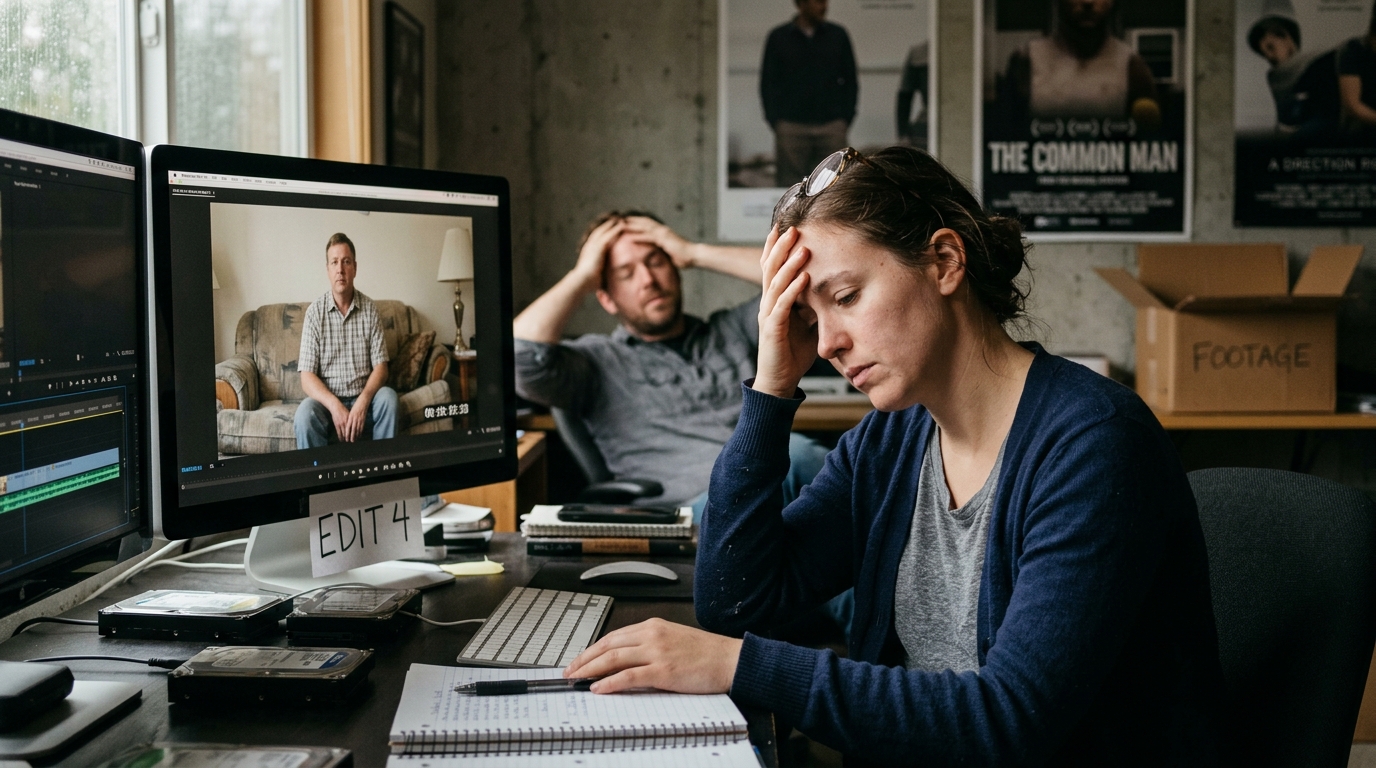
PORTLAND, Ore. — An independent production company has officially halted post-production on a highly anticipated feature-length documentary after editors realized the film’s subject is entirely devoid of compelling personal conflict, trauma, or hidden depth.
Veritas Nonfiction announced Monday that it would shelve *The Space Between the Leaves*, a documentary that followed 34-year-old insurance claims adjuster Arthur Pendelton for 38 consecutive months. Despite capturing over 1,400 hours of high-definition footage, producers admitted they were unable to construct a narrative arc because Pendelton’s life is exactly as uncomplicated as it appears on the surface.
"We went into this project expecting to unearth the profound, quiet melancholy of the American suburbs," said director Marcus Vance, who previously won acclaim for a documentary about a competitive yarn-spinner. "We mistook Arthur’s long, empty stares for deep-seated existential dread. It turns out he was just waiting for his toast to pop up."
The project, which cost an estimated $1.2 million to produce, began in 2023 after Vance met Pendelton at a regional transit hearing. Struck by Pendelton’s lack of facial expression and his habit of sitting perfectly still for up to twenty minutes, Vance believed he had found a modern-day philosopher living in self-imposed spiritual exile.
Instead, production logs reveal a man of unprecedented transparency. During a filmed four-hour interview intended to explore Pendelton's childhood trauma, the subject spent forty minutes explaining the structural advantages of a dual-zipper sleeping bag.
"We tried every editorial trick in the book to manufacture some kind of psychological stakes," lead editor Sarah Jenkins said. "We layered a melancholy cello track over a sequence where he buys windshield wiper fluid to make it look like a metaphor for a weeping soul. But it didn't work. He just looked like a guy buying windshield wiper fluid at a reasonable price."
Jenkins noted that the team even flew in a specialized consultant to analyze Pendelton’s micro-expressions. The consultant concluded that Pendelton’s face lacked subtext because he was genuinely not thinking about anything.
The cancellation has sent shockwaves through the indie documentary community, which relies heavily on finding extraordinary depth in ordinary people. Investors have reportedly questioned how the crew managed to film for more than three years without realizing they had no narrative tension.
"There was one moment in year two where we thought we had our climax," Vance said. "Arthur sat on the edge of his bed for two hours, head in his hands, whispering, 'Why?' We thought it was a breakthrough. It turned out he was trying to calculate if it was cheaper to repair his dishwasher or buy a refurbished unit."
When reached for comment at his home in Beaverton, Pendelton expressed no hard feelings about the project’s sudden termination.
"They were very nice people, though they did block my driveway with their catering van once," Pendelton said. "I told them on the first day that my life was not particularly cinematic, but they told me my reluctance was 'indicative of the fractured modern male psyche.' I was actually just worried they were going to track mud onto the carpet."