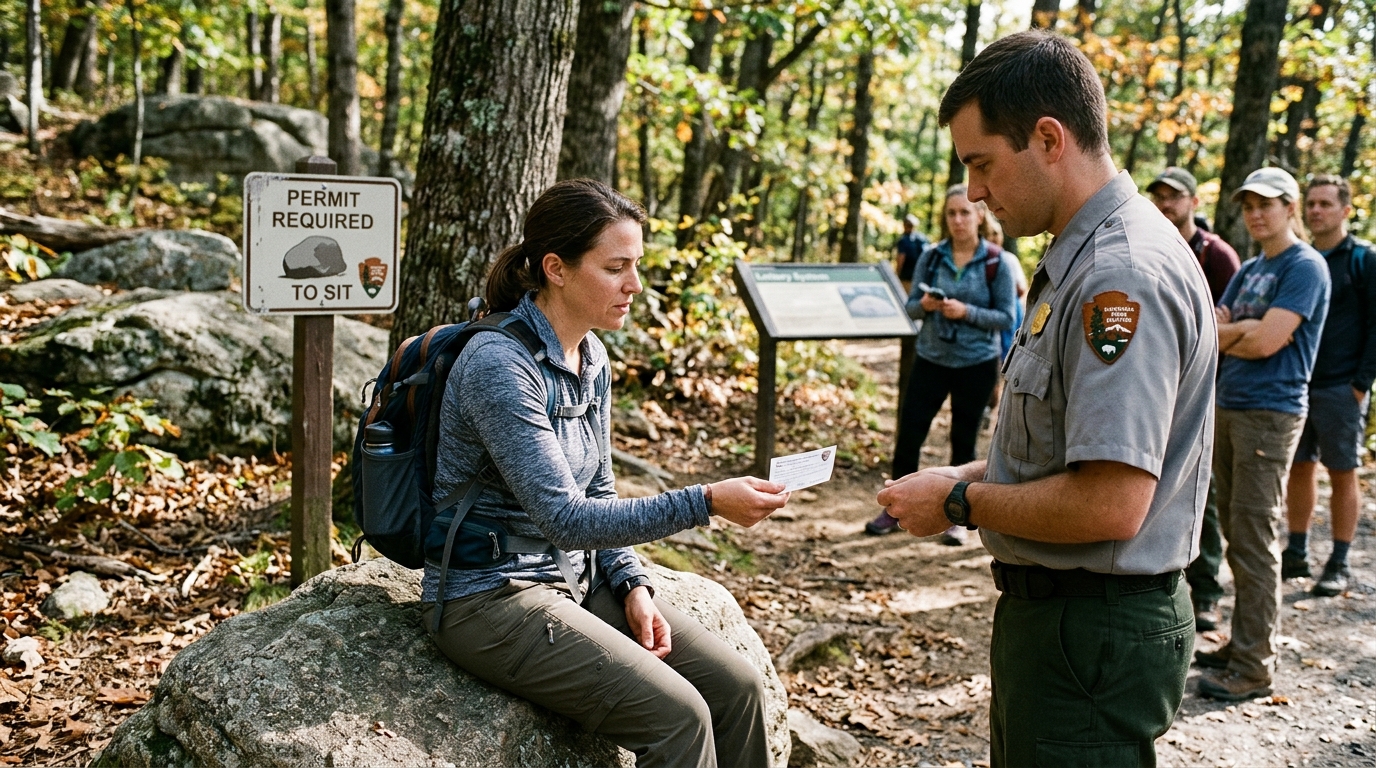
FRONT ROYAL, Va. — The National Park Service on Wednesday implemented a pilot reservation system requiring visitors to obtain a permit before sitting on, leaning against, or resting a backpack upon a specific three-foot-wide basalt boulder in Shenandoah National Park.
The designated stone, officially cataloged as Basalt Outcropping 12-A but known colloquially to park staff as "the grey one near the overlook sign," will now require a timed-entry reservation between the hours of 8:00 a.m. and 5:00 p.m. daily. The pilot program represents the federal government’s first attempt to manage "micro-congestion" at the individual geological level.
Under the new guidelines, hikers wishing to interact with Outcropping 12-A must apply through Recreation.gov at least 48 hours in advance. The reservation carries a $15 non-refundable application fee, followed by a $2 recreation fee upon successful booking. Each permit grants the holder a strict 12-minute window of physical contact, which includes sitting, standing, or utilizing the boulder as a tripod stabilizing surface.
"We reached a critical threshold where unregulated geological interaction was no longer sustainable," said Charles Vance, deputy superintendent of visitor management for the park's central district. "Last autumn, we documented instances where up to three distinct hiking parties were leaning against Outcropping 12-A simultaneously. This created an unacceptable density profile for a single sedimentary-adjacent feature."
To enforce the new policy, the park service has stationed a seasonal ranger at a newly erected folding table approximately ten yards from the boulder. Visitors must present a printed PDF or a digital QR code to be scanned before stepping inside the four-foot perimeter, which has been demarcated with biodegradable orange chalk.
While hundreds of structurally identical boulders line the same trail, hikers have already adjusted to the new administrative landscape.
"We originally wanted to sit on one of the free rocks nearby," said Sarah Jenkins, a visitor from Silver Spring, Maryland, who secured a 10:15 a.m. slot after three weeks in the online lottery system. "But those rocks don't have a designated waiting area or a ranger checking IDs, so you don't really know if you're allowed to enjoy them. This feels much safer, administratively speaking. The twelve minutes flew by, but we got some great photos of the permit confirmation screen."
Park officials defended the fees, noting that the revenue generated by the reservation system will directly fund the administrative costs of operating the reservation system. If successful, the program may expand next season to include a 20-foot stretch of gravel near the visitor center and a specific fallen oak limb in the Great Smoky Mountains.
"Our goal is not to restrict access, but to curate the quality of the stillness," Vance said, adjusting his lanyard. "When everyone can sit on a rock whenever they want, the rock ceases to be a resource and becomes chaos."