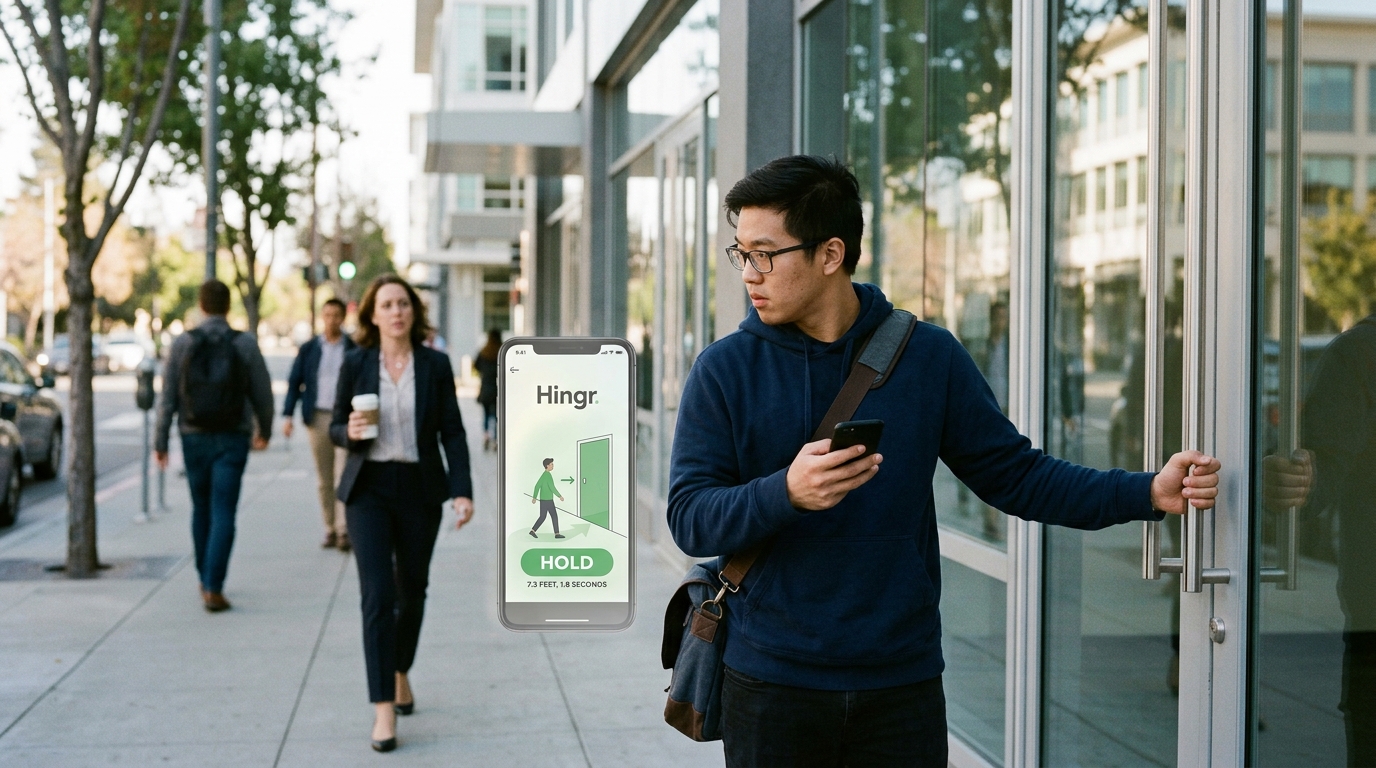
PALO ALTO, Calif.—A new mobile application aims to permanently resolve one of humanity's oldest micro-anxieties by calculating the exact physical distance at which a person is socially obligated to hold an open door for an approaching stranger.
The app, Hingr, launched Thursday on iOS and Android. It uses a smartphone’s built-in LiDAR sensors and rear-facing cameras to assess oncoming foot traffic in real time. Users point their device backward as they cross a threshold, and the app's proprietary algorithm, StrideSync, instantly analyzes the oncoming pedestrian's velocity, distance, estimated age, and whether they are carrying grocery bags or hot beverages.
The interface displays a simple, color-coded countdown. Green indicates a mandatory hold, red signals that the user should let the door close naturally, and yellow indicates a "courtesy gray area," which requires a premium subscription to resolve.
"For millennia, humans have relied on erratic internal metrics like empathy or visual estimation to decide if they should hold a door," said Marcus Vance, co-founder of Hingr. "This has led to the scourge of the 'courtesy jog'—that humiliating, half-speed run people are forced to perform when a door is held for them too early. Hingr replaces human intuition with mathematical certainty, eliminating non-consensual accelerated pedestrian transit."
According to the company’s white paper, the optimal door-holding radius under normal weather conditions is 8.4 feet. However, this distance dynamically adjusts based on environmental factors. If the outdoor temperature is below freezing, the app expands the "hold zone" to 12 feet, assuming the approaching party is moving faster. Conversely, if the approaching person is looking at their own phone, the hold zone shrinks to a mere 3.2 feet, as social negligence forfeits their right to an open door.
Beta testers of the application have reported a significant reduction in daily cognitive load.
"Last week, I saw a colleague about fifteen feet behind me in our office lobby," said Sarah Jenkins, an account executive in Chicago. "Normally, I would have stood there like an idiot, smiling awkwardly while they shuffled toward me. But Hingr vibrated twice, indicating a 'Slam Zone.' I let the door shut right in his face. It was incredibly liberating to know the data backed me up."
Several major tech campuses in Silicon Valley have already integrated Hingr into their smart-badge systems, automatically locking turnstiles if an approaching employee is outside the statistically optimal courtesy radius.
Developers are already working on the app's next update, which will focus on elevator etiquette. Vance confirmed that the upcoming feature will calculate precisely how many times a user can press the "close door" button before their facial expression is classified as actively hostile by nearby smart cameras.