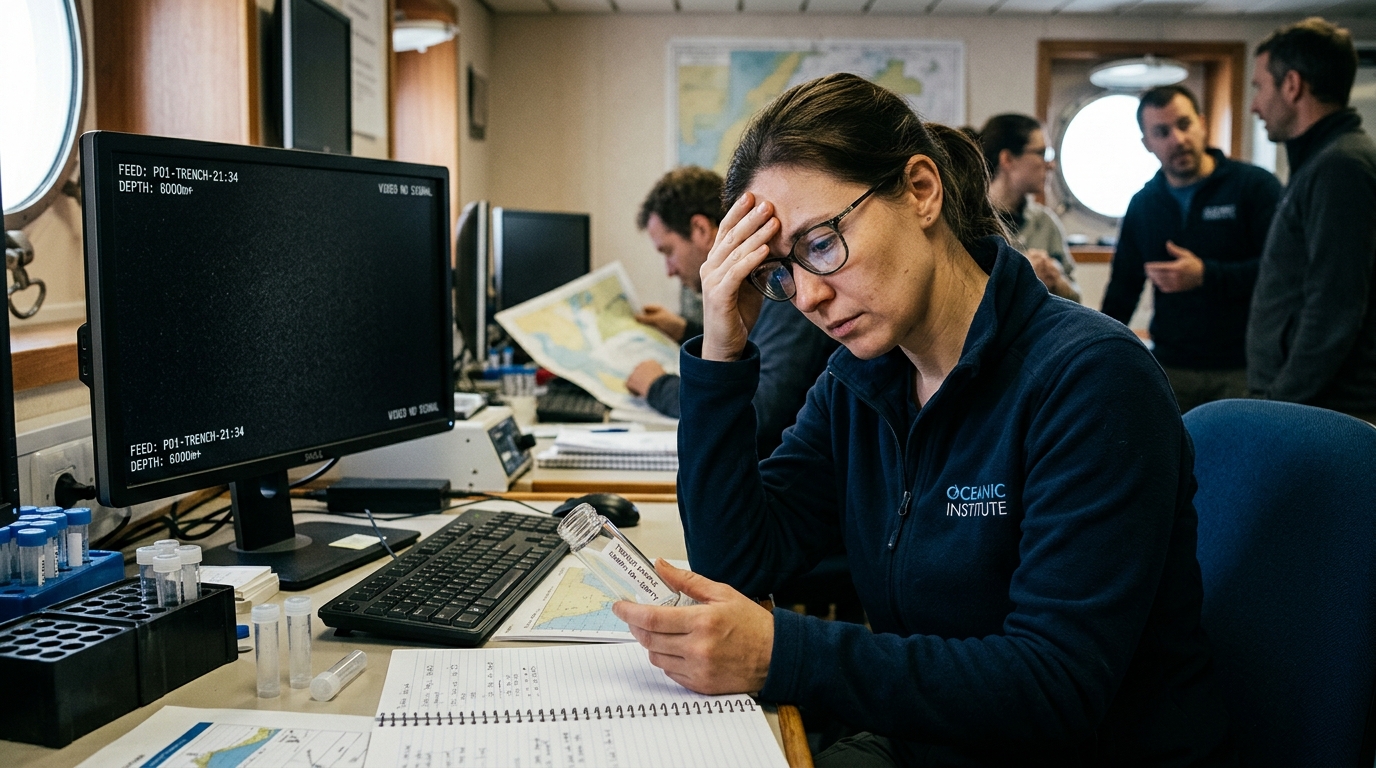
WOODS HOLE, Mass. — The National Oceanic Research Council announced Sunday a $14.2 million grant renewal for the Woods Hole Deep-Sea Exploration Initiative, praising the team’s "unprecedented methodological consistency" during an 80-day voyage that yielded absolutely no new biological specimens, geological data, or physical samples.
The Challenger Deep-IV expedition, which cost taxpayers $8.6 million, returned to port last week after dragging the seabed at depths of up to 22,000 feet. According to the mission's final report, every one of the ship’s state-of-the-art collection chambers returned to the surface filled only with pressurized saltwater, while its ultra-high-definition cameras captured exclusively pitch-black footage of barren silt.
Federal funding administrators, however, have hailed the voyage as a triumph of modern administrative science.
"Too often, deep-sea research is derailed by the unpredictable introduction of actual marine life," said Arthur Pendelton, deputy director of the council’s grant allocation division. "Researchers find a weird crab or an undocumented hydrothermal vent, and suddenly they are behind on their paperwork, trying to classify things that don't fit into our pre-approved spreadsheet dropdown menus. Dr. Vance’s team submitted 600 pages of pristine, empty data sheets on time and under budget. That is the kind of research integrity we want to incentivize."
The expedition’s chief scientist, Dr. Evelyn Vance, defended the lack of discoveries as a vital contribution to the broader scientific community, describing it as a "highly successful baseline verification of absolute vacancy."
"From a procedural standpoint, the mission was flawless," Vance said. "We deployed our $40 million remote-operated vehicle, the Nautilus II, and ran it along the ocean floor for 300 consecutive hours. It encountered nothing. Not a tube worm, not a single microscopic diatom, not even a trace of organic drift. To prove that 200 square miles of the Pacific floor are completely devoid of interest requires a level of rigorous, exhausting search protocols that lesser teams simply cannot maintain."
Under the terms of the renewed grant, which runs through 2030, the team will receive a 15 percent budget increase to upgrade their deep-sea sensors. The new equipment will allow researchers to confirm the absence of deep-sea life with up to four times the digital resolution of their previous voyage.
"Our next phase is highly ambitious," said marine technician Marcus Thorne, who spent the voyage monitoring flatlining sonar displays. "We plan to return to the same coordinates next spring with a custom-built acoustic array. This will allow us to record the deepest ocean silence with studio-grade fidelity, ensuring that if there is absolutely nothing down there, we will hear it clearer than ever before."
The council confirmed that the team's final report has already been fast-tracked for publication in the Journal of Marine Bureaucracy, where it will be featured as a model for future grant applications.