MASON, Ohio — Residents of the Whispering Pines subdivision are adjusting to a strict new interpretation of community standards after the neighborhood’s homeowners association began enforcing fines for unauthorized shadows crossing property lines.
Under Section 12-B of the Whispering Pines HOA charter, any shadow cast by a resident’s tree, mailbox, vehicle, or structure onto a neighboring lot constitutes a "spatial easement violation" unless a formal, notarized "Bilateral Solar Silhouette Agreement" has been filed with the board.
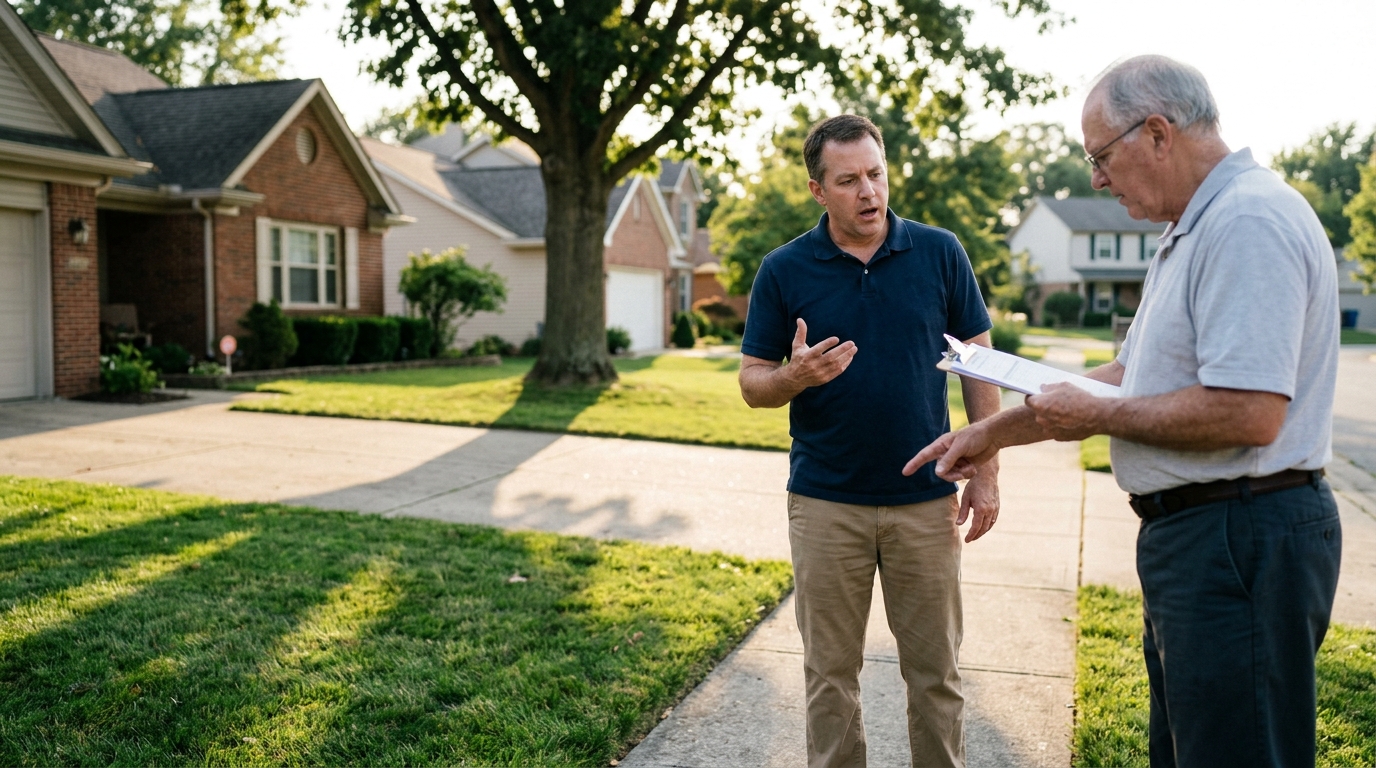
To enforce the policy, the HOA has hired a part-time climatological compliance officer who patrols the subdivision's three cul-de-sacs twice daily, specifically during the "critical transit hours" of 8:00 a.m. and 5:00 p.m. Armed with an industrial transit level and a light-intensity meter, the officer documents unauthorized darkness stretching across property lines.
"I got a $75 citation because the shadow of my parked Honda Odyssey touched the edge of the Miller family’s driveway for forty-two minutes on a Tuesday," said Arthur Pendelton, a resident of Whispering Pines since 2018. "The Millers didn't even care, but the compliance officer took a time-stamped photo. Now I have to park further down the street or negotiate a driveway-sharing treaty with my neighbor."
The rule has sparked a flurry of complex micro-negotiations across the 140-home development. Some residents have begun pruning their mature maple trees into asymmetrical, windswept shapes to prevent late-afternoon shadows from reaching adjacent lawns. Others have entered into complex "shadow swaps," where homeowners exchange morning shade rights for afternoon canopy coverage.
HOA President Clara Vance defended the policy, arguing that uncontrolled shadows represent an unregulated transfer of cooling benefits and visual real estate.
"Property lines do not stop at the surface of the grass," Vance said during Tuesday's board meeting, which was held in a strictly lit, shadow-free community room. "When your oak tree casts a shadow onto your neighbor's yard, you are unilaterally lowering the ambient temperature of their soil without their consent. That is an uncompensated taking of their solar rights."
The HOA now offers a standard three-page "Permissible Obstruction of Light" form, which requires a $45 filing fee and signatures from all adjacent property owners. For more complex structures, such as two-story homes, residents must hire a licensed surveyor to map the annual solar path before erecting any backyard swing set or pergola.
Despite the mounting tension, some residents are finding loopholes. Pendelton noted that overcast days have become a source of community-wide relief, as diffuse sunlight renders property boundaries legally indistinguishable.
"When it's cloudy, we can actually talk to each other across the lawns," Pendelton said. "But the moment the sun breaks through, everyone starts checking their watches and running for their tape measures."