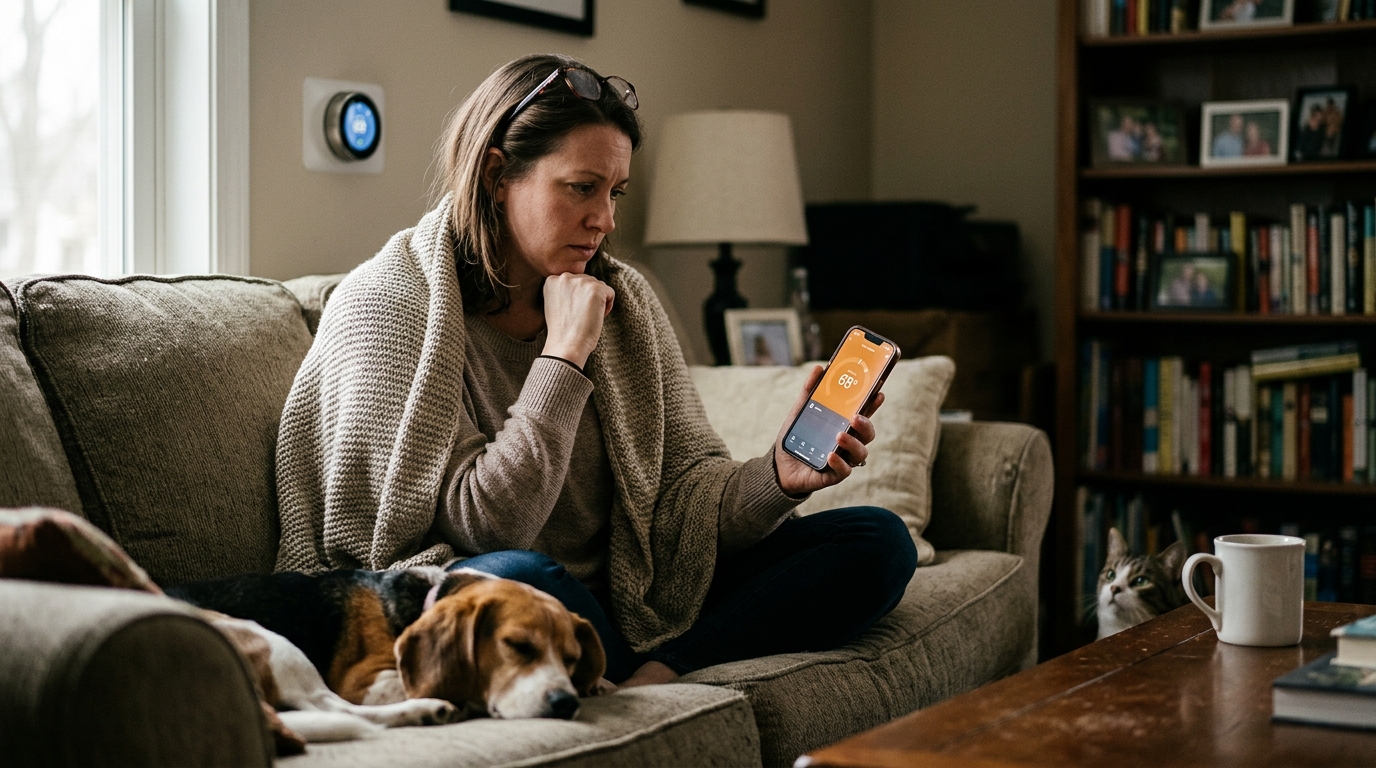
BOULDER, Colo. — A comprehensive study released Thursday by the Institute for Sensory Calibration reveals that approximately 74 percent of American adults are currently unable to determine whether they are physically hot or cold without first consulting a digital interface.
The peer-reviewed paper, published in the Journal of Somatic Science, monitored 1,800 participants across various climate zones over a 14-month period. Researchers found that when subjects were placed in rooms where the temperature was gradually lowered to 54 degrees Fahrenheit, a vast majority did not report feeling cold until they were permitted to look at a smart thermostat, a smartphone weather application, or a wearable fitness tracker.
"We observed a profound disconnect between physical autonomic responses and cognitive awareness," said Dr. Charles Geller, the lead coordinator of the study. "Subjects were actively shivering, displaying goosebumps, and rubbing their arms for warmth, yet when asked to describe their physical state, they repeatedly answered that they were 'awaiting telemetry.' Once the digital display was turned on, showing the actual temperature, the subjects immediately reported feeling cold."
According to the study, this phenomenon—termed "delegated thermal perception"—is most acute among adults aged 22 to 45 who reside in homes equipped with multi-zone smart-climate systems. The reliance on external data has reportedly weakened the neurological pathway that translates basic cutaneous thermoreception into conscious decision-making.
"My husband and I sat on our couch in Naperville for three hours last Tuesday, shivering under two duvets," said Miranda Croft, 34, a software account manager who participated in the study’s home-monitoring phase. "We knew we felt different, but our home network was undergoing a routine server migration, so we couldn't access the ambient indoor air index. We didn't want to make a premature adjustment and put on sweaters if the house was actually at 71 degrees. It felt safer to wait for the system to come back online."
The study also highlighted a growing secondary market for "thermal confirmation applications." These programs require users to input their current heart rate, local humidity, and recent caloric intake to generate a push notification informing the user whether they should close a window or put on a cardigan.
"We are seeing a generation of consumers who treat their own skin as an untrustworthy third-party narrator," said Dr. Helen Cho, a clinical psychologist at Denver Health who was not involved in the study. "They require a second opinion from a server farm in Virginia before they can confidently identify a breeze."
The trend has begun to impact municipal infrastructure. In Seattle, transit officials recently installed digital "Thermal Validation Beacons" at major bus stops after commuters complained they could not decide whether to unzip their raincoats without a localized micro-climate readout.
For Geller and his team, the long-term implications of the study suggest a permanent shift in human biology. "The body is highly efficient," Geller said. "If you do not use the neural pathways designed to tell you that your toes are freezing, those pathways will eventually atrophy. Soon, we may require a firmware update just to realize our socks are wet."