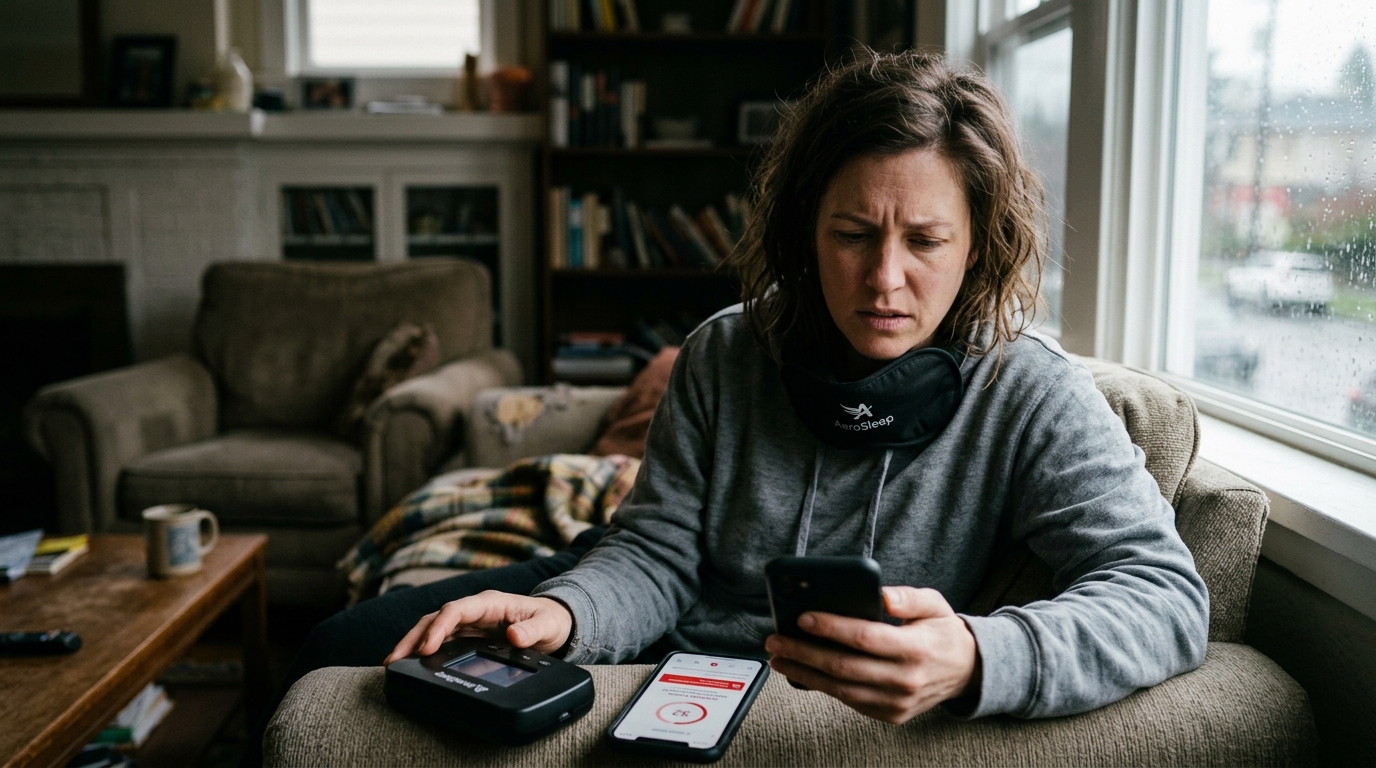
SAN FRANCISCO — AeroSleep, the market leader in wearable biometric technology, is facing backlash from users following a firmware update that actively penalizes customers for dreaming "inefficiently."
First rolled out on Tuesday, the update introduces the "Dream Integrity Index" (DII) to the company's popular AeroSleep Band 5. The feature uses integrated electroencephalogram (EEG) sensors to monitor brainwave patterns during rapid eye movement (REM) sleep, translating neural activity into narrative structures. If a user’s dream fails to meet the company’s new guidelines for cognitive optimization, the mobile application deducts points from their daily readiness score and sends automated push notifications advising them on how to dream more productively.
According to the company’s updated terms of service, high-scoring dreams are those that prioritize linear, realistic scenarios—such as organizing a filing cabinet, sorting mail, or walking through a suburban neighborhood. Surrealist elements, nonlinear timelines, and unresolved plot points are classified as "cognitive waste."
Marcus Vance, a software engineer from Seattle, woke up on Thursday morning to find his daily sleep score had plummeted to 42 out of 100. The application informed him that he had spent 45 minutes of deep REM sleep in a "narrative violation."
"The app told me my dream lacked actionable resolution and that I had wasted critical processing power on non-existent geography," Vance said. "Apparently, I spent the third cycle of my sleep dreaming that I was teaching a lecture on medieval history to a classroom of golden retrievers. The app flagged it as 'highly illogical' and suggested that tonight I try to focus on standard grocery shopping or laundry folding to rebuild my cognitive baseline."
In online forums, hundreds of users have reported similar reprimands. One user was penalized for dreaming that they could fly, which the app flagged as a "spatial impossibility likely to induce daytime disorientation." Another was docked thirty points after their late grandmother appeared in a dream to offer advice, a scenario the system categorized as "chronological inconsistency."
AeroSleep has defended the update, asserting that dreaming is the brain's natural defragmentation process and should be treated with the same rigor as daytime productivity.
"We are simply helping our users audit their subconscious minds," said Dr. Helen Rostova, chief behavioral officer at AeroSleep. "A dream about falling through a bottomless void represents a severe failure of spatial efficiency. By flagging these anomalies, we encourage the brain to adopt more structured, productive REM-state scenarios that translate directly to daytime focus. If you are spending your nights fleeing from a giant, sentient clock, you are not preparing yourself for the modern workforce."
The company confirmed that users who consistently record "unstructured" dreams for three consecutive nights will receive haptic vibrations at 5:00 AM, accompanied by pre-recorded audio seminars on logical reasoning.
Despite the criticism, some users have begun adjusting their pre-sleep routines to satisfy the device's algorithms.
"I spent last night trying to force myself to dream about a quarterly budget review," Vance said, staring at his wrist. "I still got a C-minus because my brain apparently introduced a talking stapler in the final minutes. I’m hoping to get down to pure, unadorned tax preparation by Friday."