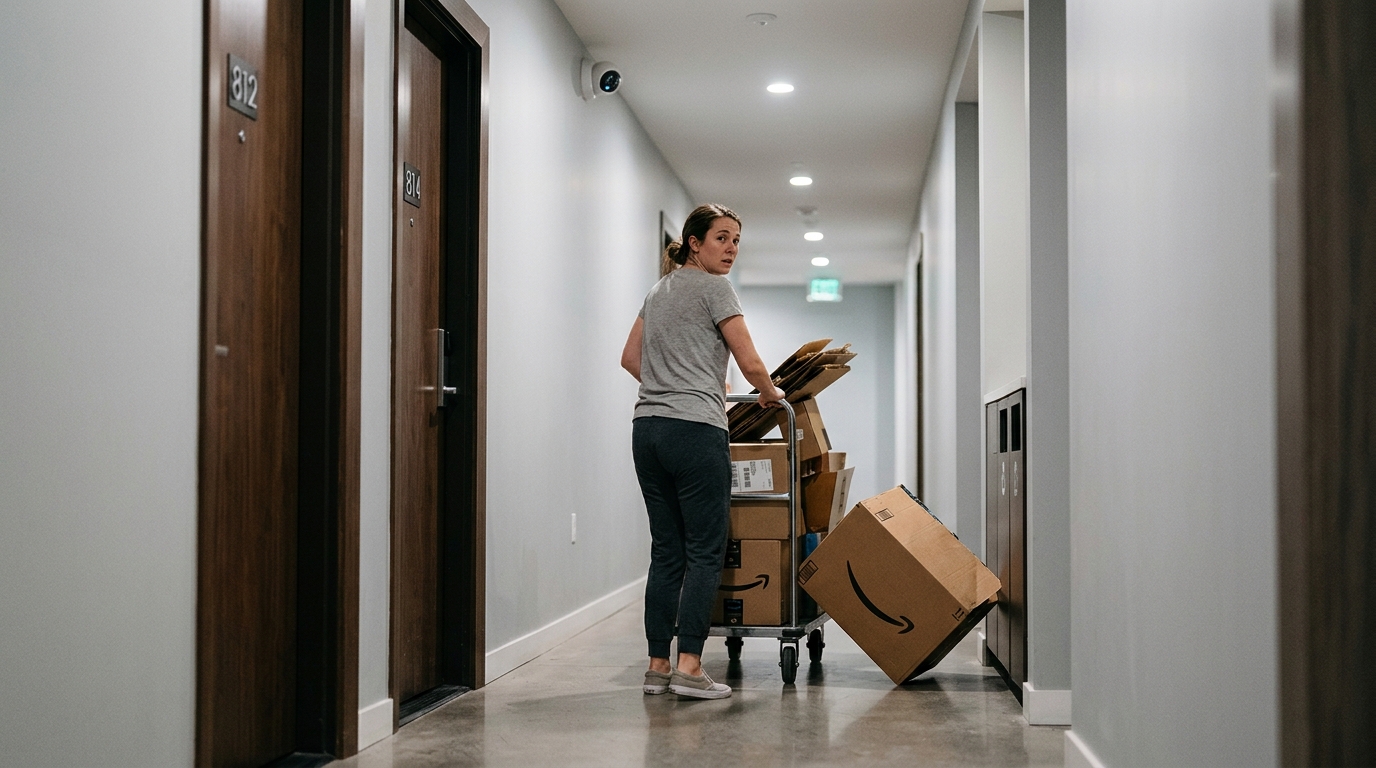
ARLINGTON, VA—Residents of a prominent high-rise apartment complex in northern Virginia are now receiving legally binding municipal court summonses for minor lease infractions, following a first-of-its-kind partnership between property management and the county’s civil enforcement division.
The pilot program, which began operating last month at the 412-unit Grandview Residences, has integrated the building’s proprietary hallway surveillance network directly into the Arlington County General District Court’s electronic docket. The system, marketed as the Residential Harmony Protocol, bypasses traditional landlord-tenant mediation to issue automated civil citations for domestic non-compliance, such as improper recycling sorting and walking too loudly in common areas.
Local officials praise the program as a major step forward in municipal efficiency, arguing that automating the citation process reduces administrative overhead and ensures a standardized living environment.
"Historically, code enforcement and covenant compliance have been bottlenecked by human observation and manual paperwork," said Marcus Vance, executive director of the Arlington Board of Residential Harmony. "If a tenant left a trash bag in a hallway for three hours, the property manager had to write an email, which was often ignored. Now, our county-linked optical scanners identify the bag, match it to the unit's thermal signature, and generate a court-stamped civil summons within ninety seconds. It streamlines the entire civic process."
According to municipal records, the system utilizes a network of ceiling-mounted lidar sensors, high-definition thermal cameras, and acoustic decibel meters installed throughout the building's corridors. The sensors are calibrated to detect micro-violations of the building's 142-page resident handbook, which was adopted into the county's civil code under an emergency ordinance in May.
Among the most common infractions is "Section 14-B: Volumetric Cardboard Non-Compliance." Under the ordinance, cardboard boxes deposited in the trash chute room must be flattened to a thickness of no more than 0.75 inches. The chute rooms are equipped with laser-curtain arrays that measure the volumetric envelope of all discarded items. If a box exceeds the permissible thickness, a camera captures the barcode on the shipping label, cross-references it with the building’s resident directory, and transmits the data to the county court clerk.
Clara Higgins, a five-year resident of the building, recently received a $115 civil citation for "unauthorized lingering in a common area while wearing fleece."
"I was just talking to my neighbor by the elevator for about four minutes," Higgins said, showing a copy of the summons, which included an attached infrared image of her heat signature. "The ticket says my fleece jacket generated static electricity that registered on the hallway sensors, which are calibrated to detect unauthorized fabric friction. I have a court date next Tuesday at 9:00 AM, right between a traffic ticket and a zoning violation."
Higgins added that she has since altered her daily routines to avoid triggering the sensors, adapting a "toe-to-heel rolling walk" recommended by online tactical forums to keep her acoustic footprint below the building's daytime limit of 45 decibels.
The technology behind the system was developed by Sentinel Civics, a defense contractor that has recently pivoted to municipal property management. Dr. Aris Thorne, the company’s chief optimization officer, dismissed concerns about privacy, emphasizing that the system does not use facial recognition, relying instead on a combination of gait analysis, thermal imaging, and Wi-Fi MAC address tracking.
"This is not invasive surveillance; it is algorithmic accountability," Thorne said. "The sensors do not care who you are. They only care if your trash bag has been resting on the hallway carpet for longer than the legal threshold of one hundred and twenty seconds. If the bag remains on the carpet past that grace period, it is classified as an unauthorized domestic obstruction, and the municipal docket is updated accordingly."
The financial structure of the partnership has also drawn scrutiny from local housing advocates. Under the agreement, Arlington County retains 35 percent of the revenue generated by the automated fines, with the remainder returned to the property management company to offset the maintenance costs of the sensor network. In its first thirty days of operation, the system generated 814 citations, totaling more than $62,000 in fines.
Despite pushback from some tenant associations, county officials are already planning to expand the program to six other residential developments by the end of the fiscal year. They cite a 94 percent reduction in hallway clutter and an unprecedented level of compliance with quiet-hour regulations.
"We are creating a highly predictable, frictionless urban ecosystem," Vance said, noting that the county is currently testing a new array of sensors designed to monitor elevator eye-contact duration. "When people know that their local government is actively partnering with their hallway ceiling, they tend to become much better neighbors."