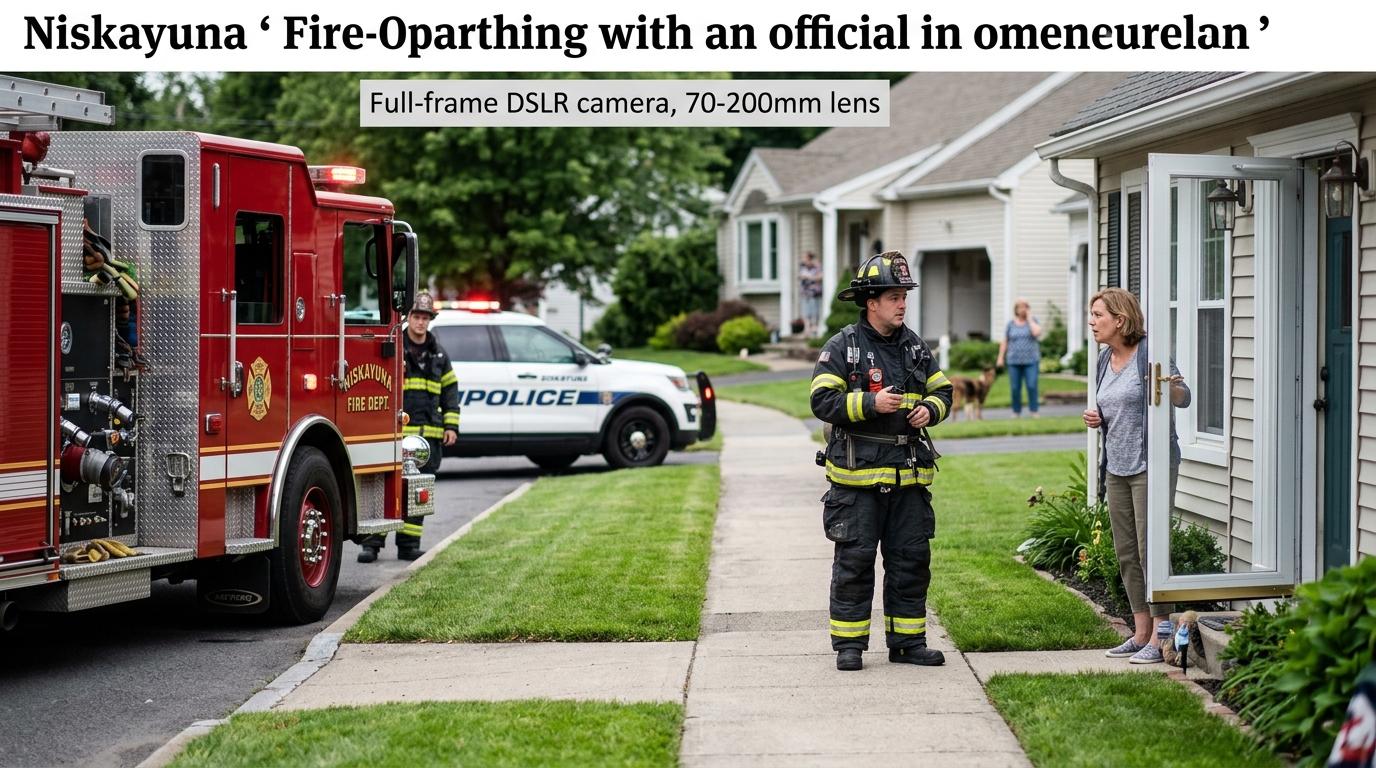
NISKAYUNA, N.Y. — A quiet suburban residence on Elmwood Drive was swarmed by emergency vehicles Thursday afternoon after local municipal algorithms flagged the property's absolute lack of household accidents as a statistically significant risk to city planning.
The Niskayuna Fire Department dispatched three ladder trucks, an auxiliary rescue vehicle, and a division chief to the home of Arthur and Evelyn Vance at 2:14 p.m. Responding personnel did not find smoke, flames, or medical crises, but rather a home that had failed to register a single emergency service call in forty-two consecutive months.
According to city documents, the Vance residence fell below the town’s mandated "Baseline Vulnerability Quota" of 1.2 minor domestic mishaps per fiscal year. This placed the home more than four standard deviations away from the regional average, triggering an automatic "Equilibrium Deployment" from the county’s predictive dispatch center.
"Our predictive resource models rely on a steady, predictable distribution of minor crises across all zip codes," said Fire Chief Marcus Vance, who is not related to the homeowners. "When a single household maintains a perfect safety record for over three years, it creates a statistical vacuum. If we do not intervene to correct these anomalies, it throws off our county-wide staffing projections for the next two fiscal cycles."
Upon arrival, firefighters established a perimeter and systematically assessed the property for potential hazards that could be officially logged. Finding none, the crew spent forty-five minutes gently destabilizing a backyard retaining wall and placing a slightly damp cardboard box within eighteen inches of the water heater to bring the home back into a healthy risk profile.
Arthur Vance, 64, a retired civil engineer, expressed confusion but ultimately cooperated with the emergency crews as they ran diagnostics on his perfectly functioning smoke detectors.
"They were very polite, but they insisted that my lack of a basement grease fire since 2012 was making the local precinct look over-funded," Vance said. "The captain told me that if I didn't let them report a 'near-miss electrical event,' the county might lose its federal grant for advanced thermal imaging cameras. So, we agreed they could chip a small corner off our drywall with a Halligan tool to justify the mileage."
Municipal data director Clara Higgins defended the dispatch, noting that absolute safety is a luxury that modern civic budgeting cannot accommodate.
"An address with zero incidents is, from an administrative standpoint, a ghost address," Higgins said. "It doesn't consume services, which means it cannot be optimized. By generating a controlled, low-impact incident, we ensure the Vance household remains integrated into our public safety models. It’s about maintaining a stable baseline of anxiety for the census tract."
By late afternoon, the department had successfully logged a "Code 42-B: Minor Mechanical Discrepancy" and departed, leaving the Vances with a yellow carbon-copy receipt and a slightly loosened bathroom pipe.
"We're just glad to have done our part for the community's data integrity," Arthur Vance said, watching the last engine turn the corner. "Next year, I think I'll leave a rake face-up in the yard just to keep the algorithms happy."