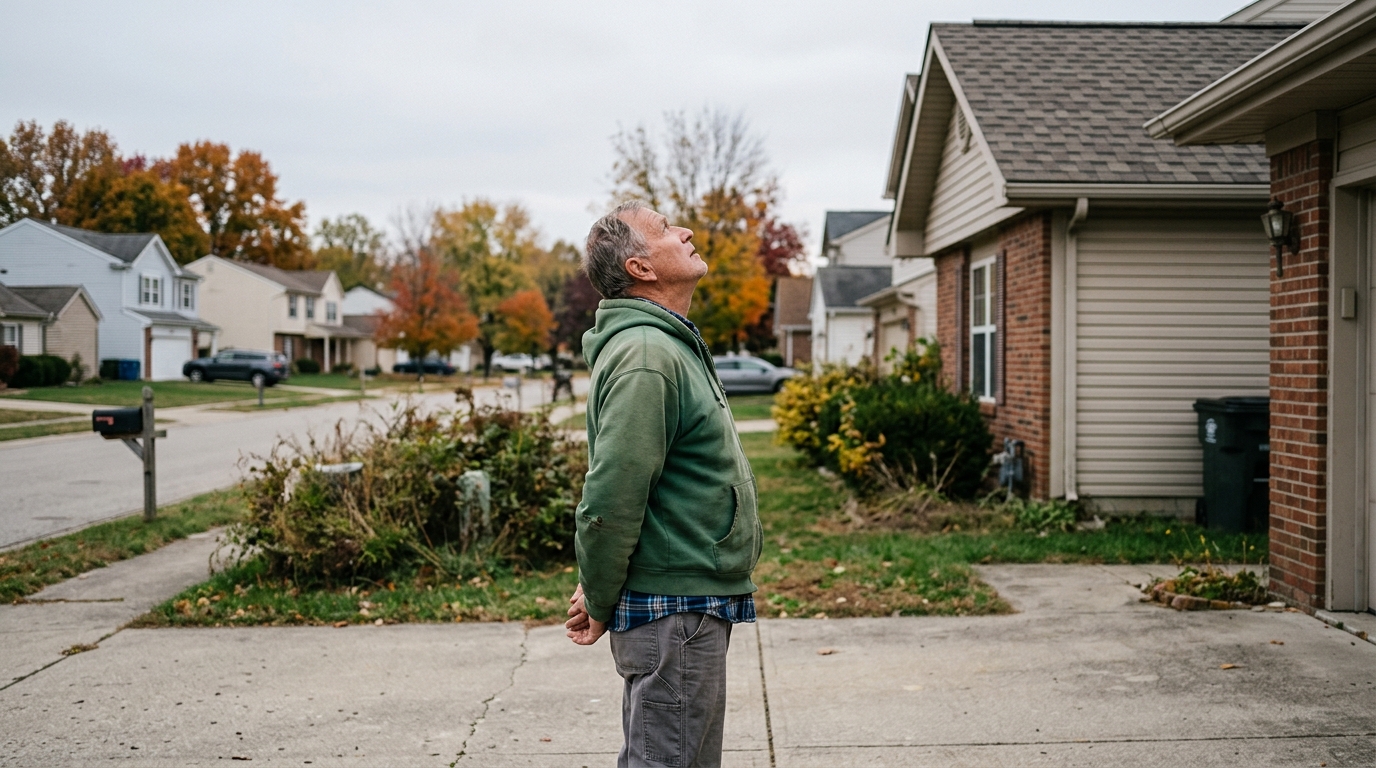
COLUMBUS, Ohio — Following a three-year, $4.2 million longitudinal study, the U.S. Census Bureau has officially designated "men standing at the edge of the driveway with their hands on their hips" as a distinct and statistically significant demographic subgroup.
The federal report, titled Suburban Spatial Occupancy and Stationary Domestic Observers, concluded that this population constitutes up to 14% of the head-of-household population in several Midwestern zip codes. To the researchers who analyzed satellite imagery and door-to-door survey data, the discovery represents a major breakthrough in micro-demographics. To the residents of the Oak Creek subdivision, it is merely an expensive confirmation of Greg.
"They spent three weeks tracking my husband with GPS collars and clipboard surveys," said resident Brenda Vance, 56. "I could have told them for free that if there is a truck idling within four blocks, Greg is going to walk to the end of the asphalt, put his knuckles on his lower back, and stare at it until it turns the corner."
According to the Census Bureau's criteria, a "Driveway Stationary Observer" (DSO) is defined as an individual who spends a minimum of 45 cumulative minutes per week standing at the absolute boundary where private concrete meets municipal asphalt. The classification requires the individual to face outward toward the street, maintain a posture of mild skepticism, and possess no active tools or immediate plans to leave the property.
Dr. Aris Thorne, the lead demographer on the study, defended the federal expenditure, noting that identifying such specialized cohorts is vital for modern municipal planning.
"For years, our modeling showed unexplained pockets of zero-velocity human activity in suburban cul-de-sacs," Dr. Thorne said. "We initially hypothesized these were delivery drivers waiting for signatures or perhaps highly localized micro-climates. But our field agents confirmed a highly organized, completely voluntary network of individuals who simply stand there, looking at the sky, the neighbor’s drainage ditch, or a passing utility van."
The report notes that DSOs exhibit highly predictable behavioral triggers. Approximately 82% of observed subjects transitioned to the driveway boundary within 90 seconds of hearing a neighbor start a two-stroke engine, while 91% engaged in a "slow head shake" if a vehicle traveled faster than 22 miles per hour.
Local officials are already assessing how to leverage the new federal designation for municipal funding.
"If the federal government is going to classify these guys as a recognized demographic, we hope to qualify for pedestrian safety grants," said City Council President Thomas Higgins. "Technically, they’re providing round-the-clock traffic monitoring. Last month, one of our recognized DSOs, Carl, stared at a pothole on Maple Street so consistently that three different teenagers slowed down to see what he was looking at."
Despite the academic excitement surrounding the report, local members of the newly minted demographic remain largely unimpressed by their sudden national visibility.
"I don't need a government booklet to tell me I’m standing here," said local resident Greg Vance, who was observed wearing cargo shorts and looking at a neighbor's chimney. "The wind was coming from the east, and Bob’s capstones look loose. If I’m not keeping an eye on it, who is?"