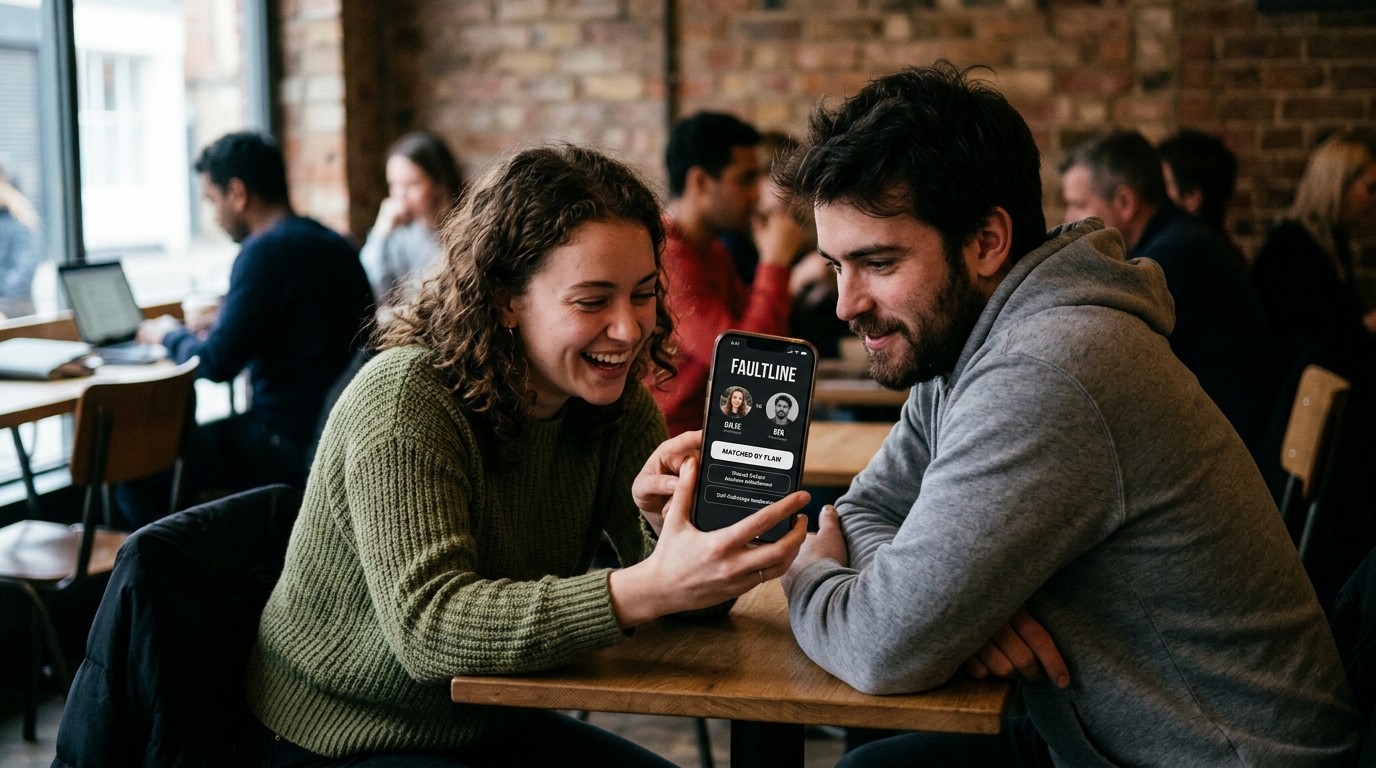
SAN FRANCISCO — A new mobile dating application is gaining rapid market share by abandoning traditional compatibility metrics in favor of matching users based entirely on their most toxic behavioral patterns.
The app, called Faultline, bypasses conventional prompts about favorite movies or travel destinations. Instead, new users must grant the platform read-access to their past five years of text messages, professional emails, and rideshare rating histories. A proprietary algorithm then analyzes this data to isolate the user’s single most disruptive personality defect, which is then used as the sole basis for pairing them with a complementary partner.
"Traditional dating apps are built on the lie that people are pleasant," said Dr. Jeanine Holloway, Faultline’s chief behavioral officer. "They match you on shared interests like hiking or artisanal cheese. But relationships don't end because you disagree on hiking. They end because one person is incapable of admitting they are lost, and the other expresses anger through weaponized silence. We simply optimize for those friction points from day one."
According to Holloway, the algorithm operates on a principle of "coordinated dysfunction." For example, a user flagged for "pathological over-explaining" is automatically paired with a user whose data shows "acute impatience with minor conversational lulls." Similarly, chronic non-responders are matched with individuals who exhibit anxious double-texting tendencies.
For Liam Henderson, a 29-year-old copywriter from Chicago, the approach has yielded the longest relationship of his adult life. Henderson was matched with his partner, Sarah, based on his "tendency to weaponize historical trivia during arguments" and her "inability to let any minor administrative error go uncorrected."
"On our first date, I misquoted the year the Suez Canal opened, and she corrected me before the waiter finished pouring our water," Henderson said. "It was incredibly liberating. Usually, you have to wait three to six months to reveal that you are a deeply annoying person. We got it out of the way before the appetizers arrived. We’ve been arguing about the layout of our shared Google Calendar for nine months now."
The platform's premium tier, Faultline Red, offers advanced filters that allow users to select for specific, high-intensity incompatibilities, such as "believes they possess a secret understanding of macroeconomic trends" or "uses baby talk when addressing pets but not partners."
Some industry analysts have raised concerns about the long-term psychological impact of the platform's matchmaking strategy. Dr. Keith Mercer, a relationship researcher at Northwestern University, warned that the app may be fostering highly stable, yet profoundly stressful, domestic partnerships.
"Faultline isn't necessarily creating happy couples," Mercer said. "It is creating couples who are so perfectly calibrated to trigger each other's specific neuroses that neither partner can ever find a logical exit point. It is a highly efficient way to guarantee a decade of mutual, low-grade resentment."
Despite these concerns, Faultline’s user base grew by 40 percent last quarter. The company recently announced plans to launch an enterprise version for corporate co-founders, designed to ensure that business partners remain locked in unproductive, defensive stalemates indefinitely.