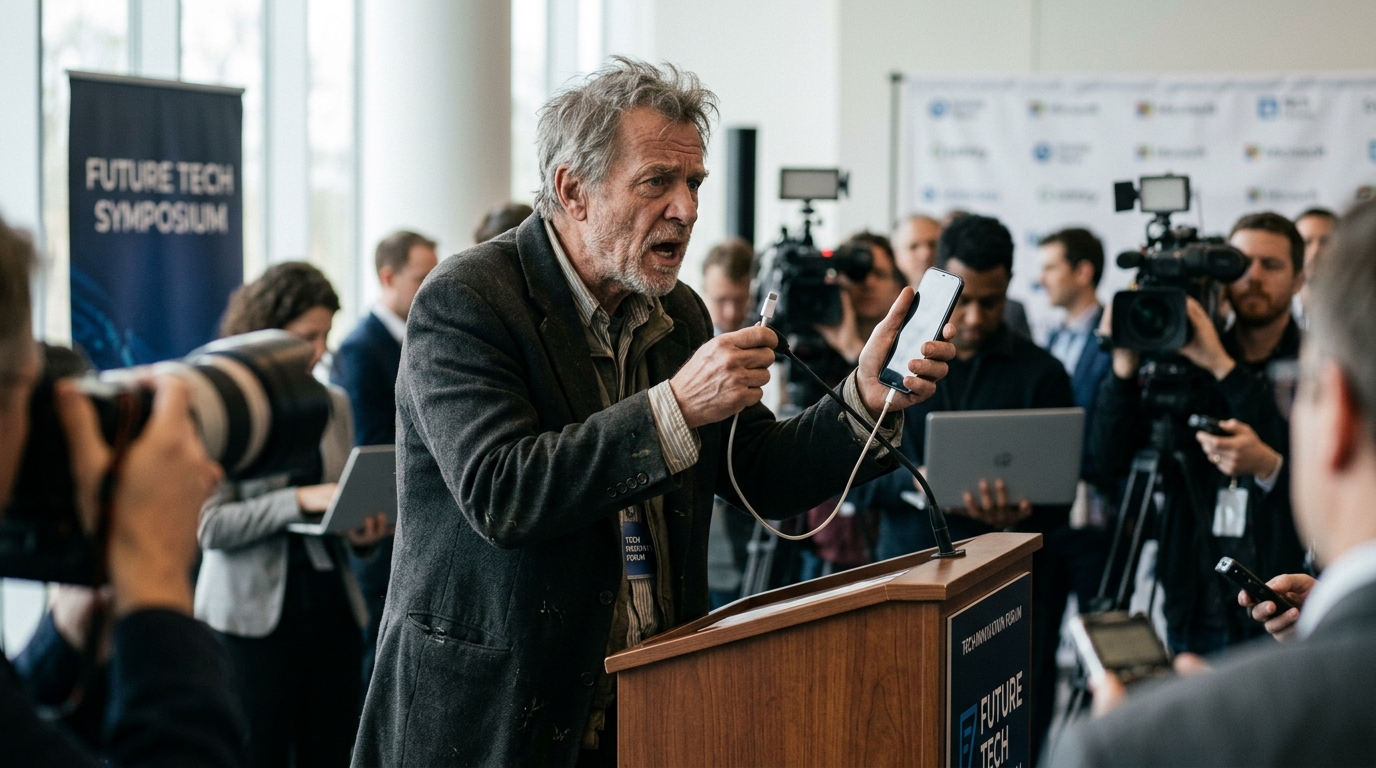
GENEVA — A historic breakthrough in temporal physics at the European Organization for Nuclear Research (CERN) was largely overshadowed on Friday when humanity’s first documented time traveler used his debut press conference to complain about the physical stability of 21st-century charging cables.
Dr. Marcus Vance, who successfully materialized in a custom-built containment chamber after traveling backward from the year 2091, reportedly cut short a presentation on the thermal dynamics of quantum displacement to address what he described as "the unacceptable lateral tolerance" of modern USB-C ports.
"I have spent the last three hours attempting to charge my temporal diagnostic unit," Vance told a room of bewildered physicists and journalists, holding up a standard six-foot braided nylon cable. "If I tilt the receiver even slightly to the left, the connection terminates. There is no tactile click. It is a mushy, speculative contact point that should have been phased out by the late 2010s."
According to observers, Vance refused to answer questions regarding the geopolitical landscape of the late 21st century, the status of global climate initiatives, or the outcome of future democratic elections. Instead, he spent twenty minutes demonstrating the cable’s loose fit on three different laptops provided by CERN staff, demanding to know if the global manufacturing sector was "in a state of active, collective denial."
"We solved the unified field theory in 2064," Vance said, sighing deeply as he repeatedly inserted and removed a metallic connector. "We harnessed gravity. Yet I come back thirty years and find that you people are living with a port geometry that relies entirely on friction and prayer. It is deeply embarrassing."
CERN administrators attempted to steer the conference back to the physics of the Chronos-4 aperture, highlighting the monumental energy required to bend space-time and the implications for modern quantum mechanics.
"Dr. Vance’s arrival is a triumph of human ingenuity," said Dr. Evelyn Carter, Director of the Chronos Initiative, during a tense exchange on the stage. "We have proven that information and matter can transcend linear time. While we understand his frustrations regarding consumer hardware standards, we had hoped to focus today’s discussion on the preservation of the temporal timeline."
However, Vance remained focused on the physical tolerances of contemporary electronics, noting that his primary data pad had repeatedly slipped into "slow charging" mode while resting undisturbed on a completely flat oak table. He further criticized the modern practice of placing charging ports on the bottom of wireless computer mice, calling it "an act of open, unprovoked hostility toward the end-user."
Before returning to his containment chamber to prepare for his return journey, Vance declined to share his data on subatomic particle stabilization, citing a lack of reliable power delivery in the facility.
"I brought the schematics for a clean, self-sustaining municipal fusion reactor on a flash drive," Vance said, packing his equipment into a pressurized metallic briefcase. "But the interface port on your main console is so compromised by microscopic pocket lint that the transfer kept timing out at forty-two percent. I am going home to a time where things stay plugged in."