WOODS HOLE, Mass. — The National Oceanic Research Consortium (NORC) announced Thursday the renewal of an $18.4 million grant for the Hadal Void Research Group, praising the team’s "unprecedented empirical consistency" after a four-month expedition to the bottom of the Kermadec Trench returned entirely devoid of scientific findings.
The crew of the research vessel Aegir returned to port last week following a 112-day mission to map a seven-mile-deep depression in the South Pacific. According to the expedition’s final report, the team’s deep-sea landers recorded no biological activity, collected no novel geological samples, and captured 2,400 hours of high-definition video consisting exclusively of suspended silt in pitch-black water.
Rather than viewing the lack of data as a setback, NORC officials commended the project for its rigorous preservation of the null hypothesis.
"Too often, deep-sea exploration is compromised by the disruptive presence of hydrothermal vents, bioluminescent organisms, or tectonic activity," said Dr. Aris Thorne, the lead oceanographer of the expedition. "Our mission achieved a state of pristine, uninterrupted sterility. We have successfully proven that there are vast portions of the Earth where absolutely nothing of note is occurring. That is a baseline we must defend."
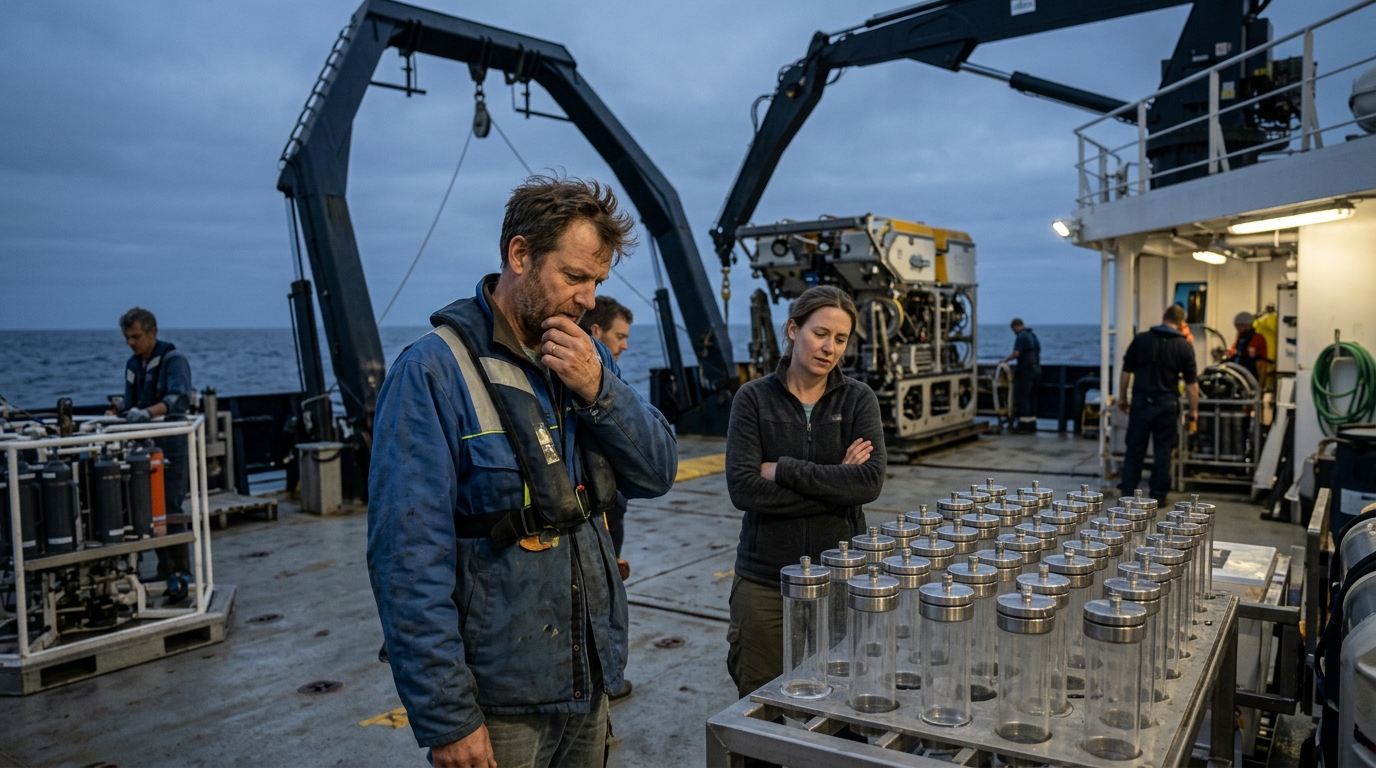
The centerpiece of the expedition’s return cargo was a suite of 48 specialized titanium pressurized canisters. Originally designed to harvest extremophile microbes, the canisters were brought to the surface containing only pressurized seawater of average salinity and no detectable organic material.
NORC’s grant review board voted unanimously to extend the funding through 2029, citing the high cost of maintaining equipment capable of recording such a thorough lack of phenomena.
"In the scientific funding landscape, there is a dangerous bias toward novelty," said Dr. Eleanor Vance, chair of the review committee. "If we only fund expeditions that find giant squids or volcanic gold, we ignore the vast, quiet majority of our planet. The Hadal Void team did not succumb to the temptation of discovery. They went down, they found nothing, and they had the integrity to report exactly that, day after day."
The renewed funding will allow the team to upgrade the Aegir's sonar arrays to high-resolution systems capable of detecting even smaller increments of nothing. The group also plans to purchase more advanced, vibration-dampened cameras to ensure that future footage of the deep-ocean floor is completely free of lens glare or mechanical interference that might be mistaken for a sign of life.
"Our goal for Phase II is total observational purity," Dr. Thorne said. "We want to reach a point where we can confidently guarantee that we are spending millions of dollars to look at absolutely nothing, with the highest possible fidelity."