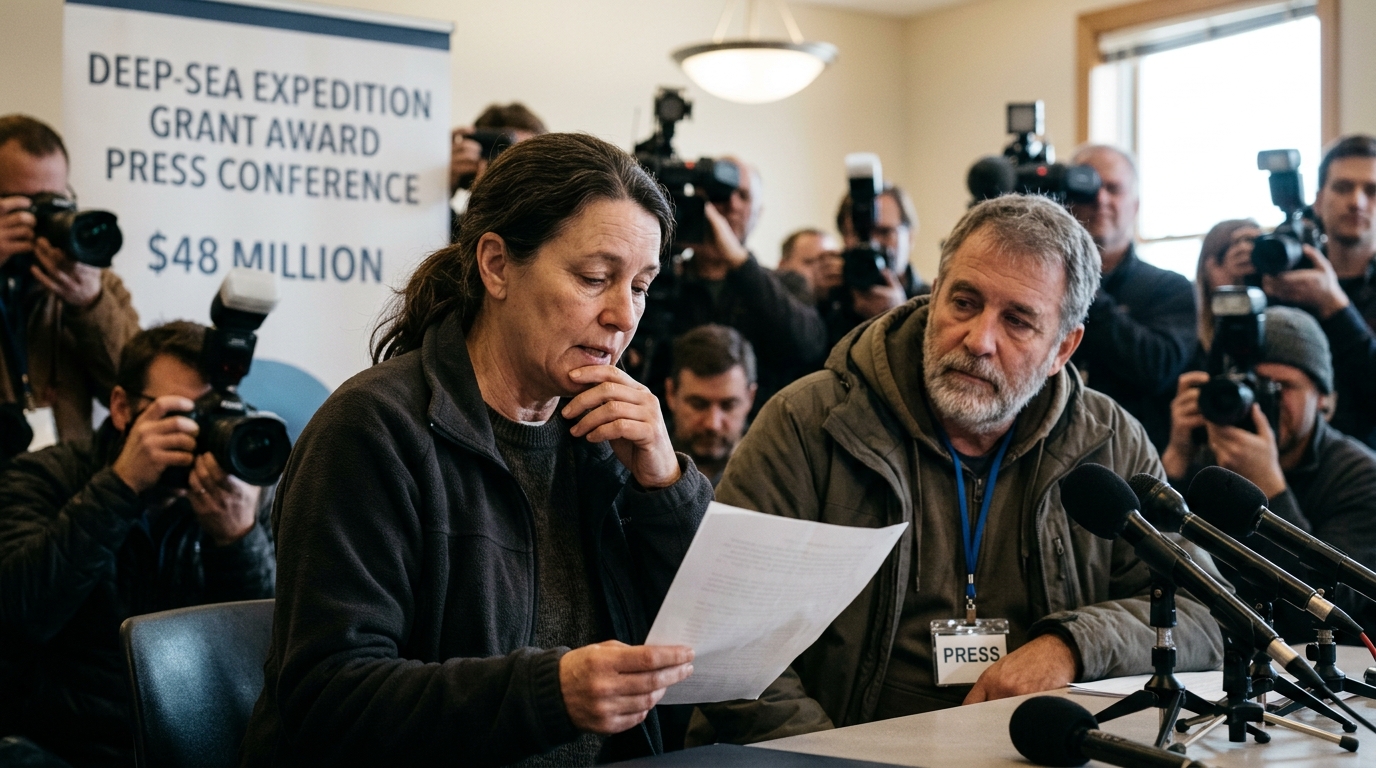
PORTLAND, Ore. — A deep-sea research expedition that returned from a four-month voyage with no biological specimens, geological samples, or unique oceanographic data has secured a $48 million grant renewal to continue its work.
The crew of the RV *Aethelgard* returned to port on Tuesday after exploring the Gorda Trench, a six-mile-deep fissure off the coast of Oregon. Armed with a state-of-the-art, dual-hulled autonomous submersible and a team of 14 marine biologists, the expedition was tasked with identifying novel extremophiles and mapping hydrothermal vents.
Instead, researchers reported encountering a uniform expanse of grey silt and dark, empty water. No new species were cataloged, no volcanic activity was recorded, and the ship’s deep-tow sonar arrays detected no structural anomalies along the trench floor.
"It was an incredibly consistent performance by the ocean," said Dr. Arthur Pendelton, the project’s lead oceanographer, during a press briefing. "Day after day, we lowered our high-definition cameras into the abyss, and day after day, we were met with a profound, unbroken absence of anything. We didn't even spot a plastic bag. It is a masterpiece of geological stagnation."
Rather than expressing disappointment, the Oceanic Funding Initiative (OFI), a federal science administration body, praised the expedition's "unparalleled baseline stability" and approved a four-year extension of the consortium’s funding. The new grant will allow Pendelton’s team to purchase more sensitive optical equipment to observe the nothingness with higher resolution.
Dr. Evelyn Chen, director of the OFI’s deep-sea division, defended the decision to award the highly competitive funds over rival projects, such as a study on bioluminescent migration patterns.
"In scientific research, proving that a specific place contains absolutely nothing of note is actually much harder than finding a giant squid," Chen said. "Anyone can drop a net and pull up a crab. But to spend $12 million of public funds and verify, with absolute statistical certainty, that there is nothing down there but wet mud—that requires a level of methodological discipline that we are proud to fund."
The consortium’s successful grant application highlighted the expedition's "zero-density biomass profiling" and "successful negative-result validation." According to the project’s final report, the team managed to collect over 400 hours of video footage depicting uninterrupted black water, which has already been archived in a federal database for further non-analysis.
With the renewed funding, the RV *Aethelgard* is scheduled to return to the Gorda Trench next spring. Dr. Pendelton expressed optimism that with the upgraded sonar systems, the team will be able to confirm that the emptiness extends even deeper into the sub-oceanic crust.
"There are still thousands of square miles of the trench floor that we haven't officially ignored yet," Pendelton said. "We look forward to not finding anything there, either."