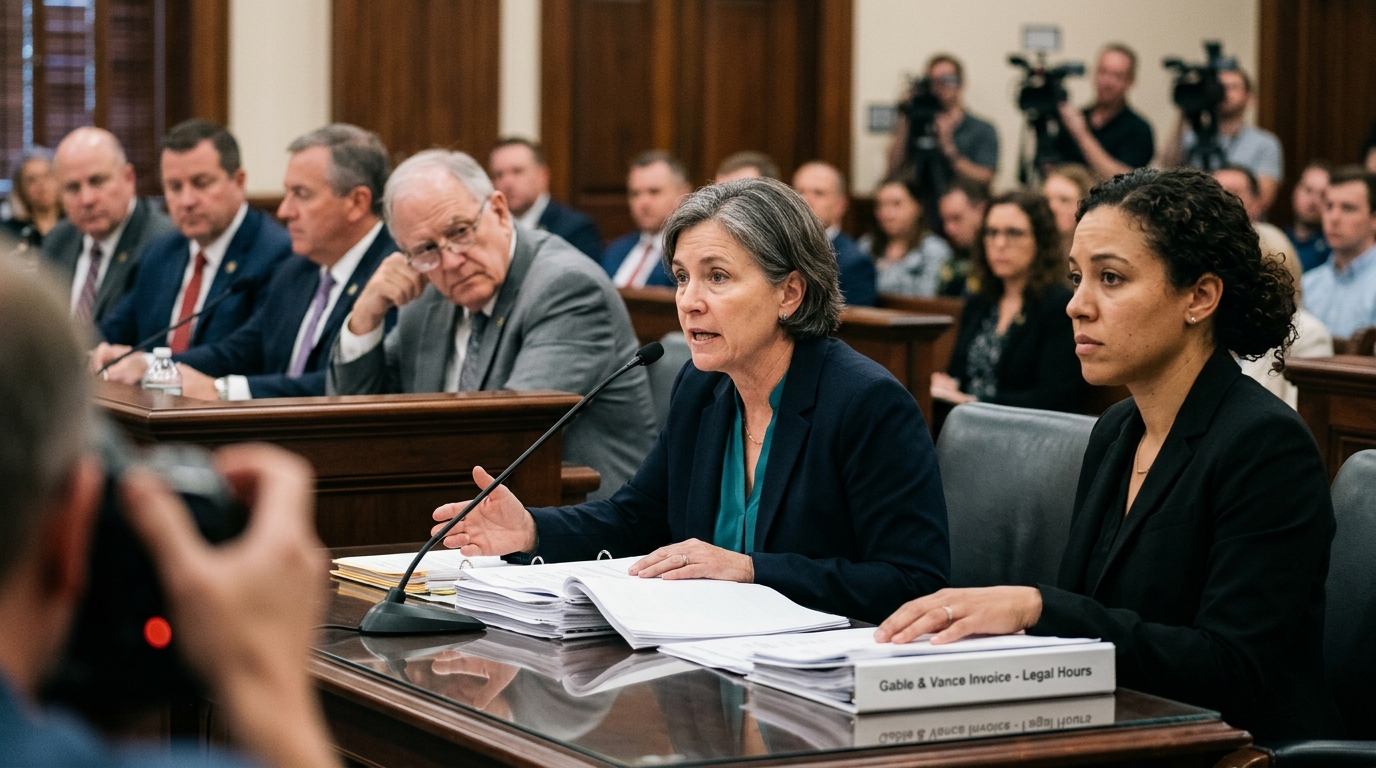
WILMINGTON, Del. — Delaware state officials on Friday defended an $8.4 million legal invoice from white-shoe law firm Gable & Vance, which includes more than 450 billable hours of "passive cognitive processing"—defined as attorneys thinking about the state’s landmark corporate tax dispute while commuting, showering, or staring out of windows.
The invoice, which covers the first quarter of the state’s defense of its franchise tax system, has drawn scrutiny from budget watchdogs for its introduction of "Cognitive Billing Units" (CBUs). Unlike traditional billable hours, which require active document review or courtroom appearances, CBUs allow attorneys to log time spent in "deep subconscious synthesis" regarding the state's litigation.
According to public records, the state was billed $1,200 per hour for senior partner Richard Gable’s "unstructured intellectual incubation," which occurred largely during a weekend golf tournament in Maryland.
"Legal strategy does not respect the boundaries of a Microsoft Word document," said Deputy Attorney General Marcus Vance, speaking at a press conference in Dover. "If Mr. Gable has a breakthrough regarding Delaware’s sovereign immunity while stuck in traffic on Interstate 95, that is intellectual property being generated for the benefit of the taxpayers. To demand that he only think while his fingers are moving across a keyboard is to misunderstand the nature of high-stakes jurisprudence."
Under the terms of the state's contract with Gable & Vance, attorneys utilize a self-reported "Cognitive Log" to track mental energy directed toward the state’s case. The system categorizes mental labor into three tiers: Active Analytical Drafting, Passive Conceptual Sifting, and Involuntary Nocturnal Processing.
The latter tier, billed at a discounted "off-peak" rate of $450 per hour, accounts for $612,000 of the total invoice. Invoice line items include "38 minutes of pre-dawn rumination on appellate venue options" and "14 minutes of sudden conceptual clarity during a spin class."
"We have implemented rigorous internal controls to ensure these hours are legitimate," said Sarah Jenkins, a spokesperson for Gable & Vance. "Our associates are trained to distinguish between general personal anxiety and case-specific cognitive friction. If an associate is lying awake at 3:00 a.m. worrying about their mortgage, that is unbillable. If they are worrying about Subchapter S corporations, that is a billable asset."
Jenkins added that the firm’s proprietary billing software, MindShare, uses "probabilistic modeling" to discount time spent on parallel thoughts, such as wondering if the oven was left on or planning a grocery list, which are automatically docked from the final invoice.
Legislative critics have questioned how the state plans to verify the mental activities of the thirteen attorneys assigned to the case. State Representative David Cho called for an independent audit of the firm's cognitive logs, noting that one junior associate billed 84 hours of "background thematic integration" in a single week alongside 60 hours of traditional research.
"We are being asked to trust that a 26-year-old law graduate spent his entire Sunday family dinner thinking about Delaware's corporate filing fees," Cho said. "We cannot run a state budget on the honor system of a lawyer's subconscious."
In response to the criticism, the Attorney General’s office announced it has commissioned a third-party administrative consulting firm to review the invoice. The consulting firm, which specializes in professional service optimization, bills at a flat rate of $950 per hour, plus a 15% surcharge for "deep listening."