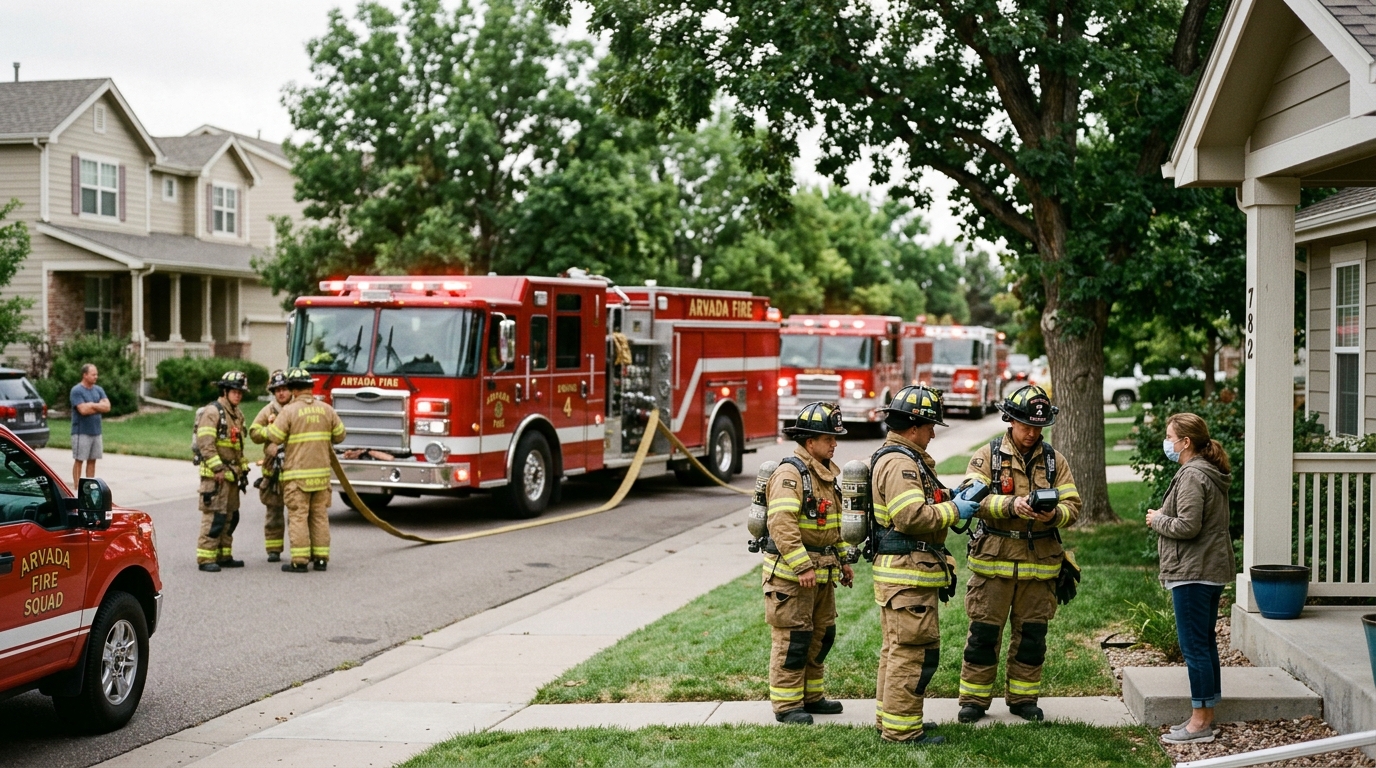
CHERRY HILLS, Colo. — A quiet suburban cul-de-sac was temporarily evacuated on Tuesday afternoon after the Cherry Hills Fire Department dispatched three engine companies and a hazardous materials unit to resolve a statistically significant drop in a local home’s vegetable crisper humidity.
The response, which began at 2:14 p.m., was triggered automatically by the city’s predictive municipal management platform, CivicaNet. According to public records, the smart-grid sensors at the residence of Arthur and Eleanor Vance detected a 4.2% decline in relative humidity within their refrigerator’s lower drawer—a variance that crossed the threshold of three standard deviations from the neighborhood’s historical baseline.
Under Cherry Hills Municipal Code 14-A, any localized data deviation classified as "statistically significant at the 99% confidence interval" requires immediate physical remediation to protect the municipality's predictive safety rating.
"Our mission is no longer just putting out active fires, but actively suppressing statistical anomalies before they can manifest as real-world inconveniences," said Cherry Hills Fire Chief Ronald Mercer, speaking from a mobile command unit parked on the Vances' lawn. "A 4.2% drop in crisper moisture is a clear mathematical outlier. If left unchecked, that level of dryness could theoretically skew our district's quarterly efficiency reports by up to two decimal points."
Upon arriving at the scene, firefighters established a 100-yard perimeter, deployed two dry-chemical hoses, and entered the residence. Finding no smoke or flames, the crew located the appliance, opened the drawer, and successfully misted a head of romaine lettuce with a standard spray bottle until local humidity sensors returned to an acceptable municipal average.
The Vances, who were watching television when the emergency responders breached their entryway, expressed confusion regarding the scale of the response.
"They were very polite, but they wouldn't let us near the kitchen," Arthur Vance, 62, said. "One of the technicians kept telling me that my celery was threatening the integrity of the county's predictive modeling. I offered to just splash some tap water on it myself, but they said unauthorized civilian stabilization could invalidate the entire afternoon's data set."
The incident has highlighted the growing reliance on automated preventative dispatch systems across suburban Colorado. Proponents of the technology argue that by treating data anomalies as active emergencies, municipalities can prevent actual crises before they occur.
"Traditional emergency services are reactive—they wait for things to burn," said Dr. Sarah Jenkins, a senior analyst at the Institute for Algorithmic Governance. "CivicaNet allows us to treat probability itself as the hazard. A perfectly flat, predictable data line is the safest environment possible, even if it requires the occasional tactical entry to moisten produce."
By 3:30 p.m., the Vance household had been declared statistically stable, and the neighborhood perimeter was dismantled. According to the department's post-incident report, the operation successfully averted a potential 0.004% fluctuation in the regional wellness index.
"It was a textbook run," Chief Mercer said. "We returned the property to the homeowners in a state of absolute mathematical neutrality."