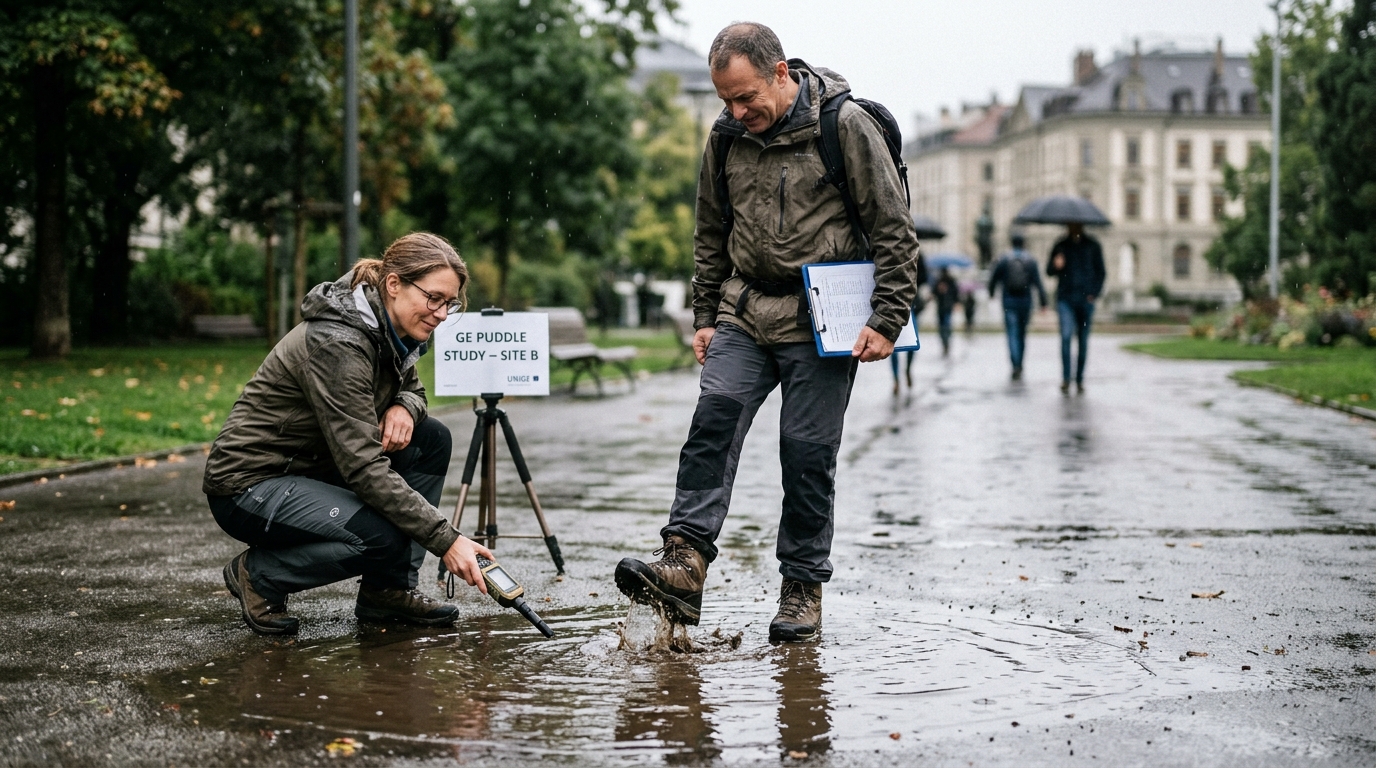
GENEVA — A landmark, 12-year study by the European Association for Hydrological Behavioralism has officially confirmed that stepping directly into a municipal puddle results in immediate, statistically significant sock dampness.
The €18.4 million project, which tracked more than 14,000 participants across six continents, sought to establish a rigorous mathematical framework for what researchers have termed the Saturated Footwear Threshold (SFT). Published this week in the *International Journal of Everyday Fluid Dynamics*, the 800-page report concludes that the transition from a dry sock to a wet sock occurs almost entirely during the period of physical contact with standing water.
"Until now, the scientific community relied almost exclusively on localized, self-reported data regarding puddle-to-shoe interactions," said Dr. Elena Rostova, lead author of the study and director of liquid dynamics at the Zurich Institute of Technology. "By isolating variables such as knit density and puddle depth, we have proven objectively that water does, in fact, penetrate standard cotton footwear when submerged. It is no longer a matter of opinion."
To conduct the trials, researchers constructed a state-of-the-art "precipitation simulation corridor" in Geneva. Participants wearing standard canvas sneakers and white athletic socks were instructed to step into simulated rainwater accumulations of varying depths. High-speed thermal imaging and moisture-sensing electrodes confirmed that 99.8% of subjects experienced what the report classifies as "the Squish Event"—the precise moment the cotton fiber loses its structural dryness and begins to squelch.
The study’s findings have already sent ripples through the international academic community. Dr. Marcus Vance, a professor of biomechanical physics at the University of Edinburgh who was not involved in the study, praised the paper's uncompromising precision.
"We have long suspected a causal relationship between stepping in water and having wet feet," Vance said. "But to see it mapped out on a molecular level, with clear graphs illustrating the rapid escalation of discomfort over a ten-minute walk post-immersion, is truly breathtaking. This changes how we conceptualize the ground."
Despite the study’s success, some critics within the global scientific community have questioned the scope of the findings, pointing out that the research focused primarily on puddles between two and four centimeters deep.
In response, the European Association for Hydrological Behavioralism has already applied for a secondary €12 million grant to study the effects of stepping on wet grass, as well as the potential dampness variables of wool-blend blends.
"We must be careful not to extrapolate these results to morning dew," Rostova warned. "Until we have the funding to observe grass-based moisture dynamics under laboratory conditions, we advise the public to treat all damp lawns with extreme analytical suspicion."