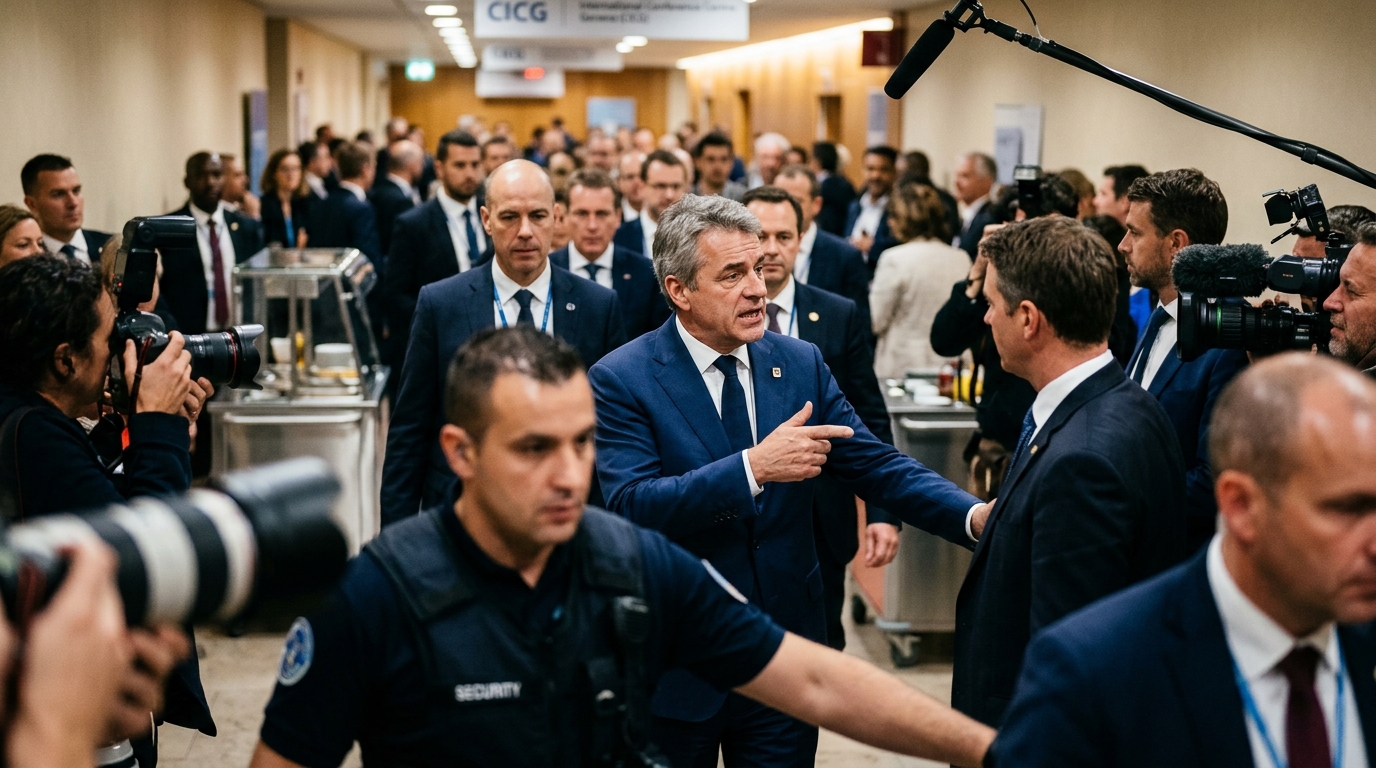
GENEVA — International trade negotiations aimed at stabilizing Western European shipping corridors collapsed in Geneva on Thursday after delegates failed to resolve a three-day dispute regarding the physical layout of the conference center’s lunch buffet.
The breakdown of the Western European Transit Treaty (WETT), a $14.2 billion framework six years in the making, occurred not over maritime tariffs or labor standards, but rather the spatial arrangement of a condiment station during Tuesday’s working lunch.
According to sources present in the negotiation room, the French delegation issued a formal "point of order" when it was observed that a jar of traditional Dijon mustard had been placed on the same ceramic serving tray as a jar of German sweet mustard, with no physical barrier separating them. The delegation argued that the lack of a "demilitarized buffer zone" between the two spreads tacitly implied a unified European agricultural market that had not yet been negotiated under Article 12 of the draft treaty.
"It is a matter of administrative sovereignty," said Marc Laurent, a senior trade attaché who spoke on the condition of anonymity to protect his diplomatic standing. "To place these two distinct culinary traditions on a single, shared plate is to preemptively ratify a customs union that our parliament has explicitly rejected. We cannot negotiate under the shadow of a forced gastronomic merger."
In response, the German delegation proposed a "Two-Sauce Solution," which would have established separate, geographically isolated tables for regional condiments. However, this proposal was immediately vetoed by the Austrian delegation, who noted that the exclusion of horseradish from the primary tables violated the summit's commitment to landlocked-nation visibility.
By Wednesday morning, the actual treaty negotiations had been entirely suspended. The 400-member plenary body instead formed an ad-hoc Working Group on Tabletop Topography. The group spent fourteen hours debating whether a bowl of mixed olives constituted a joint venture or a series of independent national entities.
"We made genuine concessions," said Birgitta Nilsson, Undersecretary for Nordic Trade, who attempted to broker a compromise. "We offered to transition entirely to individual, single-use ramekins to preserve national boundaries. Unfortunately, the environmental subcommittee intervened, noting that the increased dishwashing cycle would violate the 2024 carbon reduction mandates. The situation became structurally untenable."
The summit officially dissolved at 4:00 p.m. on Thursday after a final, failed vote on the "Draft Memorandum on Salad Dressing Equivalence," which sought to establish a fixed ratio of vinaigrette to creamy Italian options.
As delegations began checking out of their hotels, the International Secretariat expressed regret over the outcome but defended the necessity of the process.
"Diplomacy is built on the precise alignment of details, both on the map and on the table," said Secretariat spokesperson Jean-Paul Vane. "If we cannot agree on the shared custody of a pepper mill, we cannot realistically expect to manage the North Sea shipping lanes."
The treaty negotiations are not expected to resume until autumn of 2028, at which point organizers have confirmed that all future summit meals will consist of pre-packaged, identical nutrition bars.