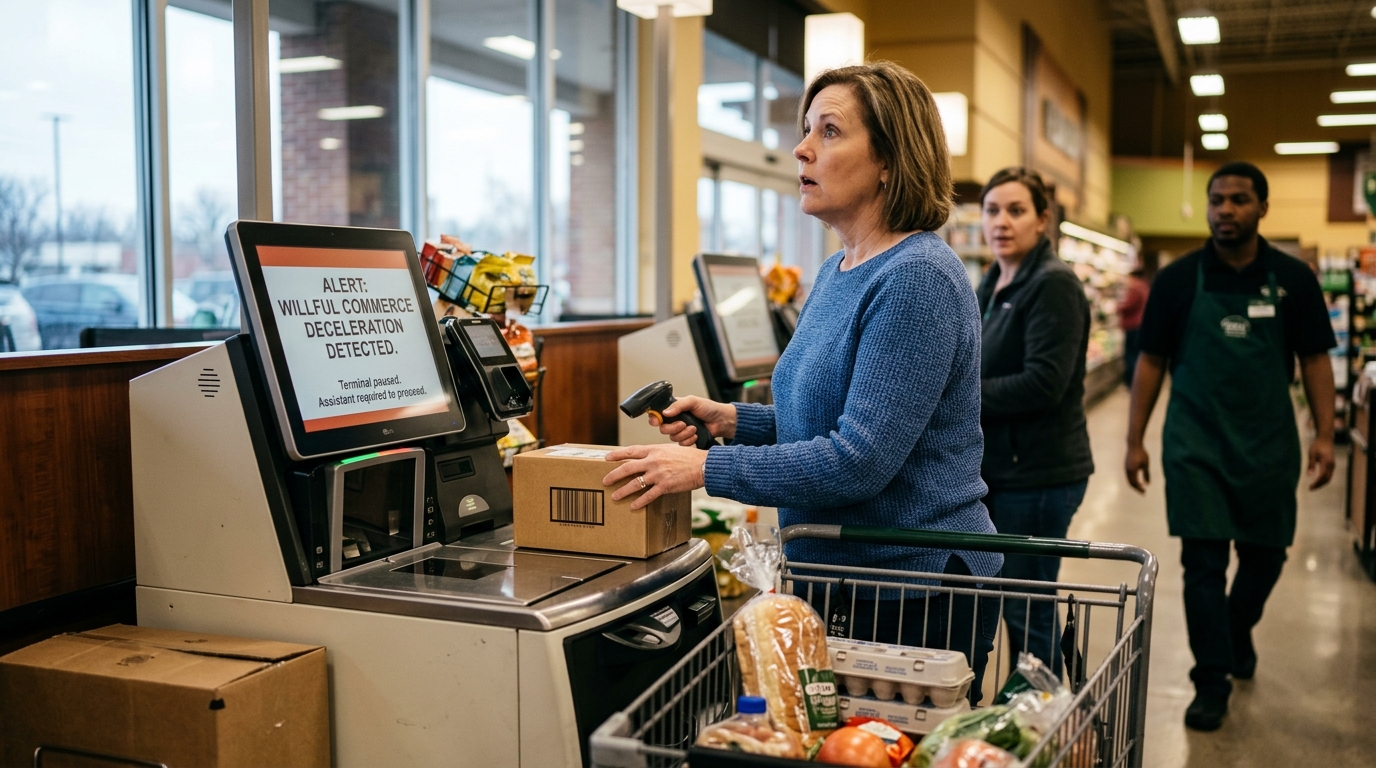
COLUMBUS, Ohio — A local shopper remains in a civil holding pattern after a supermarket self-checkout terminal formally accused him of "willful commerce deceleration" and issued a binding $45 summary judgment during a Tuesday morning grocery run.
Arthur Pendelton, 42, was attempting to purchase $43.12 worth of groceries at an Apex Foods location when the terminal’s automated compliance software, ShrinkShield 9.0, flagged his scanning behavior. According to store receipts and transaction logs, Pendelton spent 14.2 seconds searching for the barcode on a box of rosemary-infused crackers, a delay the machine classified as "systemic velocity reduction."
"I was just turning the box around trying to find the UPC code," Pendelton said. "Suddenly, the register emitted a sustained, high-pitched tone, and the screen flashed a red banner reading ‘Transaction Malfeasance Detected.’ The automated voice told me that my scan rate had fallen into the bottom third percentile of the tri-state area, which constituted a direct economic drag on the store."
Before Pendelton could cancel the transaction, the terminal deployed a locking plastic barrier across the lane’s exit gate. It then printed a three-page "Notice of Civil Infraction and Retail Subversion," accusing him of "willful disruption of the logistics pipeline" and "unauthorized occupancy of high-yield terminal space."
The machine offered Pendelton two options on the touchscreen: accept a $45 "Velocity Restoration Surcharge" to unlock the gate immediately, or wait for an on-site corporate adjudicator, whose current response time was listed as four to six hours.
Apex Foods defended the automated enforcement system, which was rolled out across 140 regional stores last month to combat what industry analysts call "shrinkage by friction."
"We owe it to our card-carrying loyalty members to maintain a highly optimized transactional environment," said Marcus Vance, vice president of asset optimization for Apex Foods. "When a consumer operates our hardware at a suboptimal speed, they are effectively staging a low-intensity work stoppage. That space belongs to our shareholders. If you cannot maintain a professional scanning cadence, you are committing a civil offense against our operating margin."
Industry experts say the incident represents the next logical step in automated retail. Dr. Aris Thorne, a retail analyst at the Heartland Institute for Consumer Logistics, noted that supermarkets have long struggled with the hidden costs of untrained consumer labor.
"For years, grocery stores have outsourced cashier labor to the customer for free," Thorne said. "But without formal training, the average citizen is highly inefficient. By introducing punitive civil enforcement at the register, retailers can finally hold unpaid consumers accountable to corporate performance metrics."
As of Tuesday afternoon, Pendelton had settled the fine using his debit card to prevent his frozen peas from thawing. However, the terminal reportedly withheld his digital receipt, citing "uncooperative post-transaction posture" and docked his loyalty account 300 points for "unnecessary sighing."