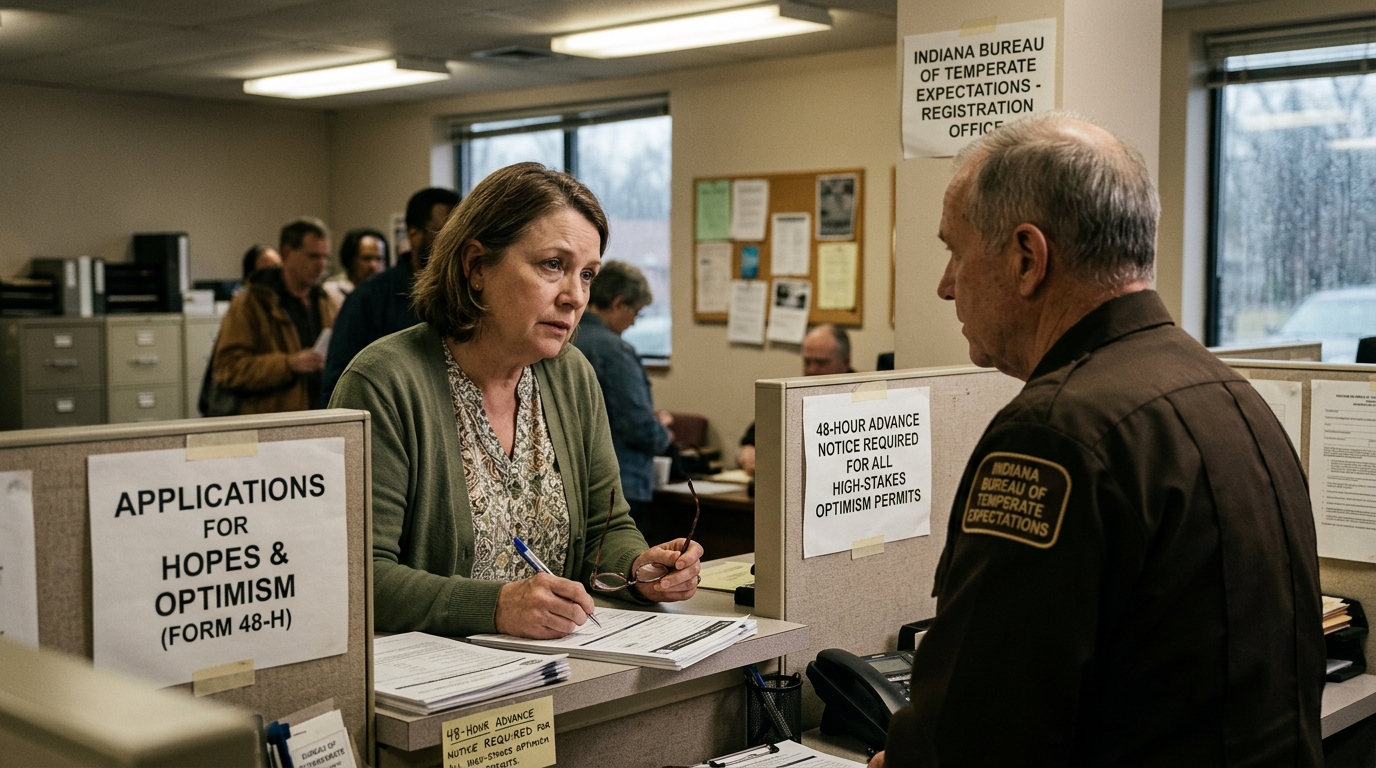
INDIANAPOLIS — The Indiana Bureau of Temperate Expectations (BTE) began full enforcement of its new municipal permitting guidelines on Thursday, requiring state residents to formally register any "significant optimism" regarding personal, athletic, or meteorological outcomes at least 48 business hours in advance.
The policy, which stems from the state’s 2025 Emotional Risk Mitigation Act, aims to stabilize the local economy by regulating the high-volume spikes in collective disappointment that frequently follow local sports losses, unseasonal rainfall, and unsuccessful job interviews. Under the new rules, any resident harboring a hope with a statistically verified probability of success lower than 58 percent must file a Form 109-H, also known as the Notice of Intent to Hope.
"Unregulated optimism is a silent drain on our public infrastructure," said Harvey Vance, Deputy Director of the BTE, during a press conference at the Statehouse. "When thousands of citizens simultaneously hope for a dry weekend or a sudden promotion without an approved mitigation plan, the subsequent emotional crash strains our municipal productivity. By requiring a permit, we ensure that the state's residents are maintaining a fiscally responsible level of expectations."
To obtain a permit, applicants must submit their desired outcome alongside a comprehensive "Disappointment Abatement Strategy." For instance, a resident hoping to successfully grow heirloom beefsteak tomatoes in clay soil must list at least three acceptable alternative outcomes, such as purchasing store-bought vine tomatoes or accepting that some summers are simply damp and unproductive.
The BTE evaluates applications using the Subjective Expectancy Index (SEI), a proprietary algorithm that weighs a resident's historical resilience against the statistical likelihood of their desired event. Those deemed to have "insufficient emotional capital" to absorb a negative outcome are routinely denied permits, or are issued conditional variances that require them to actively expect the worst.
Clara Higgins, a 54-year-old administrative assistant from Muncie, recently had her Form 109-H rejected ahead of her son’s outdoor wedding. Higgins had hoped for clear skies despite a National Weather Service forecast predicting a 45 percent chance of scattered thunderstorms.
"The bureau told me my hope profile was dangerously leveraged," Higgins said, holding a copy of her denied application, which was stamped with a red "EXCESSIVE EXPECTATION" marker. "They said that if it rained and I hadn't properly budgeted my disappointment, I might experience a sudden drop in domestic labor output. They offered me a temporary permit on the condition that I spent two hours a day visualizing the tent collapsing in a mudslide."
While some civil liberties advocates have questioned the state's authority to regulate internal emotional states, municipal risk analysts have defended the program as a necessary evolutionary step in public resource management.
"We regulate water usage during droughts and we regulate parking spaces during festivals," said Dr. Evelyn Thorne, a behavioral economist at Purdue University. "It is only logical that we regulate hope, which is perhaps our most volatile natural resource. When a community collectively hopes for a miracle—such as the Indianapolis Colts winning a postseason game with a backup quarterback—and that hope fails to materialize, the immediate drop in workplace enthusiasm costs the state an estimated $4.2 million in lost administrative hours."
Thorne noted that since the pilot program launched in Tippecanoe County last fall, local grocery stores reported a 14 percent decrease in impulse comfort-food purchases, which state officials attribute to a more stable, thoroughly managed populace.
To police compliance, the BTE has deployed a team of field auditors who monitor local online community boards, sports bars, and gardening clubs for signs of unlicensed optimism. Under the statute, expressing "unmitigated expectancy" in a public forum without an active permit can result in a civil infraction and a mandatory three-week assignment to a Reality Calibration Seminar.
Local business owners have already begun adjusting to the new regulatory environment. In downtown Indianapolis, several restaurants have updated their menus to include federally compliant descriptions. At one popular diner, the "World-Famous Sourdough Pancakes" have been rebranded as the "Statistically Consistent Griddle Cakes (Form 109-Exempt)."
"It takes the pressure off," said diner manager Marcus Gentry. "Before the permits, people would come in expecting the best meal of their lives, and if the syrup was a little cold, their whole Tuesday was ruined. Now, they look at the menu, they see the state-approved disclaimer about average batter density, and they leave feeling perfectly neutral. It’s much easier to manage."
As of Thursday afternoon, the BTE's online portal was experiencing minor delays due to a high volume of filings from residents hoping the website’s server would load faster. State officials warned that hoping for a technological resolution without filing a physical paper bypass form constituted a Class C administrative violation, carrying a fine of up to $150.