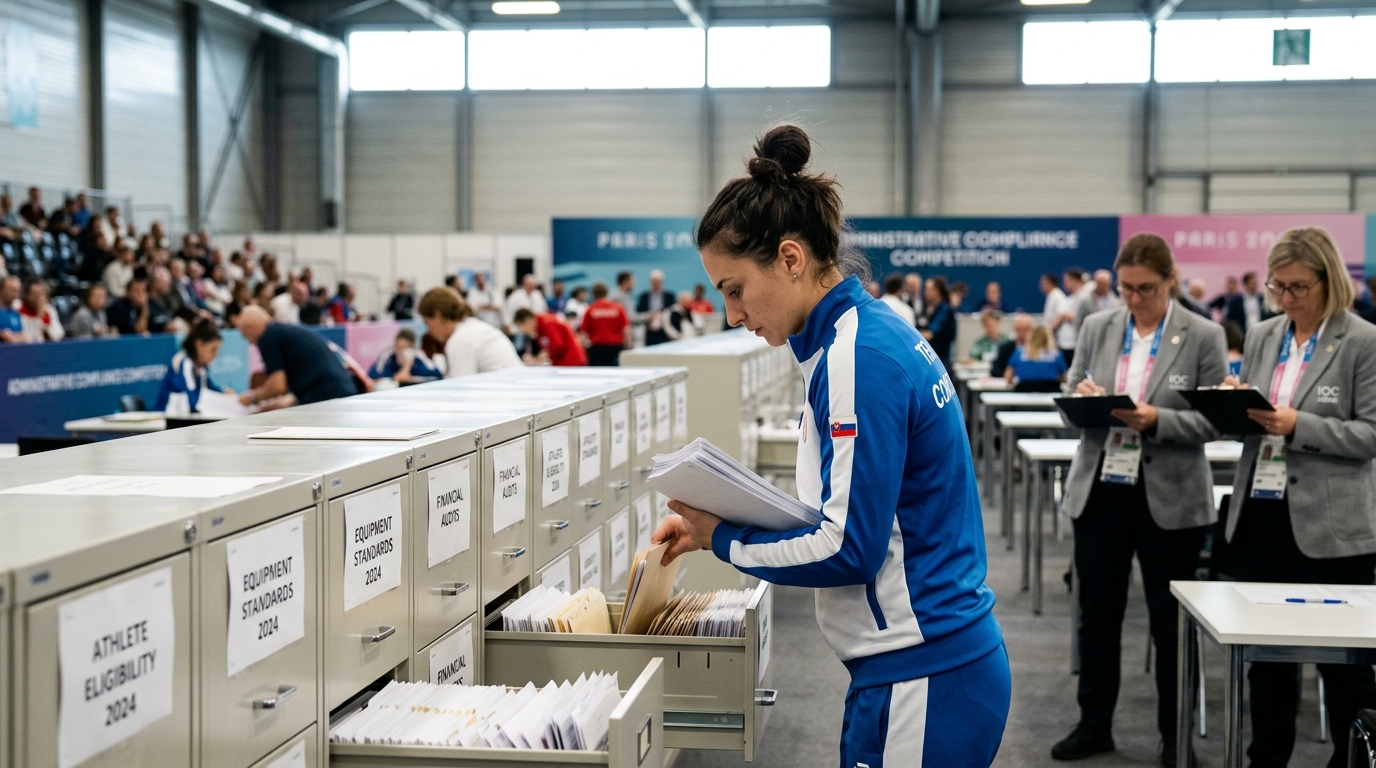
LAUSANNE, Switzerland — The International Olympic Committee (IOC) announced Monday that "Administrative Compliance" has been officially added to the roster of medal events for the upcoming Olympic Games. The sport, which will debut as a mixed-gender discipline, tests competitors on their speed, accuracy, and endurance when executing high-volume regulatory filings under intense psychological pressure.
According to the newly released Olympic Rulebook for Administrative Compliance, the event will consist of four distinct phases: the Triplicate Sprint, the Notary Freestyle, the Blind Margin Alignment, and the 10,000-word Appeal of a Denied Appeal. Competitors will be required to wear standard business-casual attire, with penalties assessed for untucked collars, unauthorized ergonomic wrist rests, or the use of non-regulation blue ballpoint pens.
"For over a century, the Olympic movement has celebrated the physical capabilities of the human body," said Jean-Luc Meraux, director of the IOC’s Department of Bureaucratic Integration. "But we have long ignored the quiet heroism of those who manage the paper trail that makes those physical feats legally permissible. To process 400 pages of visa waivers, venue permits, and medical disclosures without a single ink smudge requires an elite level of cognitive focus that easily rivals the marathon."
The sport’s judging panel will consist of seven retired administrative law judges and senior compliance officers. Scoring will be based on a points-deduction system similar to gymnastics. A perfect score of 10.0 is achievable only by presenting a flawless dossier with perfectly centered rubber stamps. Deductions will be strictly enforced: a misaligned staple carries a 0.2-point penalty, while a missing middle initial on a secondary disclosure form results in immediate disqualification.
National training facilities are already adapting to the new discipline. In Colorado Springs, USA Administrative Compliance has constructed a state-of-the-art mock federal office building where athletes train in low-light conditions to simulate late-night filing deadlines.
"The physical toll is real," said Marcus Vance, a top-ranked American competitor specializing in the Triplicate Sprint. "We’re talking about severe carpal tunnel threats, chronic paper cuts, and the mental fatigue of reading municipal zoning laws for six hours straight. If you lose focus for one second and check a box instead of initialing it, four years of training go down the drain."
Anti-doping regulations for the event will be notoriously stringent. Competitors will be screened not only for traditional performance-enhancing drugs, but also for unauthorized blue-light-blocking glasses and prescription eye drops, which are classified by the committee as mechanical vision aids.
The IOC confirmed that the gold, silver, and bronze medals for the event will not be awarded on a physical podium. Instead, winners will receive a certified digital notification of achievement, delivered via an automated email system within 60 to 90 business days.