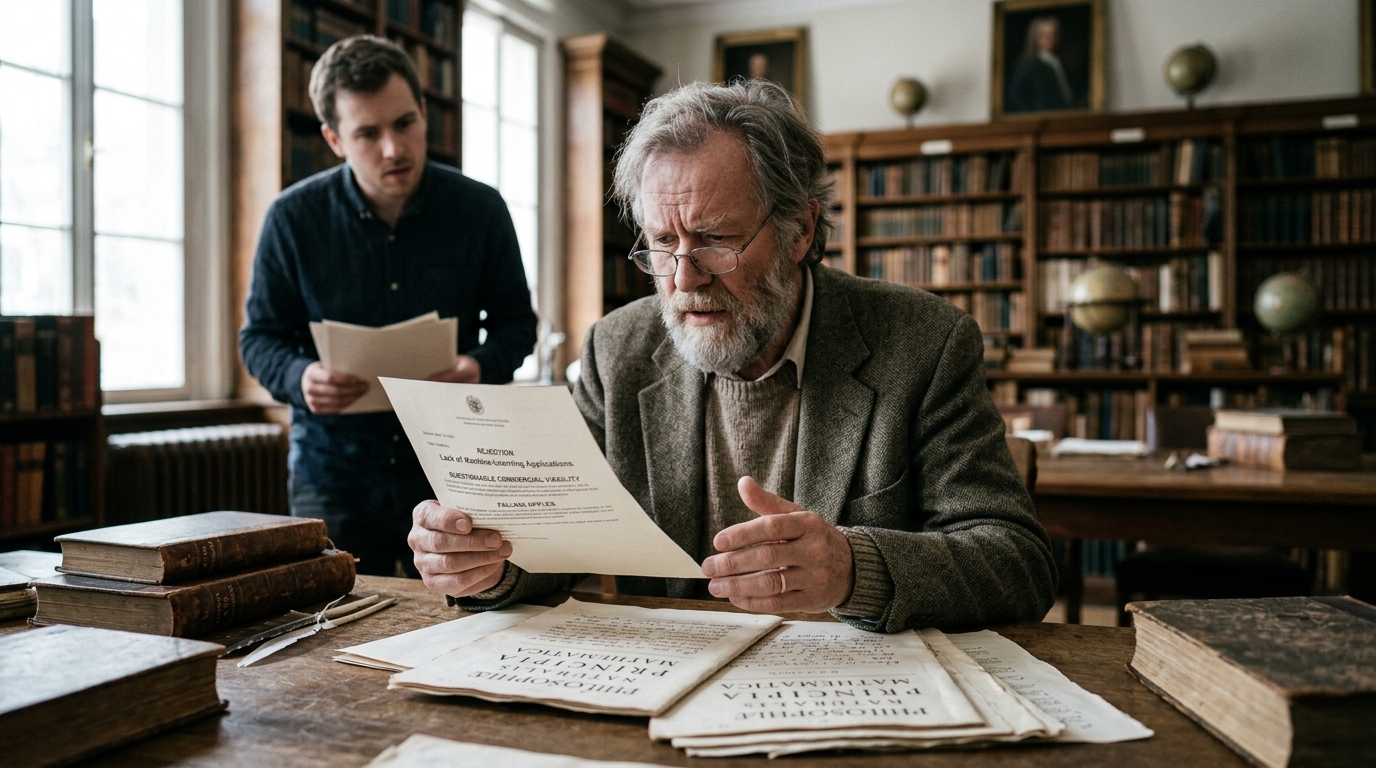
CAMBRIDGE, England — A major breakthrough in the field of classical mechanics has been put on indefinite hold after the Journal of Applied Physical Systems returned Sir Isaac Newton’s manuscript on universal gravitation, citing a lack of contemporary relevance and failure to address machine-learning frameworks.
Newton, 383, who currently serves as a fellow at Trinity College, expressed frustration after his 40-page treatise, "Philosophiae Naturalis Principia Mathematica," was flagged for "major revisions" by a three-member peer-review panel.
According to correspondence leaked from the department, the peer reviewers praised the manuscript’s mathematical rigor but questioned the real-world utility of a force that operates on all matter without a subscription model.
"While the author’s 'inverse-square law' is elegant in its simplicity, the manuscript fails to outline how this 'gravity' can be monetized or scaled to meet the needs of modern logistics providers," wrote Reviewer 2, an anonymous associate professor of data systems at the Munich Institute of Technology. "Furthermore, the author relies heavily on physical experimentation with a single apple. In 2026, we expect to see these hypotheses validated through a synthetic dataset of at least ten million virtual apples."
The panel also requested that Newton cite 14 unrelated papers on blockchain-enabled agricultural tracking, several of which were written by Reviewer 2.
University administrators have urged Newton to comply with the feedback to secure the department’s funding for the upcoming fiscal year. Under current British research council guidelines, academic departments must demonstrate the "immediate economic impact" of all theoretical discoveries within 18 months of publication.
"We are very excited about Isaac’s work on the cosmos, but the funding environment has evolved since the 17th century," said Dr. Evelyn Vance, director of research commercialization at Cambridge. "You cannot simply declare that a force holds the moon in orbit and expect a taxpayer-funded grant. We need to know: Can this force be optimized for a cloud-computing environment? Is there a mobile application?"
Newton reportedly spent the last three weeks attempting to modify his second law of motion—which states that force equals mass times acceleration ($F=ma$)—to include a variable for cloud latency. Friends of the physicist say the process has taken a toll on his disposition.
"I told them the force is universal, constant, and governs the very motion of the celestial bodies," Newton said in a brief statement outside the Cavendish Laboratory. "They asked if the celestial bodies could be tracked using a dashboard with real-time push notifications. I do not know what a dashboard is. I am an alchemist."
Despite the setback, Cambridge’s development office remains optimistic that Newton’s research can be salvaged. A workshop has been scheduled for next Tuesday to help the physicist rebrand his theory of gravitation as "Decentralized Downward Mass Acceleration" (DDMA) in hopes of securing a partnership with an electric vehicle manufacturer.