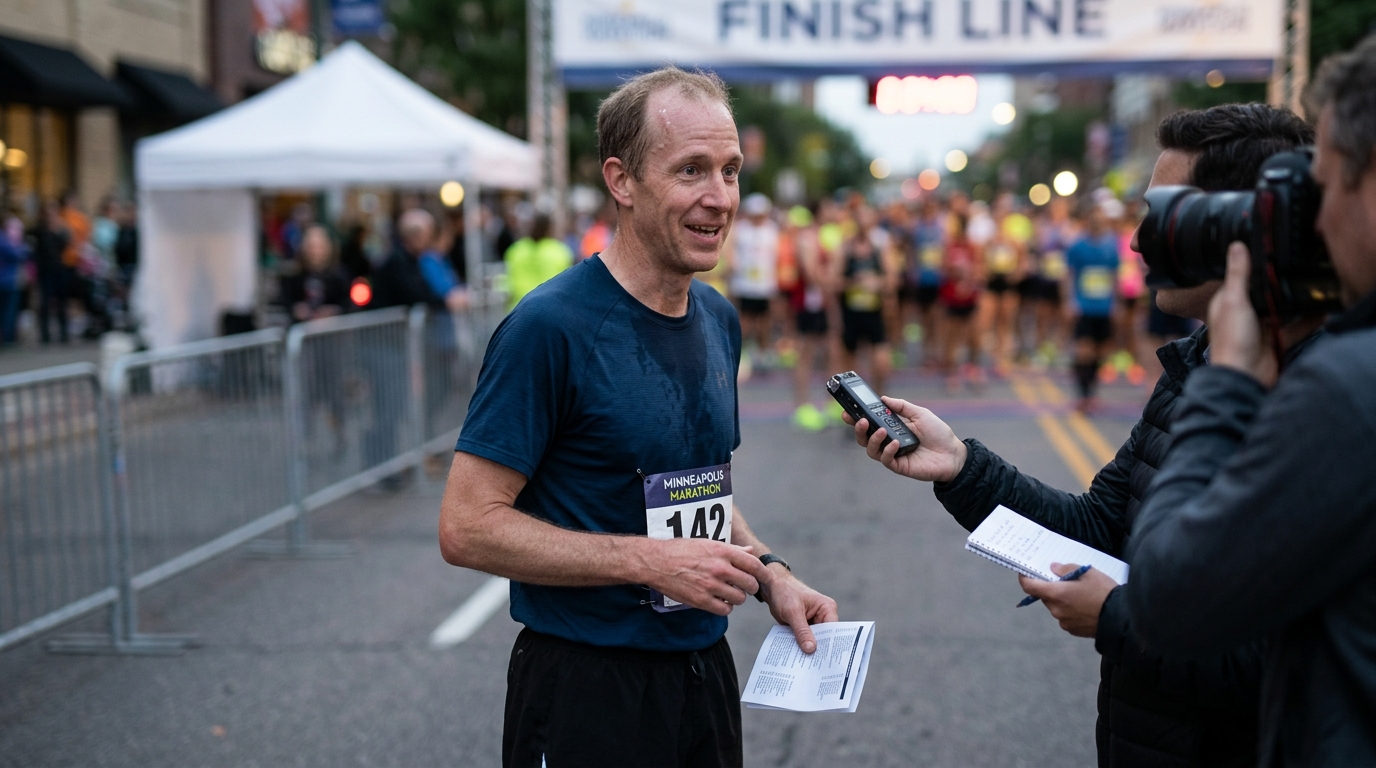
MINNEAPOLIS — Local human resources coordinator Arthur Pendelton was declared the official winner of the 42nd annual Twin Cities Marathon on Saturday, despite crossing the finish line more than three hours after the lead pack, following a sweeping metadata audit by race organizers.
Bernard Kiprop of Kenya, who crossed the finish line first with a course-record time of 2:08:12, was disqualified along with 140 other elite and amateur runners. The mass disqualifications stemmed not from performance-enhancing drugs or course cutting, but from a failure to comply with the race’s digital pre-registration guidelines.
According to the Twin Cities Road Runners Association, Section 14.b of the updated competitor agreement required all participants to upload a "Pre-Race Hydration and Metabolic Self-Attestation" form directly to the event's registration portal. The rules specified that the document must be submitted as a native .HEIC image file with active EXIF location metadata enabled, proving the document was signed within five miles of the runner's registered training address.
"We sympathize with Mr. Kiprop and the other elite athletes, but athletic performance cannot excuse administrative non-compliance," said Marcus Vance, president of the Twin Cities Road Runners Association. "The modern marathon is a multi-dimensional event. It begins at the keyboard, and our safety protocols are non-negotiable. If we overlook a file-format error, we jeopardize our entire liability insurance structure."
Pendelton, 39, who completed the 26.2-mile course in 5 hours, 14 minutes, and 42 seconds while wearing a gray cotton t-shirt and carrying a handheld water bottle, was the first runner to successfully cross the finish line with a fully compliant digital footprint.
"I work in corporate compliance, so I always read the technical appendices of terms-of-service agreements," Pendelton said, holding the winner's trophy. "I noticed the portal was quietly rejecting standard PDFs, so I just took a live photo of my signed paper form on my phone and uploaded it with location services set to 'Always Allow.' I didn't think it would be my most competitive attribute today, but you have to play to your strengths."
The verification process took nearly six hours, during which three independent digital forensic auditors reviewed the submission histories of the top 150 finishers. Kiprop was disqualified because his agent had uploaded a compressed JPEG from a desktop computer in Nairobi, which stripped the necessary geotags. Other top finishers were eliminated for submitting scanned documents that lacked active timestamp metadata.
"It is devastating," said Elena Rostova, who completed the women’s division in 2:24:05 but was disqualified because her upload was flagged as a PNG. "I spent four months training in the mountains of Colorado. I didn't realize my phone's default screenshot export settings would be the deciding factor."
The $15,000 first-place prize was awarded to Pendelton in a quiet ceremony at dusk next to an empty medical tent.
Organizers confirmed that for the 2027 race, competitors will be required to complete a two-factor authentication prompt via SMS at the Mile 18 water station to verify they are still the original registrant.