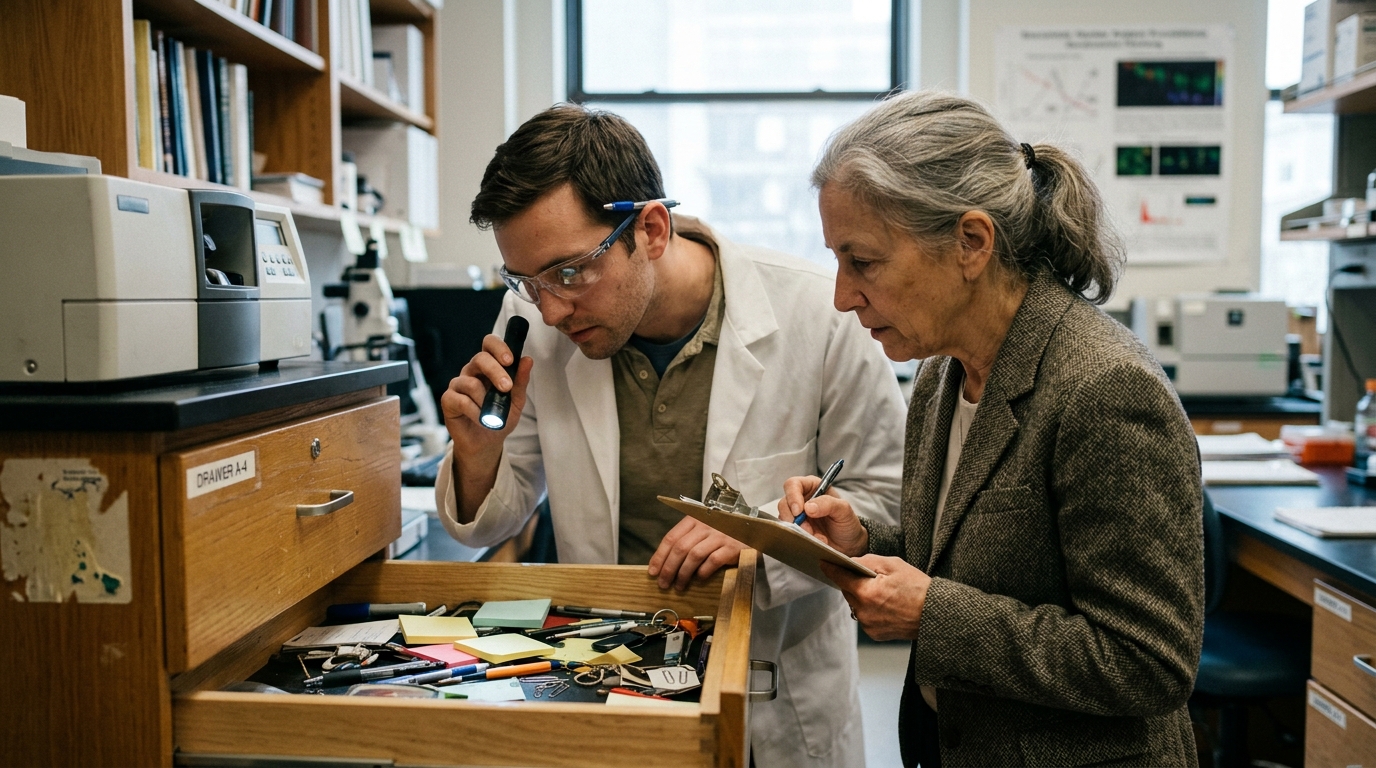
BOSTON — Researchers at the Massachusetts Institute of Technology announced Wednesday the conclusion of a landmark five-year study confirming that household objects placed inside a closed drawer remain in that exact drawer until a human physically opens it and takes them out.
The study, published in the Journal of Applied Spatial Dynamics, monitored 412 dressers, nightstands, and kitchen cabinets across three states. Using fiber-optic micro-cameras, infrared motion sensors, and continuous weight-variance scales, scientists tracked the behavior of everyday items—such as keys, spare batteries, and garlic presses—when left completely unobserved.
"For decades, the scientific community has operated under informal assumptions regarding drawer contents," said Dr. Aris Thorne, lead author of the study and chair of the Department of Macro-Spatial Mechanics at MIT. "While laypeople have long assumed that a pair of scissors remains in the utility drawer when the drawer is closed, we lacked the rigorous, empirical data to rule out localized quantum displacement or spontaneous domestic evaporation. Now, we can say with 99.8% statistical confidence: it is still in there."
The project, funded by a $14.2 million grant from the National Science Foundation, sought to resolve the "Cabinet Paradox"—the persistent human belief that missing items must have vanished into a parallel dimension rather than simply being pushed to the back behind some napkins.
To conduct the research, Thorne’s team engineered a custom "Smart Dresser" equipped with high-resolution internal LiDAR. Over a 36-month observation period, the dresser’s top drawer was opened and closed 12,000 times. In 100% of trials where a blue ballpoint pen was placed in the drawer and the drawer was closed, the blue ballpoint pen was still present when the drawer was reopened.
"The data is remarkably consistent," said Dr. Helen Vance, a cognitive physicist at the University of Chicago who was not involved in the study. "Even when we accounted for variables like humidity, seasonal temperature shifts, and household members claiming they 'didn't touch it,' the items did not move. It turns out that a drawer is simply a wooden box that slides. When you close it, the wood continues to exist, and so does the spoon."
The study's findings are expected to have massive implications for the fields of cognitive psychology and home organization, effectively debunking the popular "Out of Sight, Out of Reality" model of domestic storage.
However, the research team noted several limitations. While the study confirms that objects do not move on their own, it did not address why finding a specific roll of Scotch tape still requires rummaging through the drawer for up to four minutes despite knowing it is there.
"That is the next frontier," Dr. Thorne said, adjusting his glasses. "We are currently applying for an $8 million grant to study why the item you are looking for is always at the very bottom beneath things you don't remember buying."