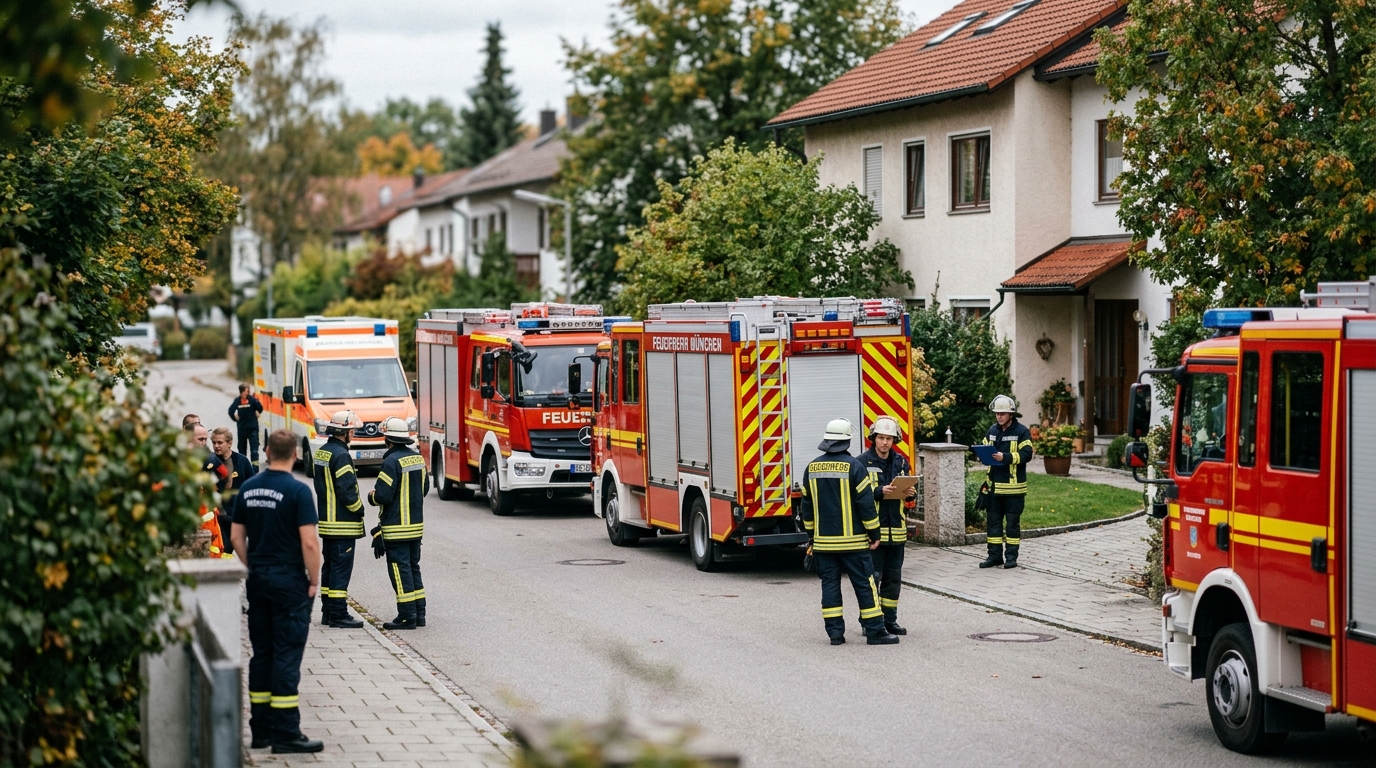
MUNICH — The Munich Fire Department dispatched three fire engines, an emergency rescue vehicle, and an aerial ladder truck to a quiet residential driveway in the suburb of Bogenhausen on Tuesday morning, resolving what municipal analysts later classified as a critical threat to the city’s quarterly data symmetry.
The high-priority deployment, which involved 18 active-duty firefighters, was not triggered by smoke, gas, or structural collapse, but by a 0.04-second deviation in the city’s rolling average response times.
According to municipal records, the Bavarian Department of Municipal Logistics ordered the dispatch at 9:14 a.m. after predictive algorithms warned that the week's unusually low emergency rate was threatening to flatten the department's mandated Gaussian distribution curve. Without an immediate, controlled mid-tier response, the city risked losing its "AAA" statistical predictability rating from European municipal auditors.
"An emergency service cannot simply react to events as they occur; that is a 19th-century methodology," said Dr. Helmut Vance, Chief Data Officer for the Munich Metropolitan Area. "If our response times are too fast because nothing is burning, the algorithm begins to anticipate a state of absolute safety, which causes the insurance algorithms to fluctuate. By placing four emergency vehicles on a completely dry, vacant driveway for exactly 11 minutes and 42 seconds, we restored our standard deviation to a healthy, predictable norm."
Upon arriving at the scene, firefighters did not unpack hoses or deploy ladders. Instead, they stood in a highly organized semi-circle on the lawn of resident Brigitte Weber, occasionally checking their digital clipboards and calibrating their pressure gauges against the ambient air temperature.
Weber, 54, said she was weeding her flowerbeds when the convoy arrived with full sirens blaring.
"The chief came up to me very politely and asked if he could park on my curb to offset a regional data deficit," Weber said. "I asked if they wanted to come inside for tea, but he explained that consuming warm liquids during a statistical calibration event would introduce an unweighted variable into the regional moisture index. So they just stood there until a buzzer went off on their tablets, got back in their trucks, and drove away."
The Munich deployment highlights a growing trend among highly optimized European smart cities, where municipal resources are increasingly deployed to manage the health of the data itself rather than physical infrastructure.
"We are very pleased with the outcome," Vance added, noting that the Bogenhausen deployment successfully brought the city’s weekly coefficient of variation back to a stable 1.42. "Had we not intervened, we would have been forced to stage a controlled three-car collision on the Autobahn next Thursday just to keep the regional transportation models from thinking the population had abandoned driving entirely."