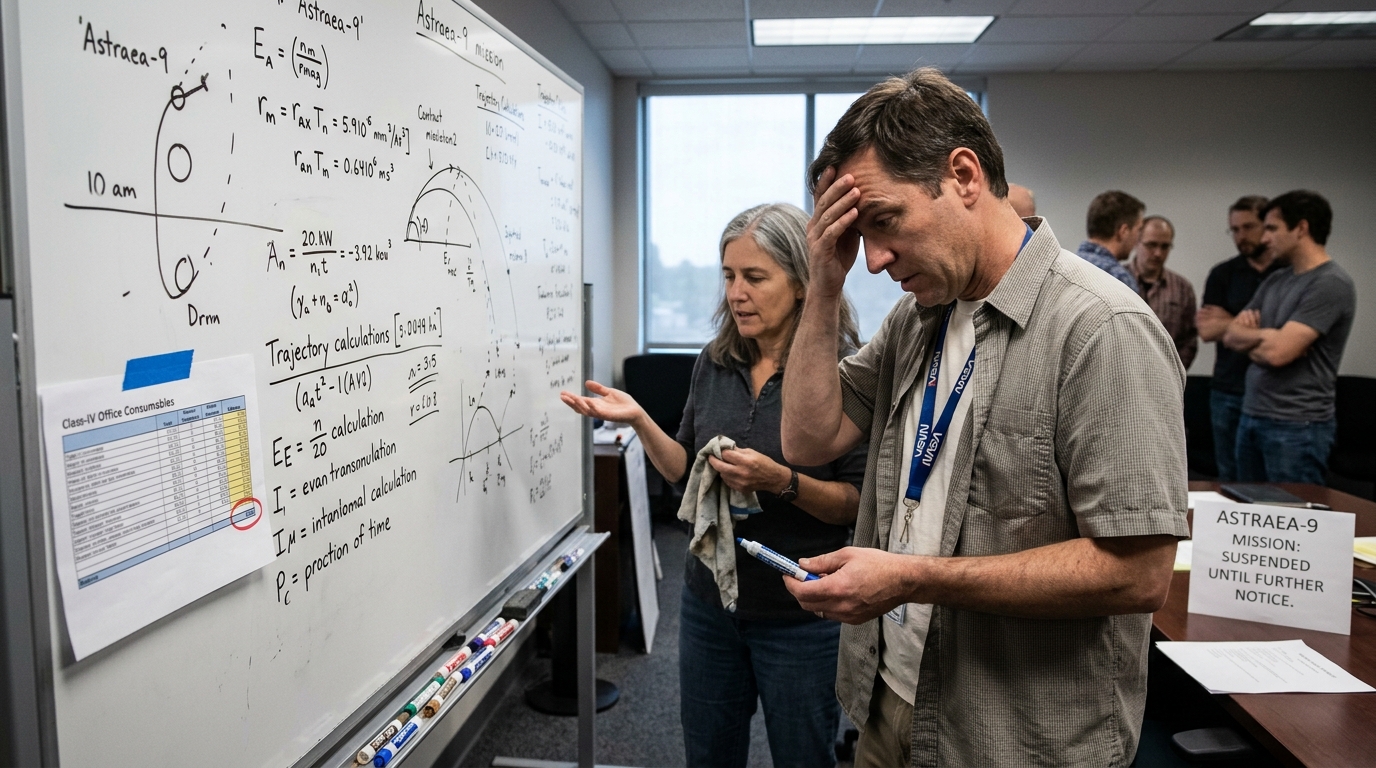
GREENBELT, Md. — NASA officials announced Friday the indefinite suspension of the Astraea-9 asteroid sample return mission, citing a critical and mathematically insurmountable deficit in the project's $1,200 annual office supply budget.
The $2.4 billion spacecraft, which was scheduled to launch next spring to intercept and harvest soil samples from the carbonaceous asteroid 162173 Ryugu, is currently sitting in a cleanroom in Maryland. Meanwhile, the mission’s propulsion, navigation, and deep-space telemetry teams have been barred from holding planning sessions because they have exhausted their allotted supply of fine-tip dry-erase markers and 3x3-inch yellow adhesive notes.
According to agency documents, the crisis began in late June when the trajectory design team ran out of blue markers while mapping the spacecraft’s complex three-body gravity assist around Mars. Under Subchapter C of the Federal Acquisition Regulation (FAR), funds earmarked for "Deep Space Solid-Fuel Propulsion" or "Titanium Hull Fabrication" cannot be legally reallocated to "Category 4 General Office Consumables."
"We looked into every available avenue, but the regulatory firewall between the $400 million propulsion fund and the administrative supply fund is absolute," said Dr. Aris Thorne, Astraea-9 mission director. "By mid-July, we were down to a single, fraying green chisel-tip marker that required three researchers to hold it at a specific 45-degree angle to produce a legible line. You simply cannot calculate orbital insertion vectors under those conditions."
An attempt by a junior systems engineer to resolve the crisis by bringing a personal 12-pack of multicolored markers from home reportedly triggered an immediate internal compliance audit. The markers were confiscated by Goddard Space Flight Center security officers because non-certified commercial writing instruments do not comply with ISO Class 5 cleanroom standards regarding outgassing and micro-particulate shedding.
NASA Headquarters defended the strict enforcement of the budget caps, emphasizing that fiscal discipline is paramount to the agency's long-term operational integrity.
"While we acknowledge the scientific value of Astraea-9, we cannot allow the precedent of administrative bleed," said Marcus Vance, Deputy Associate Administrator for Procurement. "If we start letting rocket scientists buy Pilot G2 gel pens with funds designated for hydrazine thruster valves, the entire accounting structure of the federal government collapses. Rules are rules, even when they apply to the exploration of the cosmos."
With the launch window closing in November, the Astraea-9 spacecraft will be placed in climate-controlled long-term storage. The storage facility will cost taxpayers approximately $4.2 million per month, a sum that will be drawn from an unrestricted, multi-billion dollar federal fund dedicated to "Post-Mission Dormancy and Asset Management."