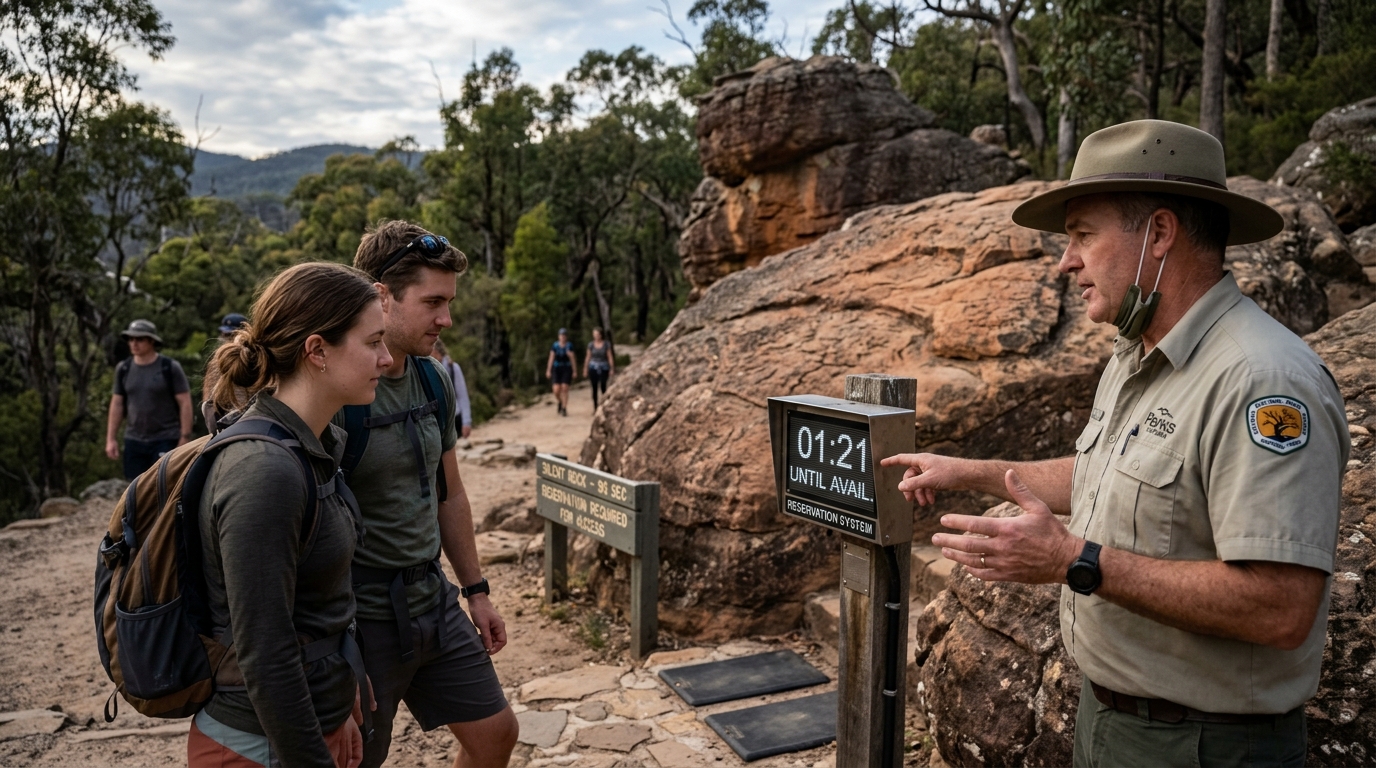
HALLS GAP, Australia — Park authorities in Victoria have implemented a high-precision digital booking system to regulate access to a single, flat-topped sandstone boulder in the Grampians National Park, citing the need to manage "micro-congestion" along popular walking trails.
Under the new system, which took effect Friday, visitors wishing to sit on, lean against, or place a backpack upon "Rock 41-A"—a waist-high rock located approximately two kilometers from the Pinnacle Lookout—must reserve a 90-second time slot through a mobile application before embarking on their hike.
The "Stationary Geological Feature Permit" (SGFP) costs $2.50 AUD per session. It is currently the only individual natural object in the Southern Hemisphere requiring its own dedicated reservation queue.
"We reached a point where the unstructured utilization of Rock 41-A was compromising both the integrity of the sandstone and the flow of pedestrian traffic," said Annette Vance, Regional Director of Parks Victoria. "By allocating precise 90-second windows, we ensure equitable access to the rock’s unique flat surface while mitigating the risk of unauthorized, multi-party lingering."
To enforce the new regulations, Parks Victoria has installed a solar-powered pressure sensor beneath Rock 41-A, calibrated to detect any weight exceeding five kilograms. If a visitor remains on the rock past their allotted time, a low-intensity LED strip embedded in the nearby dirt transitions from green to amber, and eventually to flashing red, signaling that the user must vacate the boulder for the next permit holder.
While park officials praise the system's efficiency, some hikers have found the transition to micro-scheduled recreation jarring.
"I hiked up to see the valley, sat down to tie my boot, and the rock started beeping at me," said Marcus Thorne, a visitor from Melbourne. "A ranger came out from behind a eucalyptus tree and asked to scan my phone. I didn't have a booking for that specific coordinate. He told me I could stand near the rock for free, but any weight-bearing contact with the stone itself required an active SGFP."
According to park documentation, the reservation system has already reduced "unplanned physical interactions" with Rock 41-A by 74 percent. However, the system has also created a secondary market, with popular sunset slots on the boulder reportedly being resold on third-party digital forums for up to $40 AUD.
Recreation management experts suggest that micro-reservations represent the future of public land conservation. Dr. Alistair Finch, a senior lecturer in environmental spatial planning at the University of Melbourne, noted that regulating individual features is more efficient than closing entire trail networks.
"If you control the nodes of pause, you control the trail," Finch said. "By managing Rock 41-A, we effectively regulate the physiological rhythm of the entire mountain."
Parks Victoria confirmed that if the trial is successful, it plans to expand the program to "Root 12," an exposed eucalyptus root on the Grand Canyon loop, by the end of the year. Meanwhile, the surrounding 400,000 acres of the national park remain open and entirely free of charge, though they lack designated seating.