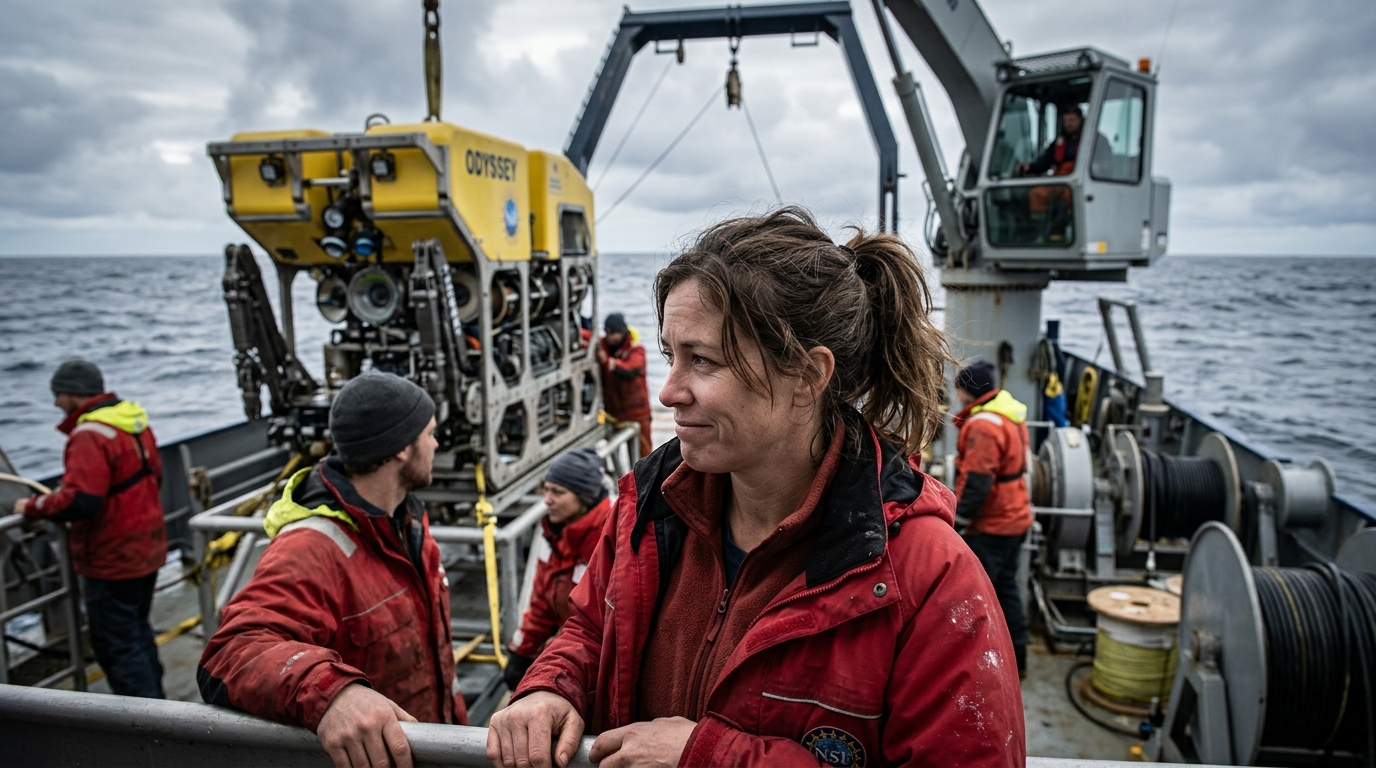
WOODS HOLE, Mass. — The National Science Foundation (NSF) has awarded a $14.2 million grant renewal to the deep-sea research vessel Aegir after its three-month expedition to the Puerto Rico Trench successfully returned with absolutely no new scientific discoveries, biological samples, or geological data.
The decision, announced Tuesday at the Woods Hole Oceanographic Institution, secures funding for another three years of "Project Void," an initiative praised by federal administrators for its unmatched cost efficiency, predictable reporting, and complete lack of ecological complications.
While typical deep-sea missions often return with samples of bioluminescent organisms, unexpected thermal vents, or previously unclassified marine life, the Aegir’s 32-person crew returned with 412 hours of high-definition video depicting a uniform, featureless expanse of dark gray silt. The expedition’s physical collection consisted entirely of twelve gallons of sterile salt water and a small piece of discarded synthetic rope from 1994.
"From an administrative standpoint, this is the most successful voyage we have ever funded," said Dr. Meredith Vance, deputy director of ocean sciences at the NSF. "Usually, when a vessel returns, we are immediately hit with years of tedious paperwork. A new species of crab means environmental impact assessments, habitat preservation hearings, and budget reallocations to study its digestive tract. Dr. Finch’s team delivered a perfectly flat line. It is a dream to audit."
According to the expedition’s final report, the crew deployed a $3.2 million remote-operated vehicle (ROV) to a depth of 27,000 feet, where it sat stationary for ninety days. Aside from a brief moment in week four when a speck of marine snow drifted past the camera lens—an event later classified by researchers as "non-actionable clutter"—the footage remained entirely static.
Dr. Alistair Finch, the lead oceanographer aboard the Aegir, defended the expedition’s lack of output as a triumph of modern methodological discipline.
"It takes an incredible amount of restraint to spend $14 million and not accidentally discover a worm," Finch said while organizing his empty sample vials, all of which will be reused for the next voyage without needing to be washed. "We stayed focused. We didn't chase anomalies. We chose a spot that looked completely dead on the satellite scan, and we proved, beyond a shadow of a doubt, that it is indeed completely dead. There is a profound, bureaucratic peace down there."
The academic community has responded to the grant renewal with a mixture of envy and professional admiration. In recent years, marine biologists have faced mounting pressure to justify their funding with sensational discoveries, a cycle that many researchers claim leads to burnout and administrative exhaustion.
"My team found a rare, antibiotic-producing sponge in the Mariana Trench last summer, and we’re still buried under the EPA compliance forms," said Dr. Sarah Jenkins, an ecologist at the Scripps Institution of Oceanography who was not involved in the Aegir project. "We had to write a 400-page conservation strategy just to keep our lab doors open. Meanwhile, Finch’s team just got to check the 'No Changes' box on their progress report and go home. Honestly, they’re geniuses. They’ve figured out how to make oceanography sustainable."
The NSF’s renewal of the grant will allow the Aegir crew to upgrade their equipment for the next phase of the study, which begins in early 2027. The funding will be used to purchase ultra-high-definition 8K cameras to document the gray silt in sharper detail, as well as a more robust winch system to ensure the ROV can sit on the barren seafloor without drifting into any nearby, potentially active ecosystems.
Dr. Vance noted that the NSF is currently looking into other scientific disciplines where "zero-yield predictability" could help balance the federal budget. The agency is reportedly considering a similar grant renewal for an astronomical survey team in New Mexico that has pointed its telescope at a dark, empty patch of space between two distant galaxies since 2019.
"Science is about asking big questions," Vance said. "And sometimes, the best answer we can possibly receive is 'nothing to report.' It keeps the spreadsheets clean, it keeps the committees happy, and most importantly, it means we don't have to hire any more taxonomists."
Back at the Woods Hole docks, the crew of the Aegir was already preparing for their next departure. When asked what he hoped to accomplish during the upcoming three-year voyage, Dr. Finch looked out over the water with quiet determination.
"If we do our jobs right," Finch said, "we won't even need to turn on the lights."