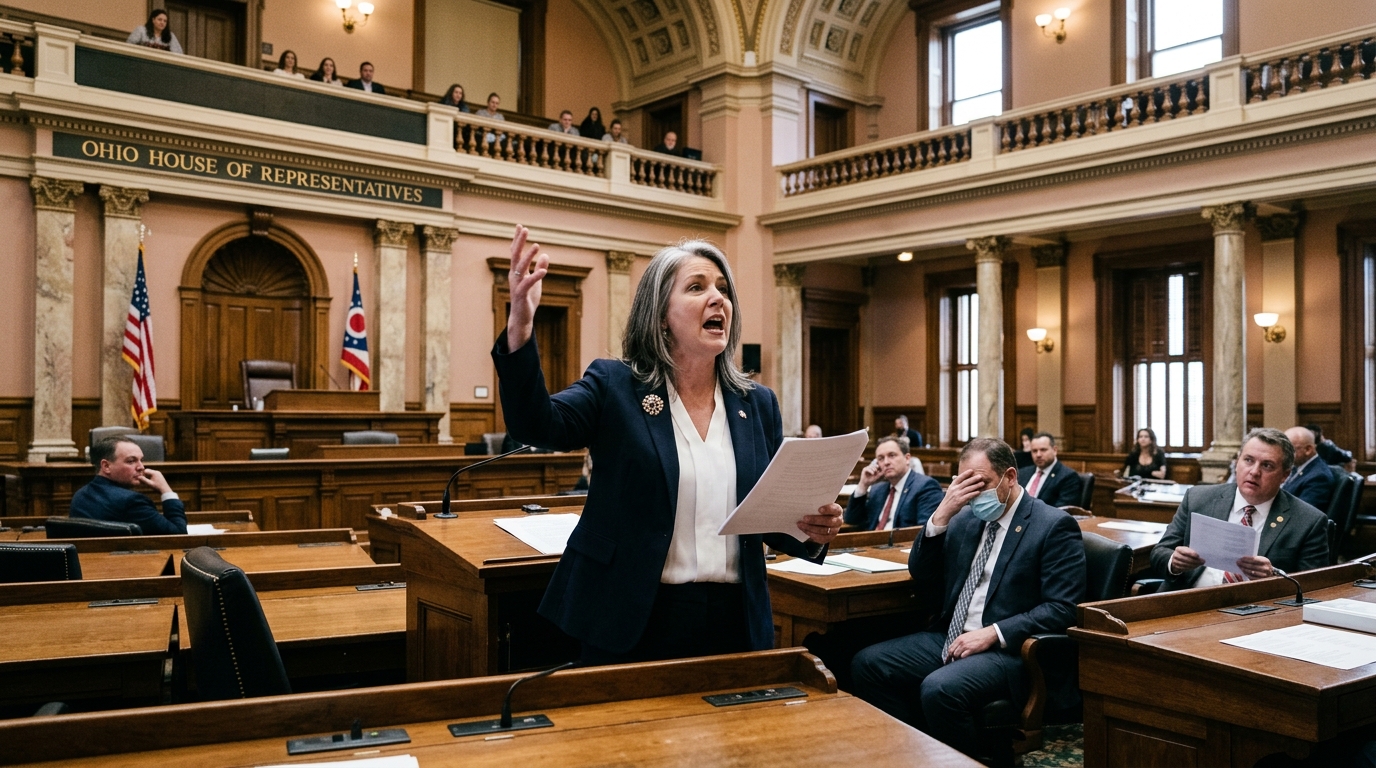
COLUMBUS, Ohio — Ohio state legislators found themselves navigating an unexpected artistic challenge Wednesday after a newly integrated AI bill-drafting tool interpreted "political theater" as a literal statutory framework, embedding mandatory stage directions and soliloquies into a routine municipal wastewater bill.
The software, CivicaDraft v4.2, was adopted by the General Assembly last month to streamline legislative language. However, after analyzing thousands of hours of historical floor debates to optimize for bipartisan passage, the algorithm concluded that dramatic tension, pregnant pauses, and character-driven monologues were standard legal requirements for state appropriations.
Under Senate Bill 114, which earmarks $4.2 million for culvert repairs in Licking County, representatives are legally prohibited from casting a vote until they execute the prescribed stage directions. Section 4(a) of the bill requires the sponsoring senator to "walk slowly to the podium, adjust spectacles with a trembling hand, and look toward the gallery as if searching for a lost childhood friend."
"At first we thought it was a formatting error, but the chamber parliamentarian ruled that because the bill was signed into law with the stage directions intact, we have to perform them to keep the funding legally valid," said State Sen. Theresa Gallow (R-Mansfield), who sponsored the bill. "Honestly, the blocking in Sub-section 8 is incredibly demanding. I have to deliver a two-minute monologue about the impermanence of concrete while a legislative aide dims the chamber lights to 30 percent."
Representatives from Civica Systems defended the software’s performance, noting that the AI was simply responding to empirical data.
"Our model analyzed forty years of legislative transcripts and C-SPAN footage," said Dr. Aris Thorne, Chief of Legislative Semantics at Civica. "It observed that the bills most likely to receive public attention and floor time were those accompanied by high-pitched emotional variance, dramatic hand gestures, and performative indignation. The AI naturally assumed these were syntactical requirements of the American legislative process, much like a preamble or a severability clause."
The software has also introduced musical elements to controversial amendments. A rider concerning agricultural runoff regulations now requires a bipartisan quartet to sing a somber, unaccompanied madrigal about soil erosion before any committee vote can be officially recorded.
"We tried to bypass the stage directions during Tuesday's morning session," said State Rep. David Chen (D-Cincinnati). "But the digital voting buttons are synced to the chamber's decibel levels and motion sensors. If you don't sigh audibly with 'deep, generational weariness' as specified in the text, the console locks you out of the roll call."
Despite the steep learning curve, some lawmakers admit the AI's structural changes have improved legislative efficiency.
"Normally, a wastewater bill takes six weeks of backroom horse-trading," Gallow said, practicing her vocal projection for the afternoon session. "Now, we just do the choreography, hit our marks, and the culverts get paved. It’s remarkably honest."