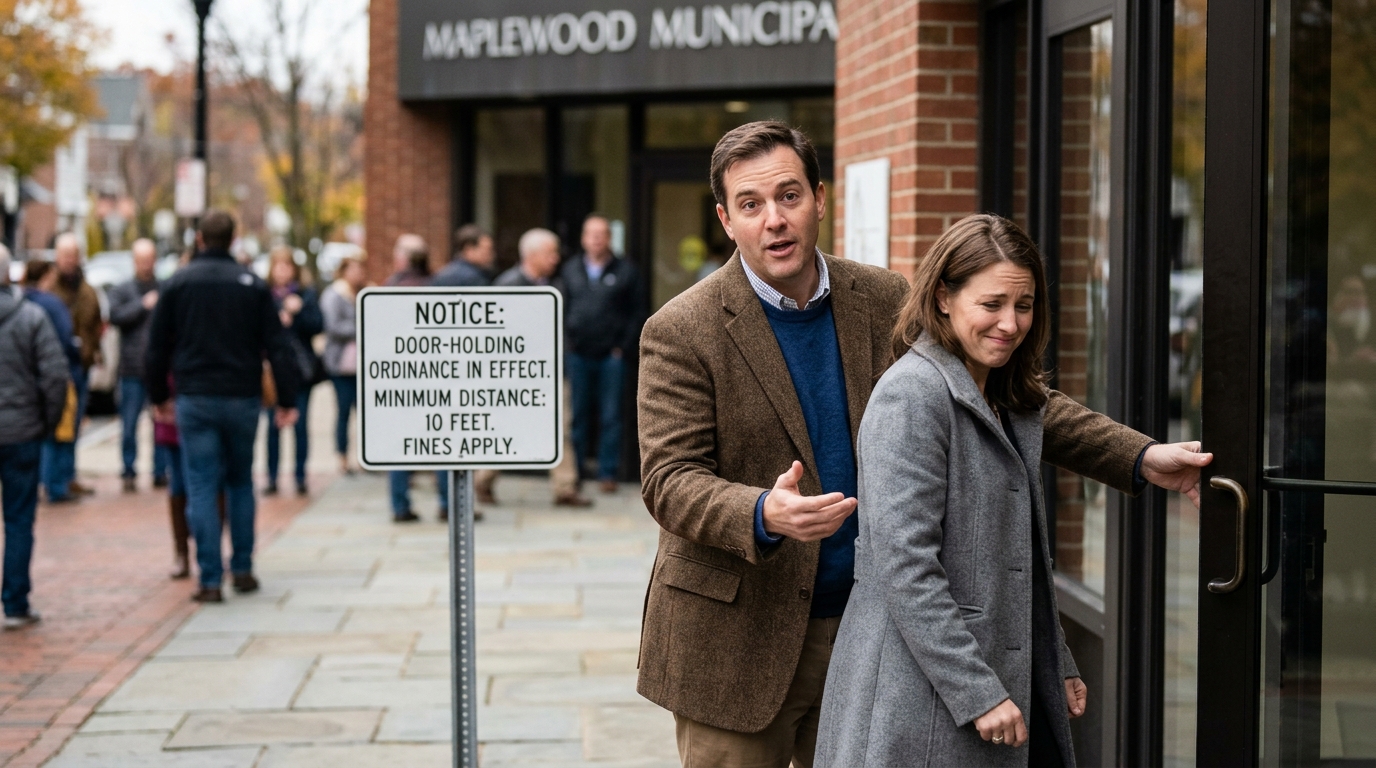
MAPLEWOOD, Ohio — The Maplewood City Council voted 5-2 on Monday to pass Ordinance 412-B, a sweeping public-decency measure that establishes strict legal boundaries for holding open doors for approaching strangers.
According to council members, the law is designed to eliminate the "courtesy trot"—the socially awkward, semi-athletic shuffle residents feel forced to perform when an over-polite stranger holds a door open from an inappropriate distance.
Under the new guidelines, the city has established three distinct spatial zones for pedestrian interaction. The "Zone of Mandated Courtesy" covers any distance under 10 feet. Within this range, citizens are legally obligated to hold the door for those behind them; failure to do so carries a $50 fine for "antisocial entryism."
Conversely, the "Zone of Coercive Hospitality" begins at 25 feet. Holding a door for anyone beyond this threshold is now strictly prohibited. Code enforcement officers have been instructed to issue $150 citations to violators whose actions force approaching pedestrians to accelerate their pace to avoid appearing rude.
"For too long, the citizens of Maplewood have had their commutes disrupted by over-eager door-holders forcing them to jog while carrying hot coffee or wearing inappropriate footwear," said Councilwoman Diane Vance, the bill’s primary sponsor. "This is about restoring dignity to the pedestrian experience. If you see someone 30 feet away, you let that door close. Let them walk at their own pace."
Not all residents are pleased with the municipal intervention. Arthur Pendelton, 54, received a warning citation on Tuesday morning outside a local post office.
"I was just trying to be a gentleman," Pendelton said. "I held the glass door for a woman who was near her car. Apparently, she was 27 feet away. She didn't even run; she just pointed at the code enforcement officer standing behind me. It felt like a setup."
To enforce the new regulations, Maplewood's municipal code officers have been equipped with laser-rangefinder clipboards. The city has also begun installing "Courtesy Threshold Markers"—discreet brass tacks embedded in the pavement outside major commercial entrances—to help residents gauge acceptable distances.
Dr. Aris Thorne, a sociologist specializing in micro-interactions at Ohio State University, praised the ordinance as a necessary regulatory intervention.
"The courtesy trot is a classic tragedy of the commons," Thorne noted. "The door-holder gets a cheap hit of moral superiority, while the door-receiver pays the physical toll of a sudden, unwanted cardiovascular event. Regulation was the only logical path forward to protect public joints and composure."
The ordinance is scheduled to go into full effect on August 1. In a show of compliance following Monday's vote, council members exiting City Hall were observed actively letting heavy wooden doors slam directly in the faces of colleagues walking mere paces behind them.