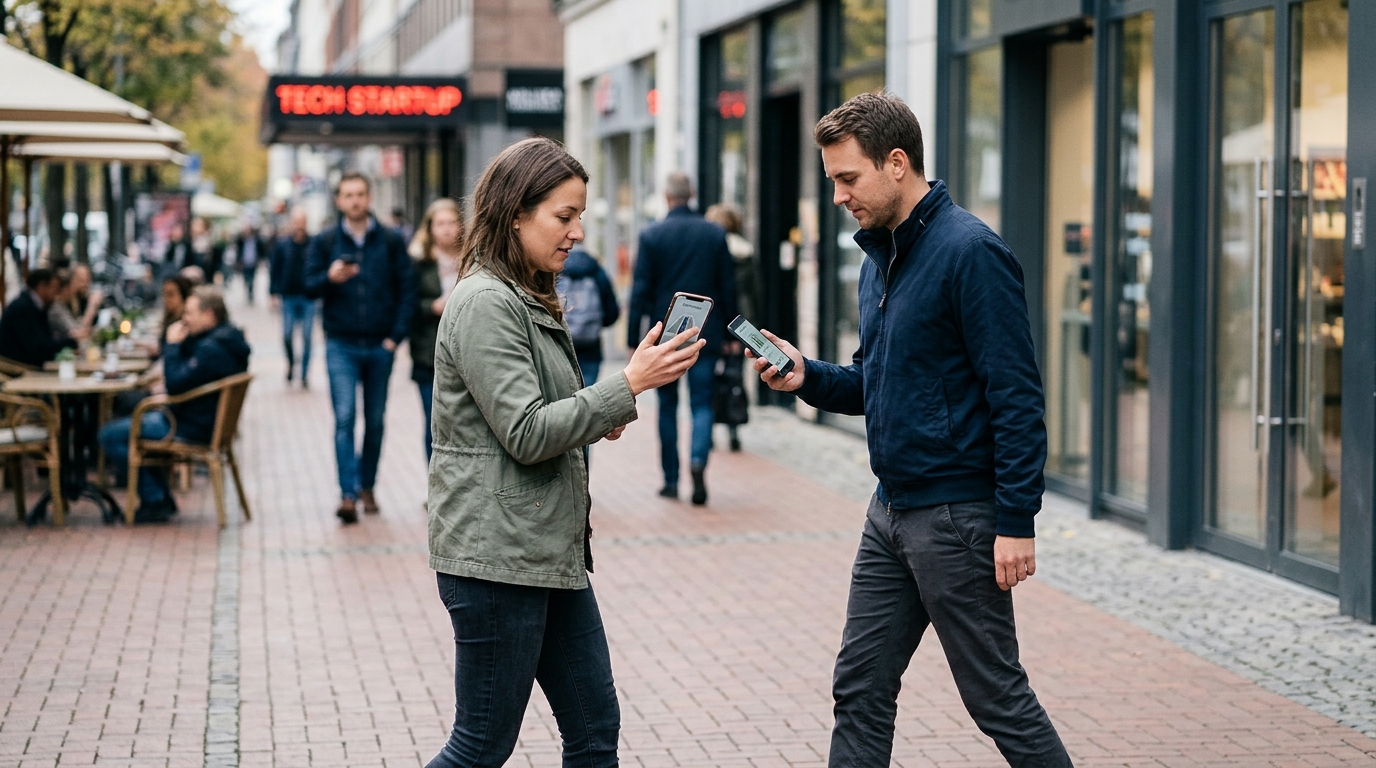
SAN FRANCISCO — A Silicon Valley startup has secured $14 million in series-A funding for a mobile application designed to eliminate the "sidewalk dance," the centuries-old physical negotiation that occurs when two oncoming pedestrians repeatedly step in the same direction to avoid a collision.
The app, PathMerge, uses ultra-wideband radio frequencies and predictive spatial modeling to assign real-time, lateral passing lanes to pedestrians before they make visual contact.
"The manual sidewalk interaction is a glaring inefficiency in modern navigation," said Marcus Vance, chief executive of PathMerge. "For generations, humans have relied on unreliable micro-expressions, shoulder dips, and apologetic murmurs to pass one another. PathMerge digitizes this friction, removing the need for improvised physical coordination."
When two PathMerge users approach within 30 feet of each other, their smartphones emit a synchronized haptic pulse. A left-thigh vibration instructs the user to veer left, while a right-thigh vibration directs them right.
The platform operates on a tiered priority system. While the free version, PathMerge Basic, frequently requires users to yield toward the curb, muddy tree wells, or scaffolding, the $9.99 monthly "Right-of-Way" tier guarantees the dry, center-tile lane in all municipal zones. A higher-level "Enterprise" tier automatically prompts oncoming free-tier users to step completely off the sidewalk to allow uninterrupted passage.
"I used to experience mild social anxiety whenever I saw someone walking toward me on a narrow bridge," said Sarah Jenkins, 34, a digital marketing consultant in Seattle who has been beta-testing the app. "Now, I just stare at my screen, follow the blue directional arrow, and let the algorithm handle the spatial equity. It saves me from having to make brief eye contact or do that little apologetic half-smile."
However, municipal planners and safety advocates have raised concerns about the growing number of physical collisions involving "analog" pedestrians who do not have the software installed.
Dr. Helen Cho, a professor of urban kinetics at the University of Washington, noted that the app's predictive models fail to account for individuals who are not connected to the cloud.
"We are seeing a marked increase in low-speed collisions between PathMerge subscribers and non-subscribers," Dr. Cho said. "Subscribers are so accustomed to the app negotiating their vectors that they no longer look up to see if an oncoming mail carrier or child is actually going to yield the center of the pavement."
Despite these friction points, Vance remains optimistic about universal adoption, noting that the company is currently testing a new software update to negotiate eye contact during elevator rides.
"Our goal is total spatial optimization," Vance said. "Once we eliminate these micro-decisions, the human mind is free to occupy more productive digital spaces."