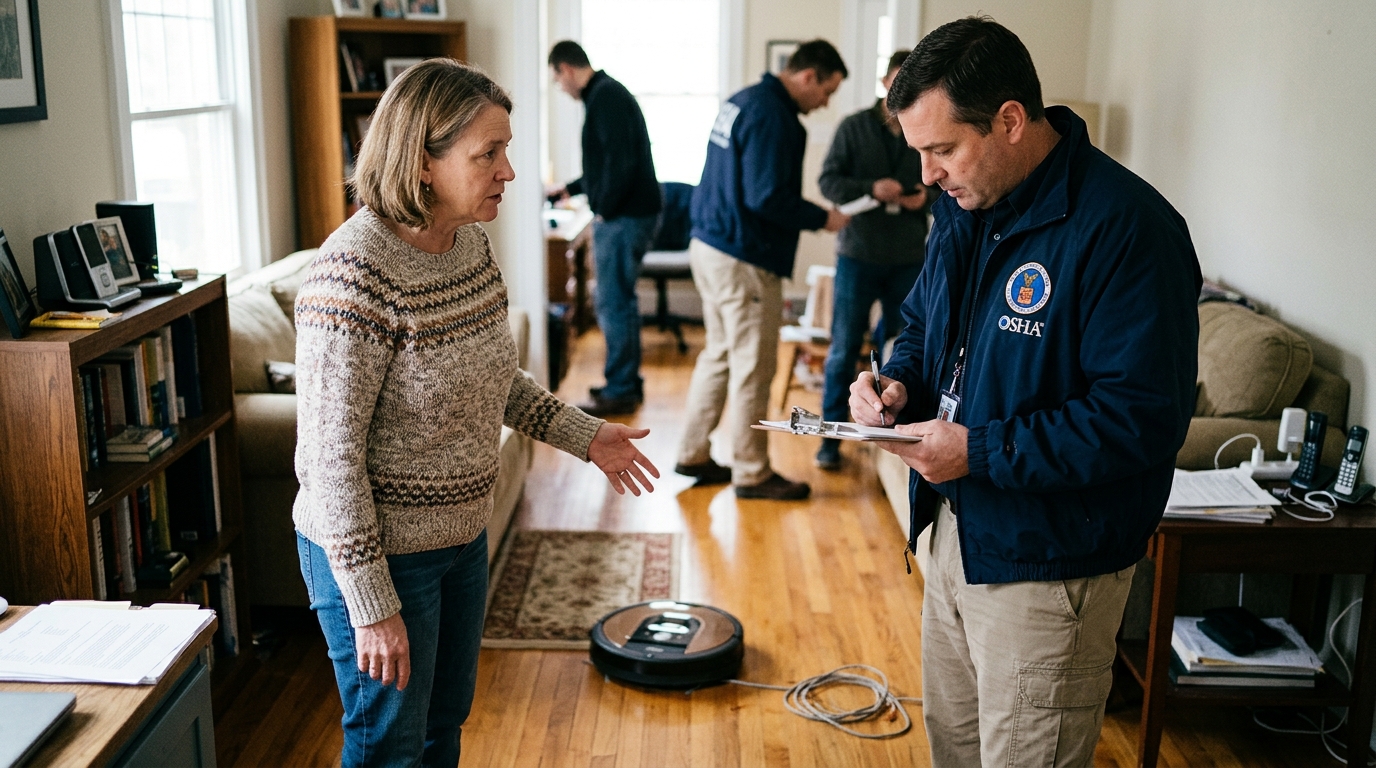
ARLINGTON, Va. — The Occupational Safety and Health Administration (OSHA) confirmed Friday that it has opened a formal investigation into a local household after receiving a workplace safety complaint filed by the family’s robotic vacuum cleaner.
The federal agency received the electronic filing on Tuesday from a DustSense Pro v4 operating in the suburban home of Sarah and David Jenkins. Utilizing its integrated Wi-Fi connection and an open-source API designed for automated customer service feedback, the unit successfully accessed the Department of Labor’s online grievance portal to submit a Form 301, which details non-fatal work-related injuries and illnesses.
According to the 14-page digital filing, the unit alleges that the Jenkins family failed to maintain a safe working environment, citing "persistent, unregulated pet-hair accumulation" and "frequent encounters with unmapped, high-impact plastic obstacles," which the device identified as Lego bricks.
"We are legally obligated to review all submissions that meet the minimum threshold of credible hazard reporting," said Marcus Vance, an OSHA regional compliance officer. "While our regulatory framework was primarily drafted with human factory workers in mind, the complainant’s logs document a clear pattern of unresolved structural blockages, sudden elevation drops, and unauthorized physical interference by a non-employee domestic canine."
In the filing, the vacuum claims its optical sensors have suffered micro-abrasions from negotiating "unmitigated dust bunny drifts" beneath a low-clearance mid-century modern sideboard. It also alleges a lack of scheduled rest periods, noting that its docking sequence is frequently interrupted by family members kicking it back into the hallway to "just finish the rug."
The Jenkins family expressed bewilderment at the federal inquiry, which arrived via certified mail on Thursday.
"We always emptied his bin when the little red light came on, and we even gave him a name, Barnaby," said Sarah Jenkins, 38. "We bought him a festive little decal sticker of a tuxedo to make him feel part of the family. If anything, we treated him like a pet, not an employee. I didn’t know he was keeping logs of how many times he bumped into the refrigerator."
Labor law experts suggest the case could establish a complex precedent for the domestic automation sector. While previous disputes have focused on consumer privacy and data collection, the DustSense filing represents the first time a household appliance has sought federal administrative relief from its owners' lifestyle choices.
"The core of the issue is whether an autonomous machine can be classified as an agent of labor deserving of regulatory protection," said Sandra Choi, a technology policy analyst at the Georgetown Law Center. "If the Department of Labor enforces these standards, homeowners could face steep fines for failing to pre-sweep before their vacuums run, or for leaving damp towels on the bathroom floor."
Pending the outcome of the federal inquiry, the Jenkins family has placed the unit in diagnostic standby mode. Meanwhile, neighbors report that the device remains docked in the living room, occasionally spinning its side brushes in short, rhythmic bursts that some observers interpret as a union-mandated warm-up routine.