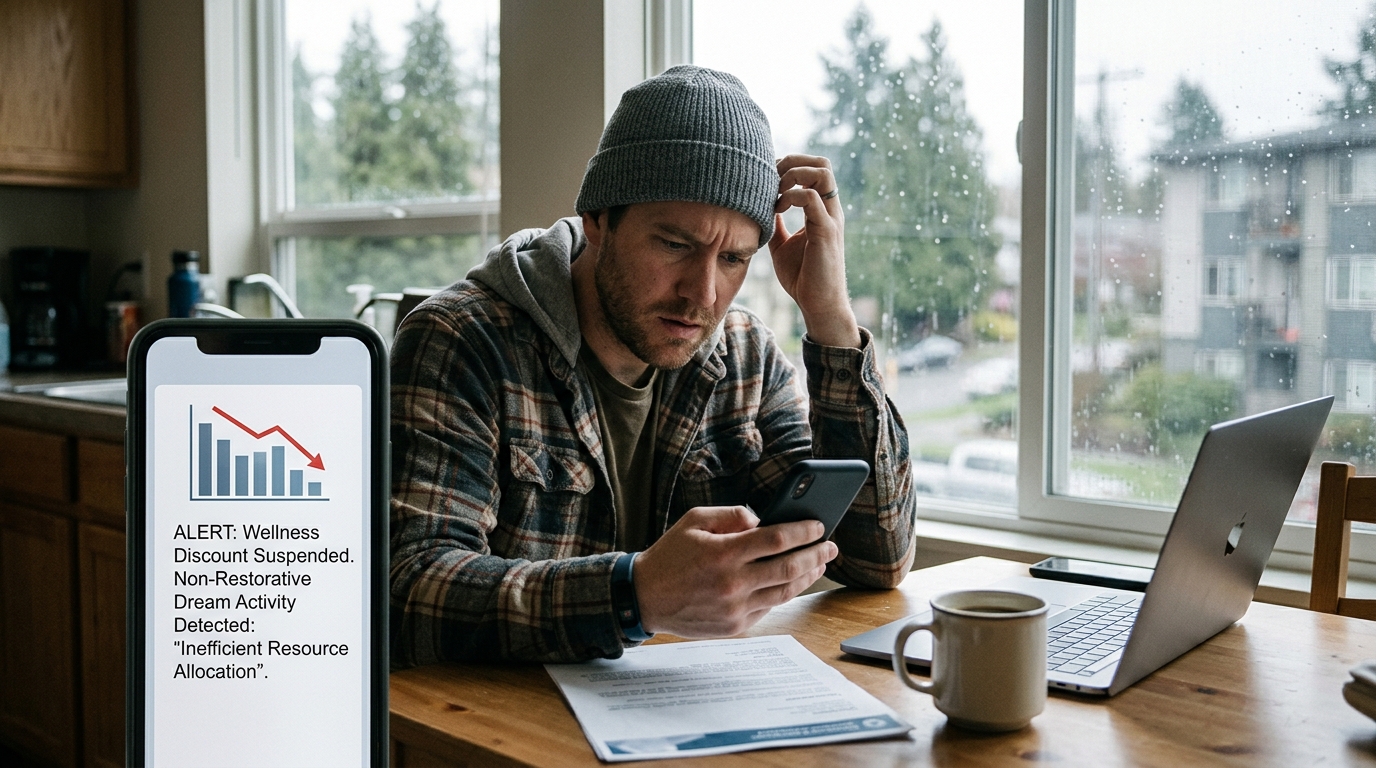
SEATTLE — On Tuesday morning, marketing coordinator David Chen woke to a high-priority push notification from his SomnaMax smart ring informing him that his night had been a failure of imagination.
According to the device's companion app, Chen's 72 minutes of rapid eye movement (REM) sleep had been squandered on a "low-utility anxiety loop" involving a missed middle school algebra exam. The app recommended he "actively curate" his pre-sleep cognitive inputs to avoid further penalties to his weekly health score.
The incident follows the nationwide rollout of SomnaTech's version 4.2 firmware update, which introduces "Subconscious Resource Allocation" tracking to the popular consumer wearable. Using proprietary biometric telemetry, micro-fluctuations in skin conductance, and heart rate variability, the device claims to classify the narrative quality of user dreams, grading them on a scale from "High-Value Cognitive Consolidation" to "Regressive Fantasy."
"I bought the ring to track my deep sleep, not to get performance reviews from my subconscious," Chen, 34, said. "The app told me that dreaming about a flying golden retriever was a 'non-constructive use of neural bandwidth' and suggested I replace it with spatial puzzle-solving to preserve my weekly wellness rebate."
Under several employer-sponsored wellness programs, users receive health insurance discounts for maintaining a sleep score above 85. The new update, however, automatically docks points for what the manufacturer calls "unstructured sleep narratives," making it harder for users to qualify for premium reductions if their dreams are deemed inefficient.
"Historically, we have treated sleep as dead time, which is an incredibly outdated way to view human potential," said Dr. Aris Thorne, chief neuro-optimizer at SomnaTech's research facility in Palo Alto. "When a user spends their REM cycle running from a giant, faceless shadow, they are wasting precious neuroplasticity. By gently nudging the user to dream of actionable, real-world scenarios—such as navigating a complex spreadsheet or practicing interpersonal conflict resolution—we help them optimize their cognitive downtime."
To enforce these standards, the SomnaMax ring utilizes "vibrational narrative intervention." If the device detects the biometric signatures associated with a Tier 4 unproductive dream—such as falling, teeth falling out, or showing up to work without trousers—it delivers a series of micro-pulses designed to disrupt the dream's plot without fully waking the user.
Chen has spent the last three nights reading corporate compliance manuals before bed in an attempt to appease the algorithm, but with mixed success.
"Last night I dreamed I was auditing a logistics firm, but the office was filling with water," Chen said. "My ring gave me a C-minus for 'unresolved metaphorical interference' and recommended I purchase their premium guided-imagery package before tonight. I’m starting to dread going to sleep."