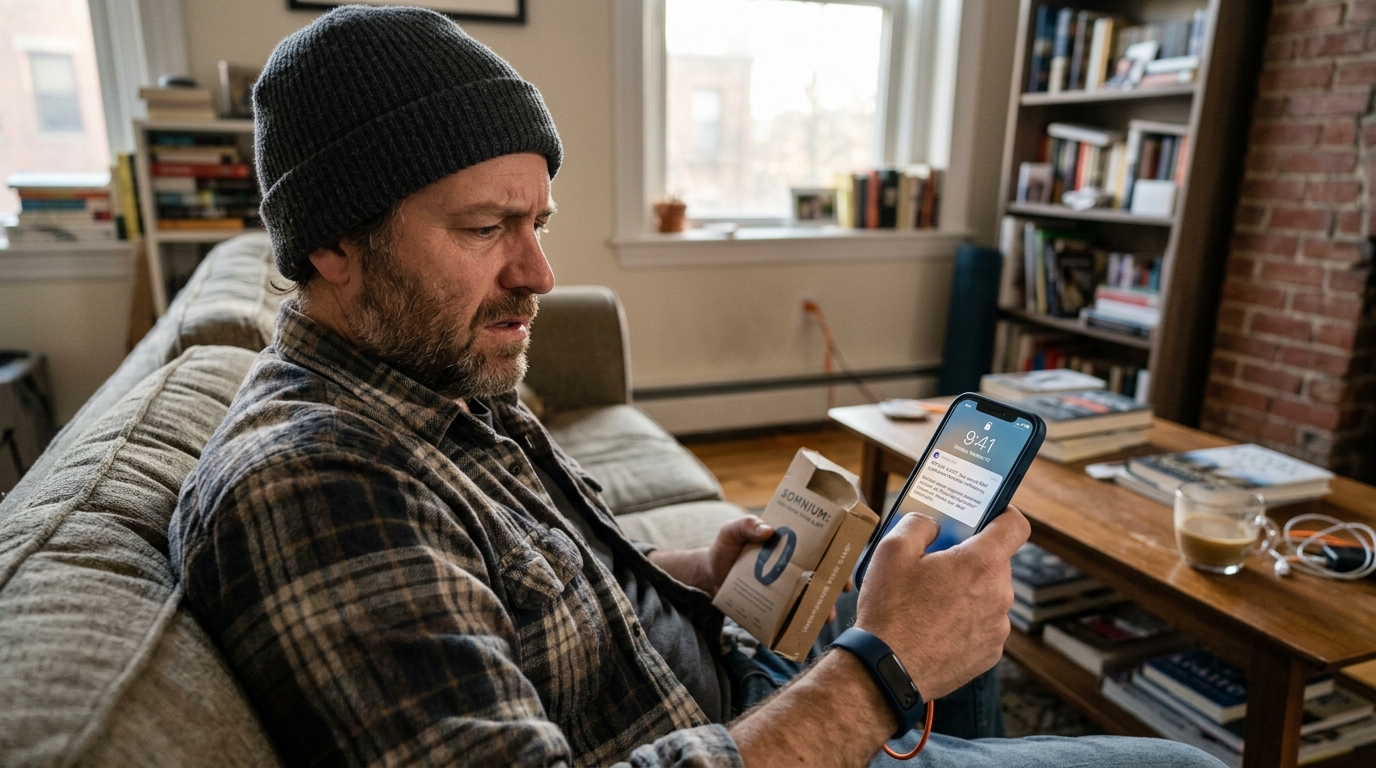
BOSTON — Local resident Arthur Pendelton received his first critical wellness notification at 6:12 a.m. on Tuesday, when his premium sleep-tracking wearable flagged his rapid eye movement (REM) sleep for "severe narrative inefficiency."
Pendelton, 34, is one of thousands of users adjusting to the latest firmware update for the Somnograph Gen-6, a high-end health monitor. The update, dubbed "Subconscious Diagnostics," uses biometric sensors and auditory feedback to evaluate not just the duration of a user’s sleep, but the qualitative utility of their dreams.
According to data logs from Pendelton’s smartphone, his trouble began during a three-hour deep sleep cycle. The Somnograph detected that Pendelton was dreaming of searching for an unlocked bathroom in his childhood home, only for the hallway to transition into a flooded bowling alley.
"The device flagged the sequence for 'suboptimal spatial physics and lack of a clear resolution strategy,'" Pendelton said. "A push notification advised me that instead of wandering around a fictional bowling alley, my REM state would be better spent visualizing my upcoming quarterly presentation on supply-chain logistics."
The Somnograph app subsequently lowered Pendelton’s overnight "Cognitive Recovery Score" to 34 out of 100, citing "unproductive nostalgia" and "thematic redundancy."
SomnoLife Technologies, the manufacturer of the wearable, defended the software update as a necessary evolution in personal analytics. Company executives argue that unstructured dreaming represents an untapped bottleneck in human performance.
"We spend roughly a third of our lives asleep, yet consumers routinely allow their minds to wander through illogical, non-monetizable scenarios like flying without a vehicle or arriving at high school unprepared for an exam," said Dr. Sarah Jenkins, SomnoLife’s Director of Subconscious Optimization. "Our algorithm is designed to gently nudge the user’s subconscious toward constructive, goal-oriented visualization. If your brain is going to spend eight hours processing data, it should at least be clean data."
Under the app’s new terms of service, users who consistently record disorganized or surreal dream sequences face soft penalties. Those who drop below a weekly average score of 60 are locked out of integrations with third-party smart appliances, such as high-end espresso machines, until their mental baseline stabilizes.
Pendelton, whose smart thermostat was automatically lowered to a brisk 58 degrees following a dream about a talking badger, expressed frustration with the device’s rigid criteria.
"I tried meditating before bed to clear my mind, but the app detected my elevated heart rate and flagged it as 'pre-sleep non-compliance,'" Pendelton said. "Last night I dreamt that I forgot how to breathe, and the watch woke me up with a haptic buzz to inform me that my anxiety-to-output ratio was trending in the wrong direction."
SomnoLife confirmed that future updates will introduce a peer-to-peer leaderboard, allowing users to compare their dream efficiency with colleagues and industry averages.
At press time, Pendelton was reportedly lying awake in his bedroom, attempting to mentally outline a three-stage marketing rollout in hopes of unlocking his smart coffee maker.