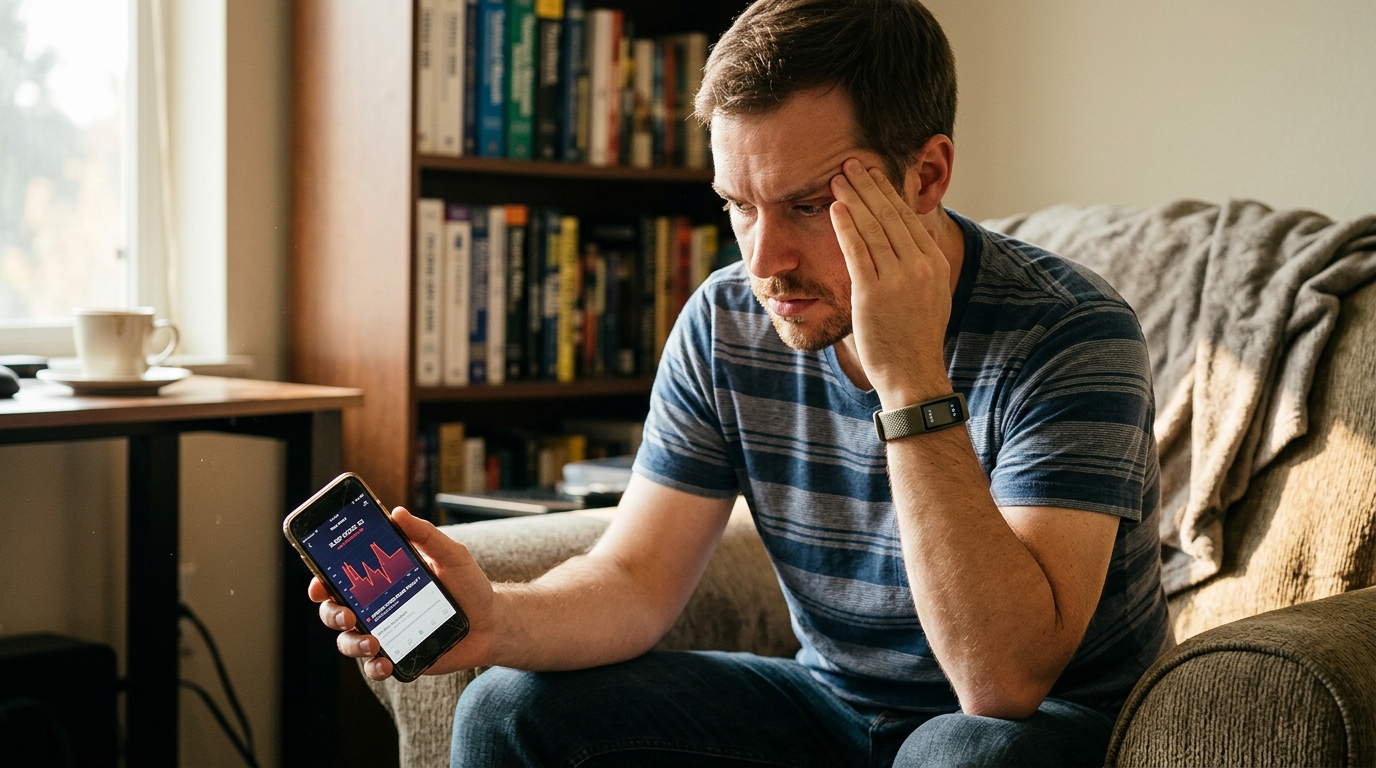
BELLEVUE, Wash. — David Chen’s morning routine used to begin with a cup of black coffee and a quick glance at his sleep tracker’s readiness score. But since the latest firmware update to his Nyx Labs Aegis Ring, the database administrator has spent his mornings defending his subconscious to an algorithm.
On Thursday, Chen, 34, woke to a critical alert on his smartphone. The Aegis companion app, which recently launched its "Subconscious Efficiency Index" (SEI), had downgraded his sleep score to a "poor" 42. The culprit was not his heart rate or his oxygen levels, both of which were optimal, but the structural integrity of his dreams.
"Your REM cycle was characterized by significant narrative drift," the push notification read. "You spent approximately 34 minutes attempting to fly by flapping your arms, despite repeated physics failures. This represents a 14% decline in cognitive defragmentation efficiency compared to your Tuesday baseline."
The update, v4.2, uses the ring's advanced photoplethysmography (PPG) sensors and micro-galvanic skin response indicators to map prefrontal cortex activity during rapid eye movement (REM) sleep. By analyzing micro-fluctuations in heart-rate variability and involuntary facial twitching, the proprietary "Somno-GPT" engine reconstructs the emotional and structural framework of the user’s dream state. According to Nyx Labs, the goal is to help users transition away from "unproductive surrealism" toward "structured, goal-oriented cognitive processing."
"I can't control what I dream about," Chen said, scrolling through a graph that highlighted a 12-minute spike labeled *Nostalgic Anxiety Loop (High School Algebra Test)*. "The app suggested that instead of dreaming about failing a test I took fifteen years ago, I should use my REM sleep to conceptualize database migrations. It even offered a curated playlist of white noise designed to trigger SQL-based problem-solving. But when I try to force it, I just dream about my teeth falling out, which the app flags as 'cliché and narratively lazy.'"
The shift from passive monitoring to active narrative auditing has sparked debate among sleep researchers. Dr. Evelyn Vance, director of the Seattle Neurological Center, suggests that consumer technology is encroaching on the last unmonetized frontier of human experience.
"Historically, dreams have been understood as the brain's natural, chaotic filing system," Dr. Vance said. "But the consumer wellness sector operates on the premise that chaos is a design flaw. By categorizing surrealism as 'unproductive,' these devices are applying corporate project-management principles to the deep subconscious. We are seeing patients arrive with 'dream anxiety'—they are literally afraid to fall asleep because they don’t want to disappoint their rings."
Nyx Labs has defended the feature as a breakthrough in cognitive hygiene. In a statement, corporate spokesperson Marcus Thorne argued that the modern attention economy demands more from the sleeping brain.
"The average adult spends nearly three thousand hours a year sleeping," Thorne said. "To spend that time wandering through a shifting labyrinth or talking to a giant golden retriever is, from a resource-allocation standpoint, highly irresponsible. Our users want to optimize every hour of their day. We are simply providing the data tools necessary to ensure their nights are equally high-yield."
On online forums, Aegis users have begun sharing strategies to bypass the narrative auditor. Popular tactics include "dream-stacking," where users listen to audiobooks about supply chain logistics immediately before sleep to prime their subconscious for high-scoring, linear narratives. Others report success by tricking the galvanic sensors with topical numbing creams, though Nyx Labs warns this voids the device's warranty. One user posted a screenshot of a perfect 100/100 "Optimal Recovery" score, achieved by dreaming entirely about a spreadsheet migration. The achievement was met with a mix of congratulatory comments and deep existential dread.
Despite the frustration, Chen admits he has found himself trying to steer his dreams in real-time. Last night, when he felt himself slipping into a familiar dream about being chased by a shadow, he consciously tried to pivot the narrative toward a quarterly budget review.
"I woke up exhausted, but the ring gave me an 85," Chen said, looking down at the dark titanium band on his index finger. "It said my lateral problem-solving was up. I guess I'll try to dream about a PowerPoint presentation tonight. It’s not particularly restful, but at least I won’t get a notification telling me I’m failing my sleep."