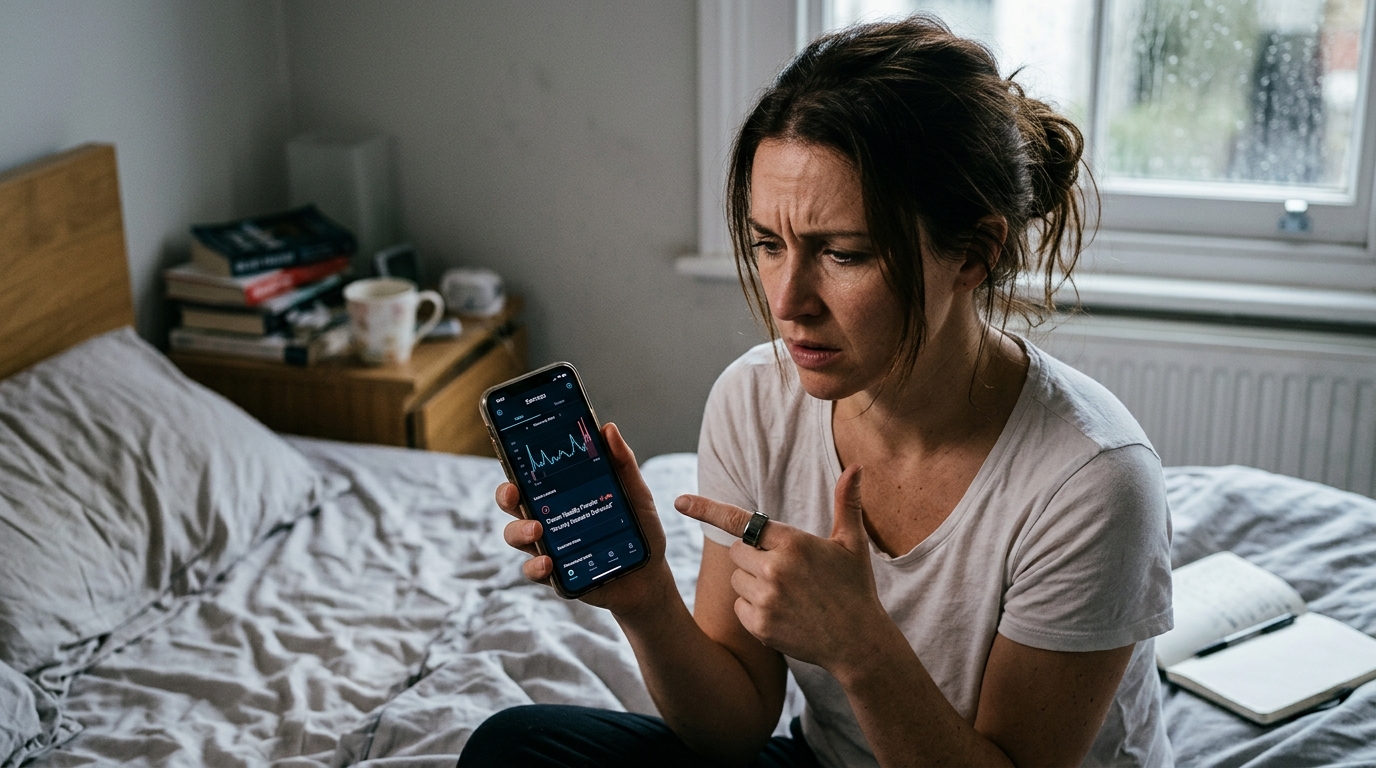
SAN FRANCISCO — A software update to the popular Somnos-V sleep-tracking ring has sparked frustration among users who report receiving low "sleep hygiene" scores and critical push notifications for dreaming about unproductive or disorganized scenarios.
The update, rolled out last Thursday by wellness technology startup Somnos, introduces "Dream-Pathing," an AI-driven biometric feature that analyzes micro-fluctuations in heart rate variability, rapid eye movement, and skin temperature to reconstruct the narrative quality of a user's REM sleep. According to the company’s updated terms of service, dreams are now graded on a scale of 1 to 100 based on their "restorative utility and narrative efficiency."
Users across the country have reported sudden drops in their daily sleep scores after experiencing common, stress-induced dreams.
"I woke up on Friday morning feeling completely refreshed, but my Somnos app gave me a 42% Sleep Quality rating," said Marcus Vance, a 34-year-old logistics coordinator from Portland, Oregon. "The app flagged my REM cycle as 'sub-optimal' because I spent twenty minutes dreaming that I was trying to find a bathroom in an infinite airport. The notification told me that my subconscious was 'demonstrating poor spatial planning' and recommended I purchase their Cognitive Alignment audio course."
Other users reported being penalized for classic dream tropes, including showing up to a high school math class unprepared, teeth falling out, and driving a car from the backseat. The Somnos interface categorizes these events as "unconstructive dream narratives" that waste valuable metabolic recovery time on unresolved conflicts.
"The goal of Somnos-V is not just to track sleep, but to curate it," said Dr. Aris Thorne, Chief of Somnambulic Optimization at Somnos. "A healthy REM cycle should consist of productive, forward-looking scenarios—such as practicing a presentation, rehearsing a tennis swing, or visualizing asset allocation. Spending 45 minutes trying to outrun a shadowy figure that represents your father is, from a metabolic standpoint, a wasted opportunity."
Dr. Thorne defended the system's "constructive friction" notifications, which advise users to "dream with intent" before falling asleep. The app's premium tier now includes a "Dream Dashboard" where users can toggle off specific genres of dreams, though disabling "existential dread" requires a $14.99 monthly subscription.
Independent sleep specialists have expressed concern over the psychological toll of grading involuntary mental states. Dr. Elena Rostova, a researcher at the Pacific Northwest Sleep Institute, warned that the pressure to perform while unconscious is counterproductive.
"We are seeing a new phenomenon of 'somnia-anxiety,' where patients are actively resisting sleep because they are terrified of getting a bad grade from their jewelry," Dr. Rostova said. "You cannot optimize the subconscious. If you dream about a giant talking owl, it is not because you have poor management skills; it is just your brain clearing out cellular waste."
Despite the criticism, Somnos announced plans to integrate its data with corporate wellness platforms, allowing employers to track "overnight cognitive readiness."
Vance, meanwhile, has spent the last three nights attempting to consciously steer his dreams toward corporate strategy to regain his "Elite Rest" badge.
"Last night I managed to dream about a clean Excel pivot table for about ten minutes," Vance said. "My ring gave me an 88, but I woke up with a headache. Still, it’s better than the notification I got on Wednesday, which just said: 'Your subconscious is underperforming.'"