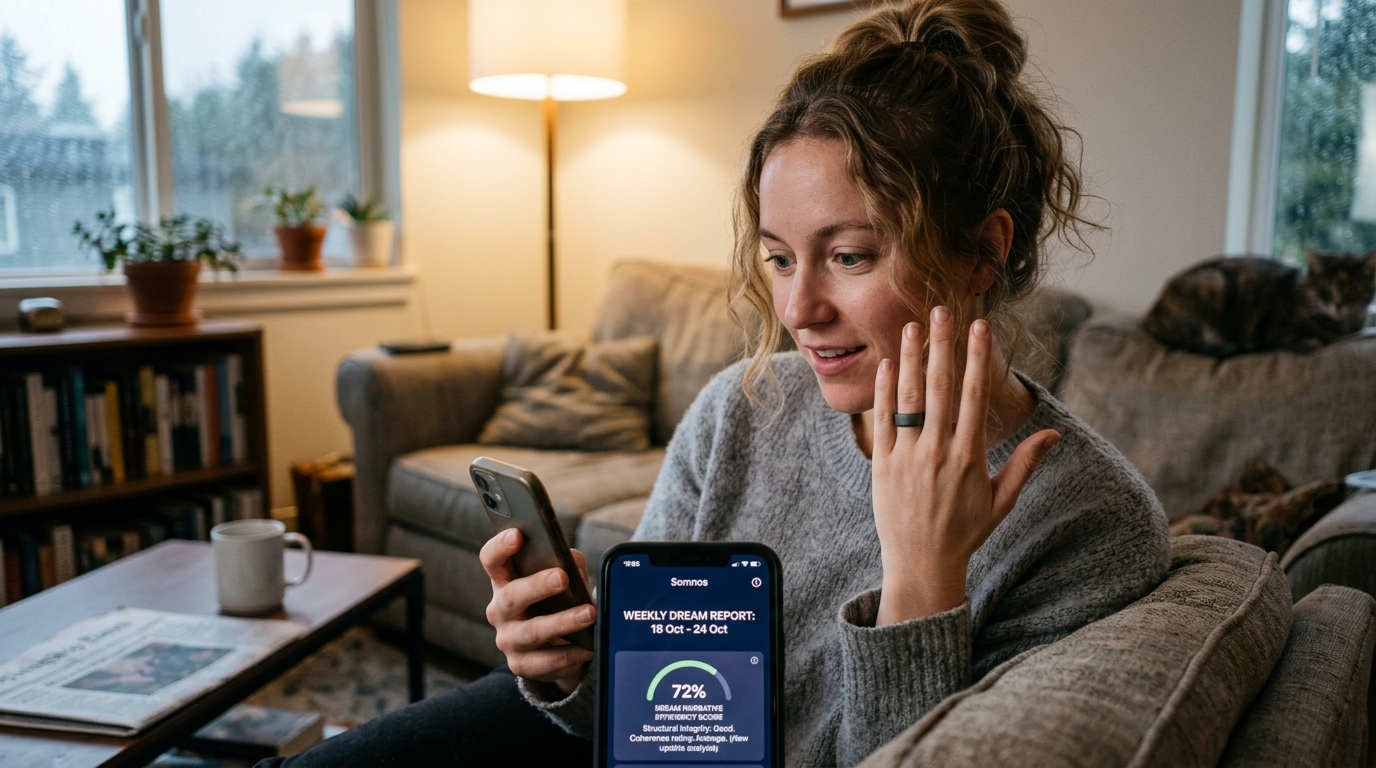
SAN FRANCISCO — San Francisco-based biotechnology firm Somnos Labs has rolled out a firmware update for its popular biometric ring that actively grades the narrative efficiency of users' dreams, prompting widespread complaints from users accused of wasting valuable REM sleep on structurally flawed subplots.
The update, dubbed Oneirology 4.0, introduces a proprietary "Dream Efficiency Quotient" (DEQ) designed to evaluate whether a user’s subconscious is utilizing sleep hours productively. According to the company’s release notes, the algorithm assesses factors such as narrative pacing, resolution rate, and metaphoric redundancy to ensure that nighttime cognitive processing aligns with daytime productivity standards.
Marcus Vance, a 34-year-old software consultant from Seattle, received his first critical notification on Monday morning. The app flagged a dream in which Vance was trying to find a classroom while his teeth fell out, rating the experience a 3.4 out of 10.
"The app told me my dream lacked a clear resolution and relied on 'cliché subconscious tropes' that yielded low cognitive recovery," Vance said. "It recommended that I replace the teeth-falling-out sequence with a more modern stress metaphor, like a public spreadsheet error, to streamline my brain's processing time. I felt exhausted before I even got out of bed."
The Somnos Ring, which retails for $399, uses localized EEG sensors and galvanic skin response to map brain activity during REM cycles. While previous versions of the software merely tracked the duration of these cycles, Oneirology 4.0 cross-references neural firing patterns with a database of 1.2 million standard dream archetypes to identify what it terms "narrative bloat."
Dr. Aris Thorne, Director of Cognitive Optimization at Somnos Labs, defended the update as a necessary step in holistic wellness.
"We found that millions of users are spending up to two hours a night trapped in repetitive, low-value dreaming," Dr. Thorne said. "If you are dreaming about flying, but you never actually reach a destination, you are burning glucose without achieving psychic closure. Our goal is to nudge the subconscious toward tight, three-act structures that maximize morning alertness."
For users who score below a 5.0 DEQ for three consecutive nights, the app automatically enables "Dream Guidance Mode," which emits low-frequency haptic vibrations to disrupt dreams that veer into surrealism or excessive exposition.
The update has created friction among users who feel their private thoughts are being subjected to corporate performance metrics. Elena Rostova, a graphic designer in Denver, expressed frustration after her app penalized her for a dream involving a talking owl.
"The notification said the owl was an 'unnecessary dialogue partner' and that the information could have been delivered via a simple written note within the dream," Rostova said. "I am currently reading screenwriting manuals before bed just to keep my weekly health insurance premium discount."
Somnos Labs confirmed that while users can opt out of the dream-grading feature, doing so will revert their device to "Basic Sleep Mode," which disables step counting and calorie translation during waking hours.