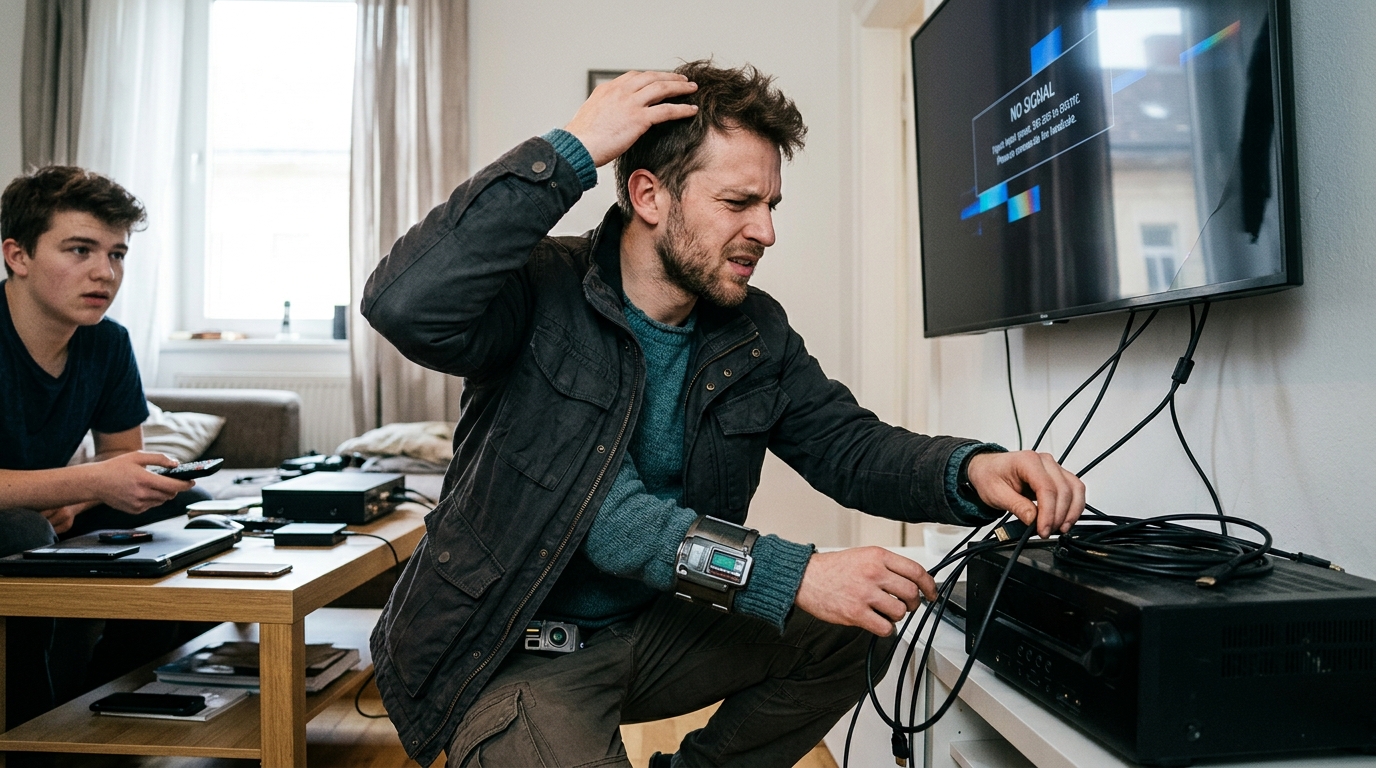
LOS ALAMOS, N.M. — A temporal traveler who materialized in the New Mexico desert last month from the year 2094 has expressed profound disappointment that modern home entertainment systems still fail to reliably recognize audio return channels upon startup.
Dr. Alistair Vance, whose arrival was initially hailed by quantum physicists as the most significant scientific breakthrough of the millennium, has reportedly spent the majority of his civilian integration period struggling to configure a mid-range smart television in his corporate housing unit.
According to administrators at the Los Alamos National Laboratory, Dr. Vance’s scheduled briefings on the future of room-temperature superconductors have been repeatedly sidelined by his ongoing grievances regarding HDMI Consumer Electronics Control (HDMI-CEC) protocols.
"We prepared a comprehensive battery of questions regarding the containment of nuclear fusion and the trajectory of global water reserves," said Dr. Helen Vasquez, a senior researcher overseeing Dr. Vance’s transition. "But Dr. Vance spent the first forty minutes of our Tuesday session demonstrating how his soundbar requires him to cycle through three different remote controls just to watch a broadcast news program. He kept asking why the optical port existed if the media industry was going to force eARC down our throats."
According to Dr. Vance, the year 2094 possesses an array of technological achievements, including atmospheric carbon scrubbers and localized gravitational manipulation. However, he noted with visible agitation that the underlying software architecture linking display units to external audio receivers remains "fundamentally broken" across multiple timelines.
"I was under the impression that by 2026, the industry would have resolved the basic handshaking logic between a television and a receiver," Dr. Vance said during a press conference on Thursday, gesturing to a whiteboard diagram of a standard high-speed HDMI cable. "Yet, when I turn on the television, the audio default reverts to the internal speakers approximately forty percent of the time. This requires me to physically reach behind the media console, unplug the cable, wait ten seconds, and plug it back in. This is not progress. This is an administrative failure."
Representatives from the Consumer Technology Association (CTA) defended current standards, pointing out that HDMI-CEC is designed to allow interoperability across multiple manufacturing brands. They noted that minor configuration errors are often the result of user error, legacy cabling, or mismatched firmware updates.
Dr. Vance rejected this explanation, calling it "corporate apologia for a protocol that has been functionally defective since its inception in the early 2000s." He further noted that despite traveling through a localized Einstein-Rosen bridge that required five gigawatts of power to stabilize, he still cannot get his streaming device to turn off his television automatically when he puts it to sleep.
"The mathematics of temporal displacement are remarkably straightforward compared to the erratic logic of a modern receiver's input auto-switch," Dr. Vance added. "In my era, we have mapped the neural pathways of the common octopus, yet if you connect a Blu-ray player and a game console to the same system in 2026, the television becomes hopelessly confused and defaults to a black screen with a floating 'No Signal' dialog box. It is humiliating for your species."
The disappointment has reportedly soured Dr. Vance’s view of the early 21st century, which he had previously studied as a golden era of physical media and analog-to-digital transition. Colleagues say he has spent several evenings in his apartment muttering about "optical cables" and "the lost simplicity of the red and white RCA jacks."
"He’s very nostalgic for things he never experienced, but he has no patience for the actual reality of our current hardware," said Marcus Thorne, a graduate assistant assigned to help Dr. Vance adjust to the decade. "I tried to explain that he could just buy a universal remote, but he got very quiet, stared out the window for a long time, and asked if we had any concept of basic engineering dignity."
As of Friday, Dr. Vance’s planned lecture on the post-quantum cryptography standards of the late 21st century has been postponed indefinitely. According to lab scheduling coordinators, the presentation will remain on hold until Dr. Vance can successfully route his presentation slides through the auditorium's ceiling projector without the audio track playing exclusively out of a single wall-mounted monitor.