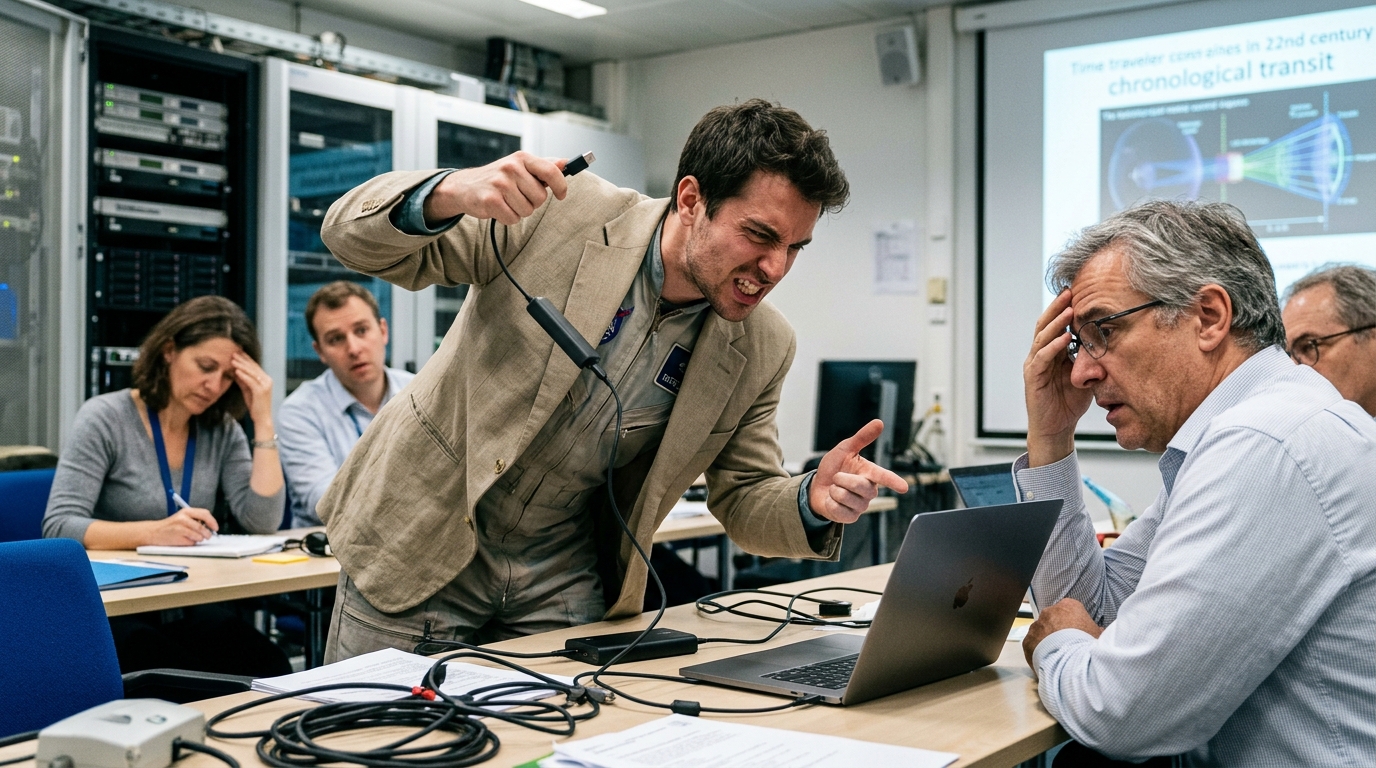
GENEVA — Scientists at the European Organization for Nuclear Research (CERN) successfully received the world’s first documented chronological traveler from the year 2148 on Tuesday, only for the historic debriefing to be derailed by the visitor’s intense, singular frustration with contemporary USB-C connection ports.
The traveler, identified in temporal transit logs as Dr. Aaron Vance, materialized in a secure containment field following a three-year international effort to establish a stable quantum bridge. However, instead of delivering warnings about existential climate threats, details of clean energy breakthroughs, or the geopolitical landscape of the 22nd century, Dr. Vance spent his initial six-hour briefing expressing deep dissatisfaction with the physical infrastructure of modern consumer electronics.
"We had prepared a rigorous 400-point questionnaire covering the grand unified theory of physics and the ultimate fate of democratic institutions," said Dr. Elena Rostova, lead coordinator of CERN’s Temporal Reception Initiative. "But Dr. Vance refused to proceed past the first slide because the projector’s connection cable kept slipping out of its slot when the table was bumped. He spent the rest of the afternoon demonstrating what he called 'unacceptable port wobble.'"
According to minutes from the closed-door briefing, Vance repeatedly expressed disbelief that a civilization capable of bending the spacetime continuum still tolerated a charging standard that lacked a mechanical locking mechanism. He spent nearly an hour analyzing a standard braided cable provided by a graduate student, calling its tactile response "mushy" and "spiritually bankrupt."
"You have successfully mapped the human genome and built global satellite communication networks, yet you go to sleep not knowing if your phone actually charged overnight because the cord was resting at a slight angle," Vance reportedly told the assembly of Nobel laureates. "It is a miracle you people managed to launch a single rocket into space with this level of structural tolerance."
The diplomatic mission further stalled on Wednesday when Vance refused to share the schematics for his sub-atomic displacement engine until the research team could provide him with a wall adapter that did not emit a high-pitched coil whine while plugged into a European outlet.
CERN administration spent an estimated €18,500 overnighting various consumer electronics and industrial-grade connectors to the Geneva campus in an attempt to satisfy the traveler. None of the items met his standards.
"He looked at our state-of-the-art diagnostic laboratory, sighed, and asked why we hadn’t standardized a magnetic breakaway system for everything," said Marcus Thorne, a senior hardware engineer at the facility. "When I tried to explain the manufacturing economics of the mid-2020s, he just stared at me and asked if we also enjoyed cleaning lint out of our pockets with toothpicks."
On Thursday evening, Vance announced he was cutting his scheduled ten-day diplomatic mission short by four days, citing an inability to work under what he described as "ergonomic hostility."
Before entering the return chamber, Vance handed a small, metallic cylinder to Dr. Rostova, which researchers initially believed to be a quantum data drive containing the secrets of cold fusion. Upon inspection, the cylinder was found to contain only a highly polished, proprietary 12-pin connector that clicked into the traveler's device with a loud, metallic snap.
"Keep this," Vance said before de-materializing. "It won't save your planet, but at least you won't have to jiggle it to make it work."